Backup heat runs on straight electricity
Electric resistance strips don't move heat, they make it directly, and that draws far more power than the compressor does on its own. A heat pump stuck on backup heat for days shows up fast on the bill.
 Hand off the search
Once you send the form, finding a pro is off your list.
Your heat pump works harder in a Wisconsin winter than it ever does in summer. Once the temperature drops into the teens and lower, it has to pull heat out of air that has almost none to give, and most units lean on backup electric strips to keep up on the coldest days. Power here isn't cheap, so that backup heat is the part of your bill that jumps, even if the thermostat hasn't moved.
Most houses around you heat with gas. Your system doesn't, so the bill behaves differently than a neighbor's, and there's no gas bill to average it against. A sharp jump in January or February doesn't mean something's broken. But it can also be the first sign that something is, especially if the jump is bigger than last winter's or the unit is running constantly instead of cycling.
A heat pump that's low on refrigerant, or has a failing defrost control, or a backup heat strip stuck on, will burn through power fast trying to keep the house at temperature. Figuring out which one it is from the thermostat isn't something you can do yourself, and most of the work of fixing it starts before a wrench ever comes out: finding a contractor who works on heat pumps and not just furnaces, calling around, explaining the system and the bill history more than once, waiting on quotes to compare.
Send the form here and that part stops being yours to do. You won't be the one tracking down who's available or repeating the story to the next person on the list. Someone who works on heat pumps in Wisconsin winters takes it from there.
Your bill jumps because the colder it gets outside, the more electricity your heat pump needs to move the same amount of heat indoors. Below about 25 to 30 degrees, most heat pumps can't pull enough warmth from the outside air on their own, so a backup heat strip kicks in to make up the difference. That strip runs on straight electric resistance heat, the same way a space heater does, and it draws far more power than the compressor alone. On a Wisconsin night in the single digits or below, that strip can end up carrying most of the load for hours at a stretch. If your bill spiked after a cold snap, that's usually it. But if the strip is running constantly, even on milder days in the 30s, something else is wrong. A unit low on refrigerant, an iced-over outdoor coil that won't defrost, or a thermostat set wrong can all force the backup heat on far more than it should be, and that's where the real cost piles up.




Electric resistance strips don't move heat, they make it directly, and that draws far more power than the compressor does on its own. A heat pump stuck on backup heat for days shows up fast on the bill.
A coil caked in frost can't pull heat from the air at all, so the system leans harder on backup strips to keep the house warm. Clearing it is a repair, not a fix you do yourself.
You might notice the outdoor unit running almost constantly, or the vents blowing air that feels cooler than you'd expect for the setting on the thermostat. Some homeowners hear the system switch over, a different sound than the compressor alone, as backup heat kicks in. The thermostat might show it's satisfied while the house still feels a few degrees off. If the heat pump can't keep pace with a cold snap, it leans on backup heat for longer stretches, and that's what drives the bill up fast. Left unchecked over a stretch of single-digit nights, that same strain is what wears down a system already working at its limit.
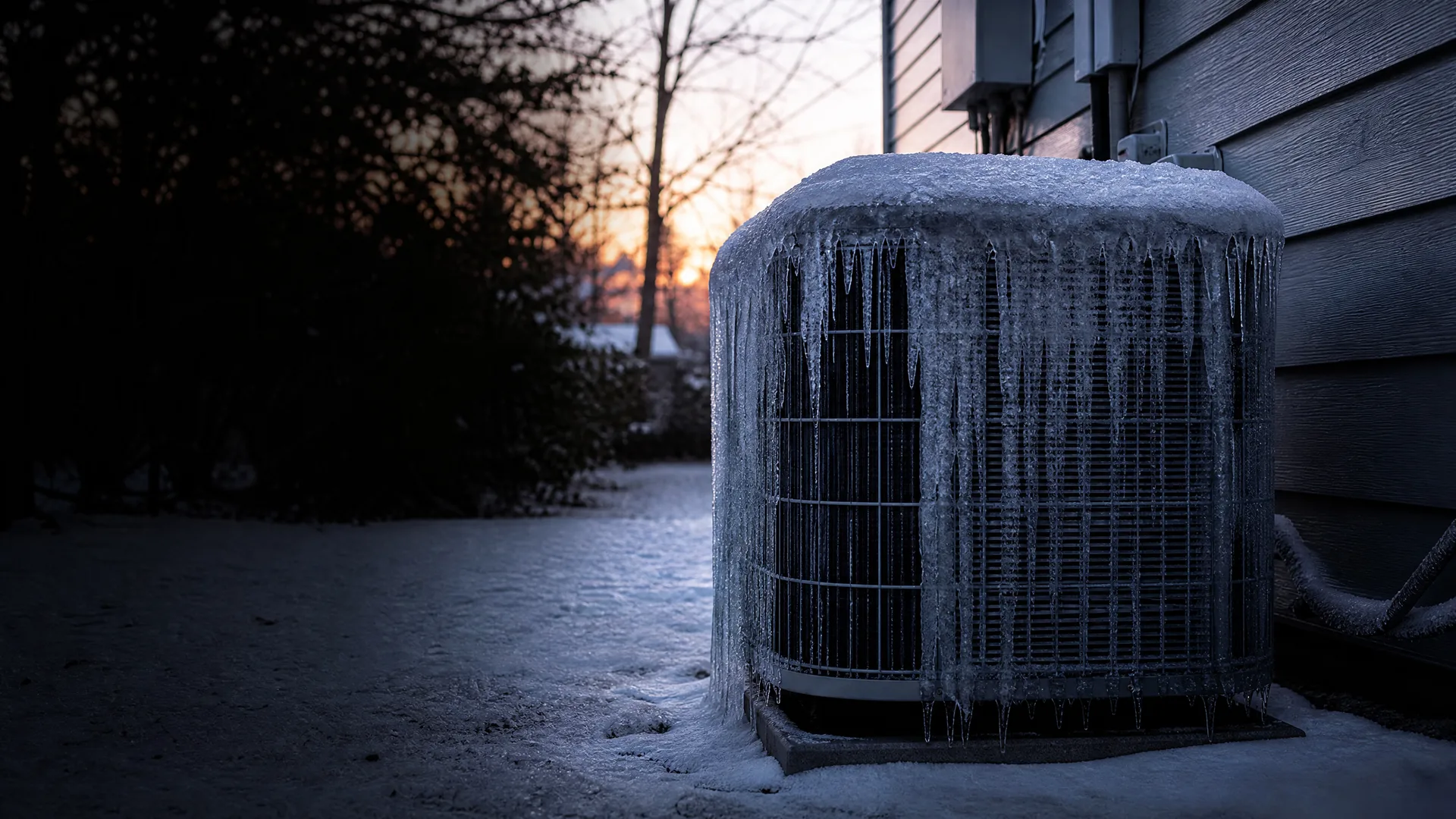
You pull your coat on before coffee and go out to grab the newspaper. The side yard is still blue with early light, the kind of January morning where the cold feels solid. You walk past the heat pump out of habit, the way you check the mailbox, and stop. The whole cabinet is coated in ice, thick over the coils, a crust of it hanging off the bottom edge. No fan noise. No hum. Just ice and quiet. You crouch down and touch it and your glove sticks for a second. Inside, the house already feels a few degrees off, that flat chill that means the system gave up sometime in the night.
A heat pump that won't shake off a Wisconsin cold snap usually has a reason, and it's rarely something you can see from the thermostat. A low refrigerant charge, a failing defrost sensor, a reversing valve that's stuck, any of these can push a system onto backup heat far more than it should be, and the power bill carries that cost all month. Sorting out which one it is means someone checking the charge, the sensors, the outdoor unit itself. Finding that someone usually means calling around, explaining the same problem three or four times, waiting on quotes, trying to judge who actually knows heat pumps versus who's guessing. That's the part you can hand off right now. Send the request and the search for a contractor stops being something you have to manage. The cold isn't going anywhere this month, but what your system is doing with it doesn't have to stay a mystery, and it doesn't have to stay expensive.
Run the heat pump on its own through a stretch of single-digit nights and the bill reflects every hour it spent leaning on backup strips to keep the house at temperature.
Have a contractor check the charge and the defrost cycle, and the heat pump can do the job it's supposed to at 20 degrees instead of handing the work to backup heat.


Your heat pump moves heat out of cold outdoor air, and in a Wisconsin winter that air carries moisture that frosts the outdoor coil. A thin layer of frost is normal and the system is built to handle it. Every so often, the system reverses itself for a few minutes, sending warm refrigerant through the outdoor coil to melt that frost off, then switches back to heating your house. While it's in defrost, it isn't heating indoors, so it leans on backup electric strips to keep the air coming out warm. That's by design, and a few short cycles a day during a cold stretch won't move your bill much.
What costs you is when that cycle stops working right. A reversing valve can get stuck partway, leaving the system running defrost mode, and backup strips, far longer than it should. A defrost sensor can misread the coil and call for a cycle when there's no frost to clear, burning power for nothing. And if the refrigerant charge is low, the compressor has to run longer to pull the same heat out of the air, which pushes the system onto backup heat sooner and more often than it needs to. The thermostat can't tell any of this apart from a genuinely cold day. It just knows the air isn't warm enough and calls for more heat, so it keeps reaching for the strips. A contractor checking the charge, the valve and the sensor can tell you which of these is actually happening in your system.



Summer here isn't the problem, but it tells you something about the same system. NOAA puts the average summer dew point across Wisconsin at 60°F, which is sticky enough that your heat pump's coil has to wring real moisture out of the air to keep the house comfortable. That's the easy work. Cooling a muggy house just means moving heat one direction, and the air outside is always warmer than what you want inside. Winter asks for the opposite: pulling warmth out of air that barely has any. The same coil that handles July's humidity without much strain is the one straining to pull heat from January air, and that's where the backup strips and the higher bill come in.
NASA POWER T2MDEW county cells weighted by homes


At 18.08 cents per kilowatt-hour, every hour your heat pump spends on backup strips costs more here than it would almost anywhere else. That's straight electricity with no gas line to soften the bill, so a few cold nights on backup heat show up fast.
EIA-861 2025 statewide residential average

The outdoor unit sits clean on its pad, lines and conduit running straight to the disconnect. It cycles on, runs, shuts off. No frost built up along the coil, no ice creeping down the side. A heat pump that looks like this most mornings is pulling its own weight, backup strips barely needed.

Dust and grime cover the cabinet, and the coil underneath is likely in the same shape. A unit that looks weathered like this often can't shed heat or frost the way it needs to, so it leans on backup strips to keep the house warm. That's when the bill climbs.

A heat pump that spends cold nights on backup strips instead of the compressor is going to cost more to run, and the bill is just the proof. The fix isn't a mystery. Somewhere in the system, the charge is low, the defrost sensor is bad, or the reversing valve is stuck, and a contractor can find out which in a visit.
What you don't have to do is figure out who that contractor is. No searching through listings, no calling three companies to see who answers, no explaining the same thing about frost on the coil and a bill that doubled to each one, no sitting with quotes trying to guess who's right. Send the form and that part is done. You'll still need the repair, and winter in Wisconsin will still ask a lot of the system once it's fixed. But finding someone to look at it stops being something you have to manage.


Stop chasing a heat pump pro