





Overhead view of a gray outdoor AC condenser unit on a concrete pad beside a mulched garden bed and a house with vinyl siding.

AC Maintenance in Whitewater, WI

Tell us about the job

Takes about a minute. No obligation.

Tune-up, service, or cleaningCentral ACWalworth County, WI
Step 1 of 2

What ZIP code is the job in?

Cooling in Walworth County runs June through August. May is the month to get the system checked, before it has to work. A technician can test the refrigerant charge and the capacitor while the AC is idle, and catch a weak part before a hot day finds it first. Wait until June and you're troubleshooting a system that's already running flat out, with a houseful of people counting on it.

3 months
June through August, your air conditioner is on duty
81°F
the average summer afternoon it cools against
43 hail events
in ten years, and hail bends the fins on outdoor coils
74 wind events
in ten years, and wind drives debris into outdoor units
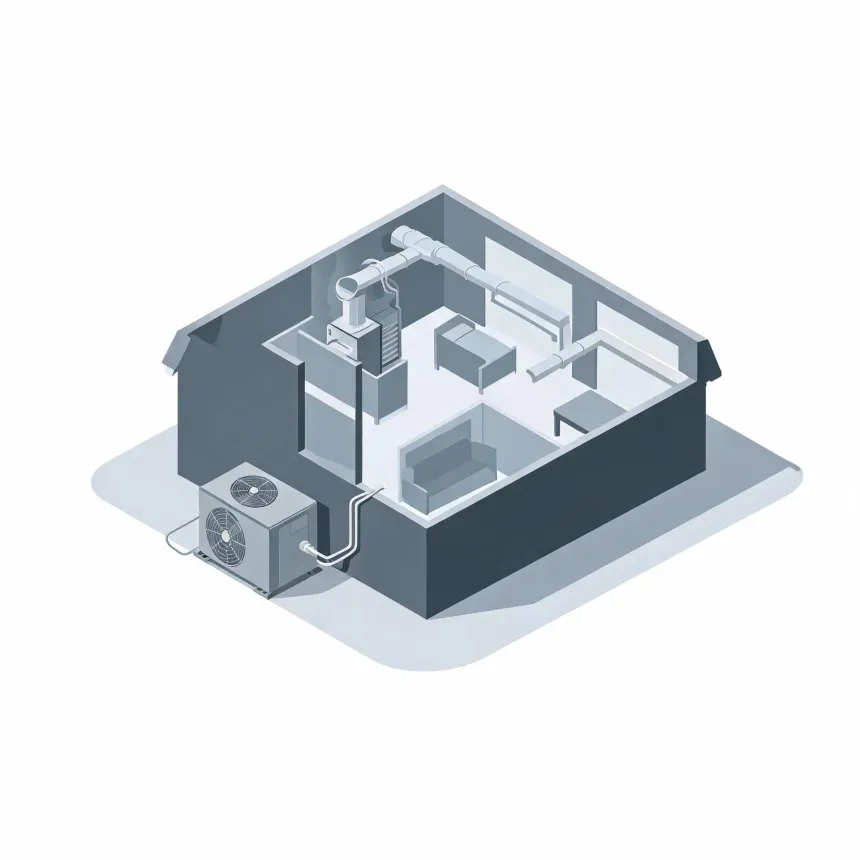
Isometric grayscale illustration of a cutaway house interior showing a furnace with ductwork, interior rooms with furniture, and an outdoor condenser unit connected by lines at the exterior wall.
Your air conditioner works hardest from June through August.

NOAA nClimDiv, 1991–2020 normals

Cooling here runs three months, June through August.

One visit before summer starts covers the season.

One tune-up before June covers the season

Half the homes here were built by 1977
Cooling runs June through August
Summer afternoons average 81°F

A few things point to a system overdue for a look. Warm air out of the vents when the thermostat is set low is the big one, especially if the outdoor unit is running and still not keeping up. Short cycling, where the AC kicks on and off in quick bursts instead of running a steady stretch, puts wear on the compressor and usually means a dirty coil or a refrigerant problem. Ice on the refrigerant lines or the indoor coil means airflow is restricted somewhere, often just a clogged filter, and running it iced up can damage the compressor. A musty smell when the air first kicks on points to moisture sitting in the ductwork or on the coil. None of these mean the system is done, but all of them get worse the longer the AC keeps running on them.

Book it before the season

It starts running hard in the first month of the season here. Book the check the month before.

Find a contractor
A man in a dark cap, dark T-shirt and brown work pants, seen from behind, carries a canvas tool bag up concrete steps toward a green front door.
A gray residential air conditioning condenser unit mounted on a concrete pad outdoors, surrounded by green grass under a partly cloudy blue sky.

Between visits, the filter is yours

The filter is the one thing worth checking without calling anyone. Pull it out, hold it up to a light, and if you can't see through it, swap it. A clogged filter starves the coil of airflow and the system has to run longer to do the same job. Keep the area around the outdoor unit clear too. Grass clippings, leaves, and anything piled against the cabinet block the airflow it needs to dump heat outside. Beyond that, leave the inside of the cabinet alone. The coil, the refrigerant charge, and the capacitor need a gauge and some training to check safely.

The dirt builds up where you can't see it

A coil that never gets cleaned collects a film of dust and grease that slows down how well it absorbs heat. The system does not fail right away. It just runs longer each cycle to do the same job, and that extra runtime wears on the compressor long before the coil ever gets blamed for it.

A small problem left alone becomes a big one

A refrigerant leak too small to notice this year is still there next year, slowly starving the compressor of the charge it needs. A technician catches it early with a gauge during a routine check. Left alone, it runs the compressor low on lubricant and heat until the fix is a compressor instead of a leak patch.

An outdoor air conditioning condenser unit mounted on a concrete pad next to a blue-sided residential house at sunset.

Book your AC tune-up in May, before homes here start needing cooling in June.

  1. Jan
  2. Feb
  3. Mar
  4. Apr
  5. May
  6. Jun
  7. Jul
  8. Aug
  9. Sep
  10. Oct
  11. Nov
  12. Dec

A tune-up checks the refrigerant charge, cleans the coils, tests the capacitor and tightens the electrical connections.

A real tune-up means hands on the system, not a glance at the thermostat. The technician pops the cabinet and checks the capacitor's output against what it's rated for, since a weak capacitor is one of the most common reasons a compressor won't start on a hot day. The refrigerant charge gets checked against the manufacturer's spec, not just topped off. The coil gets inspected and cleaned if it's carrying a film of dust, and the condensate drain gets cleared so it isn't backing up into the pan. Electrical connections get tightened, since a loose connection generates heat and that heat degrades the parts around it. The blower wheel and motor get checked too, because a blower working against resistance pulls more current than it should and runs hotter than it should.