Three illuminated two-story brick houses on a tree-lined residential street photographed at twilight, with warm window light and landscape uplighting visible against a deep blue evening sky.

AC Maintenance in Rhinelander, WI

Tell us about the job

Takes about a minute. No obligation.

Tune-up, service, or cleaningCentral ACOneida County, WI
Step 1 of 2

What ZIP code is the job in?

Keep the filter clean

A dirty filter chokes airflow across the coil, and a frozen coil is one of the most common reasons an air conditioner stops cooling. Check it by holding it up to a light. If you can't see light through it, swap it out. This is the one thing a homeowner can do that actually prevents a breakdown instead of just noticing one.


Leave the cabinet closed

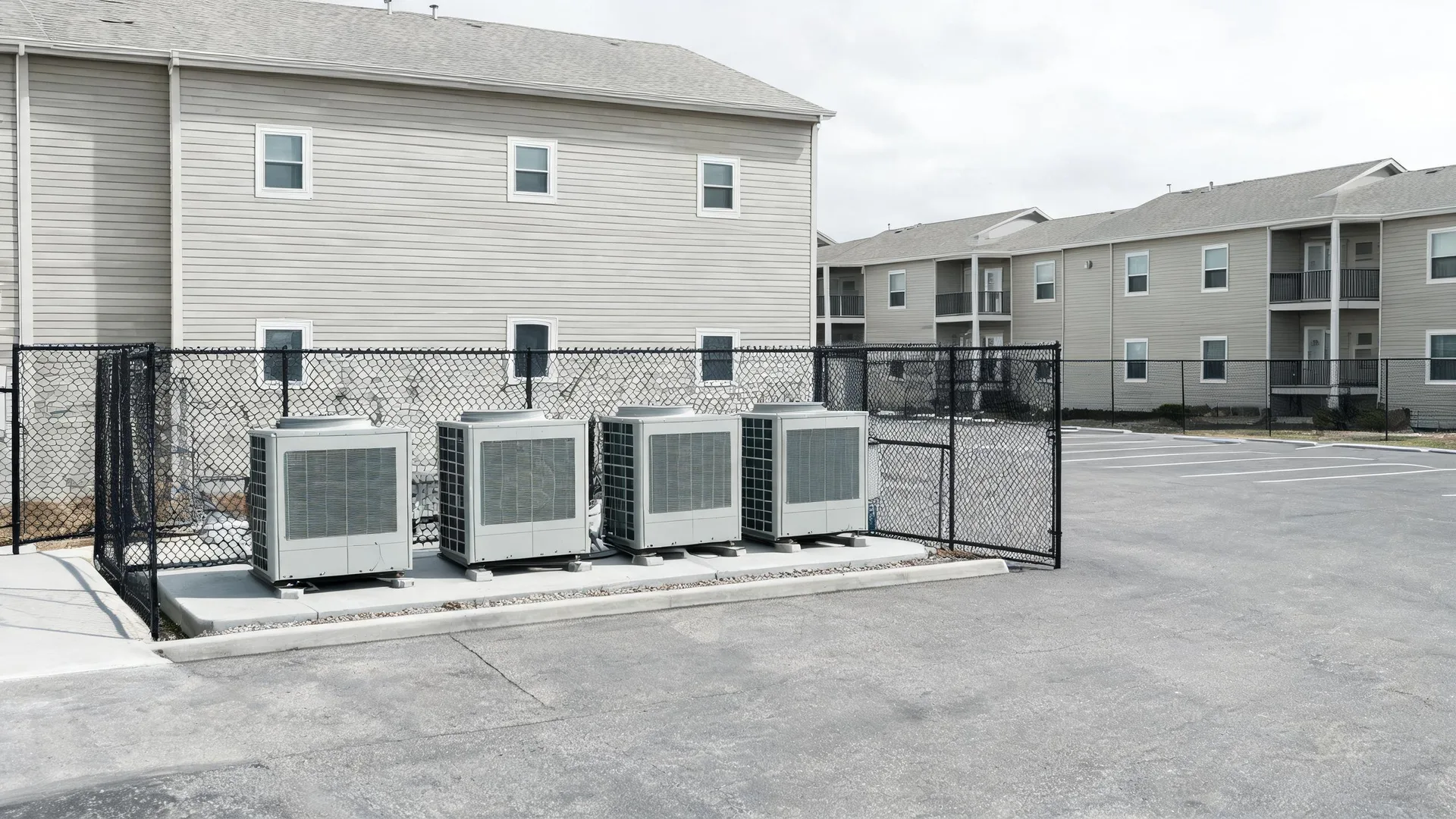
Checking refrigerant charge or testing a capacitor takes gauges and training most homeowners don't have, and opening the cabinet without them risks a shock or a bent fin that throws off airflow. What a homeowner can do is keep the outdoor unit clear, leaves, grass clippings, anything piled against the cabinet, so the coil outside can breathe.

1 months
July through July, your air conditioner is on duty
76°F
the average summer afternoon it cools against
33 hail events
in ten years, and hail bends the fins on outdoor coils
44 wind events
in ten years, and wind drives debris into outdoor units
Isometric cutaway illustration of a single-story house showing interior rooms, ductwork and an air handler in the attic space, and an outdoor condenser unit connected by lines at the exterior wall.
Your air conditioner works hardest from July through July.

NOAA nClimDiv, 1991–2020 normals

Half the homes in Oneida County were built in 1980 or later.

A system that age still has years ahead of it, which makes a yearly check worth the money.

One month of cooling a year, and it starts at full strength in July

Cooling runs July through July
Summer afternoons average 76°F
44 damaging wind events from 2015 to 2024

Keep it in good shape

If your system is fairly new, a yearly check keeps it in good shape for longer.

Find a contractor
A man in a cap, dark long-sleeved shirt and brown work pants carries a canvas tool bag as he climbs porch steps toward a green front door.
A gray metal air conditioning condenser unit mounted on a concrete pad in a flat grassy field under a partly cloudy sky.

Problems that don't announce themselves

A unit that ran fine last year can still be carrying a problem that only shows up under load. The capacitor that gets a motor spinning weakens slowly, and most fail on one of the first hot days rather than giving warning first. The same goes for refrigerant. A system doesn't use it up, so if the charge is low, there's a leak somewhere, and it gets worse over time, not better. A check catches both while the system is still running, not after it's stopped. Short cycling, warm air at the vents, ice on a line, any of those mean something already needs attention rather than a look ahead.

The drain line stops things quietly

The drain line carries away the water the coil pulls out of the air, and algae grows in that wet, dark line over time. Once it clogs, the water backs up into the drain pan and from there into the cabinet or the ceiling below it. Nothing about the cooling tells you this is happening. The air still gets cold right up until the pan overflows.

A dirty coil cools less for the same effort

Dust and grime build up on the coil surface the same way they build up on anything else exposed to moving air, just slower. A caked coil can't transfer heat the way a clean one does, so the system runs longer to reach the same temperature. It's a different failure than a frozen coil. The air still flows, it just doesn't come out as cold, and the compressor behind it works harder for less.

An overhead view of a residential air conditioning condenser unit mounted on a concrete pad next to a house with vinyl siding.

Book your AC tune-up in June, before homes here start needing cooling in July.

  1. Jan
  2. Feb
  3. Mar
  4. Apr
  5. May
  6. Jun
  7. Jul
  8. Aug
  9. Sep
  10. Oct
  11. Nov
  12. Dec

A tune-up checks the refrigerant charge, cleans the coils, tests the capacitor and tightens the electrical connections.

A tune-up starts outside at the fins. Dirt packed into them acts like a blanket over the coil, so the first step is washing it out. From there it moves to the electrical side. A capacitor gets tested under load, not just looked at, because it can read fine sitting still and still fail the moment the compressor asks it to start. The refrigerant charge gets checked against what the system calls for, not topped off by guess. Too much refrigerant is as hard on a compressor as too little. Electrical connections get tightened too. A loose connection generates heat right at the lug, and that heat is what burns a wire or a terminal over time. None of this fixes something that's broken. It finds the part that's about to be.