Profile view of a bearded man wearing a dark green baseball cap and a dark gray T-shirt against a plain light background.

What to check before calling for AC repair in Wisconsin

RepairCentral ACWisconsin
Step 1 of 2

What ZIP code is the job in?

What should I check before calling for AC repair?

Your AC isn't keeping up or won't turn on, and before you pick up the phone you want to rule out anything simple. Most of the time there's a quick check or two worth doing first, since a sticky Wisconsin summer gives an air conditioner no room for small problems to slide.

Check the thermostat, the filter, and the breaker before you call

Start with the thermostat. Make sure it's set to cool and set below the room temperature, since a setting bumped by accident is more common than people expect. Next, pull the filter and hold it up to light. If you can't see through it, air isn't moving through your system the way it should, and that alone can make a unit run constantly without cooling. Then check the breaker panel. A tripped breaker shuts the whole system down with no warning sound or error, just a house that stays warm. If the thermostat is right, the filter is clear, and the breaker is on, the problem is inside the unit itself, and that's worth a closer look before another humid day goes by.

A gray outdoor air conditioning condenser unit on a concrete pad beside a house with horizontal siding and a stone veneer base, with a wall-mounted disconnect box and conduit, next to a shrub bed and a concrete patio.

Running the way it should

Air moves out of the vents cold, the unit outside cycles on and off without struggling, and the house holds its temperature even on a sticky afternoon. The fan grille spins freely and the disconnect box stays untouched because nothing has tripped it.

An outdoor air conditioner condenser unit on a concrete pad beside a house with light gray vinyl siding, with a gray electrical disconnect box and conduit on the wall, gravel beds and dried plants nearby, and a concrete sidewalk in the foreground.

Signs it's falling behind

Weeds grow up against the housing and the gravel bed has gone dry and cracked around it. A unit this weathered has had years to pick up a weak capacitor, a dirty coil, or a refrigerant leak, any of which shows up as warm air or a system that won't keep up once the heat sets in.

Check First or Call Now

Check it yourself

  • Look at the thermostat and make sure it's set to cool and set a few degrees below room temperature, not just on.
  • Check the breaker panel for a tripped breaker, since a flipped switch can look identical to a dead unit.
  • Find the outdoor disconnect box next to the condenser and confirm the pull block hasn't been left out or loose.
  • Pull the filter and hold it up to a window; if you can't see light through it, swap it before anything else.
  • Walk around the outdoor unit and clear leaves, grass clippings or anything stacked against the sides so air can pass through the coil.
  • Check for ice on the refrigerant lines or the indoor coil, which points to restricted airflow rather than a part that's failed.

Call a contractor

  • The outdoor unit hums or clicks but the fan won't spin, which usually means an electrical part has failed, not something to force by hand.
  • Water is pooling near the indoor unit or dripping through the ceiling below it, a sign the condensate line or pump needs attention.
  • The system blows air but it never gets cold, even after you've swapped the filter and given it time to catch up.
  • You smell burning or notice a breaker that trips again right after you reset it.
  • The outdoor unit runs constantly without the house cooling down, which costs you on a Wisconsin power bill without fixing the problem.
  • Refrigerant lines are frosted even after you've cleared the airflow issues around the unit and changed the filter.
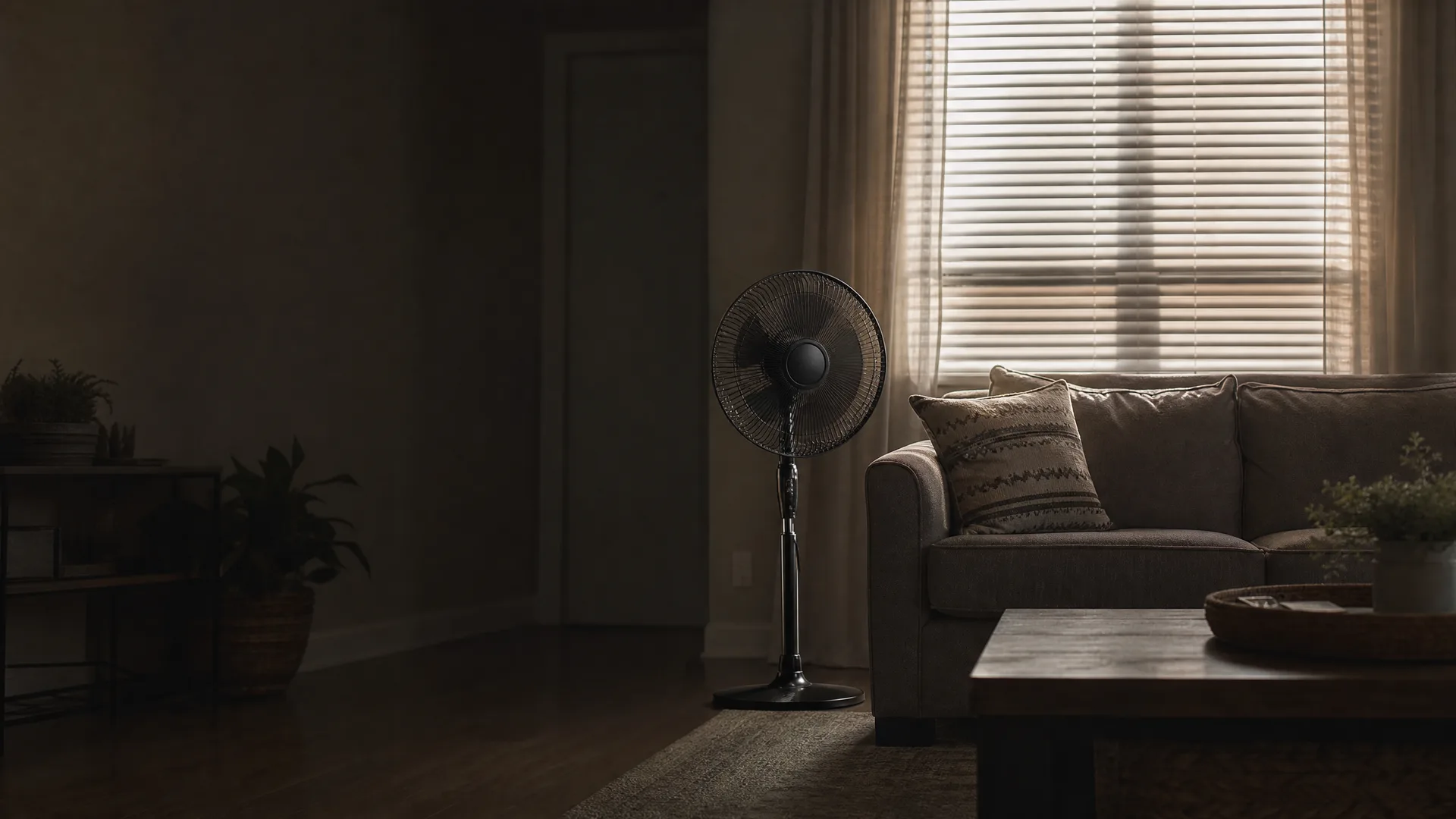
A dimly lit living room with a black pedestal fan on a wood floor beside a gray sofa with a patterned pillow, a wooden coffee table in the foreground, potted plants at left, and a curtained window with blinds behind.

By three in the afternoon the blinds are down and the living room still feels like the inside of a car. You've got the floor fan angled at the couch, pulling what cool air there is across the room, and you keep glancing at the vent overhead waiting to feel something besides warm air moving. Outside the unit is running, you can hear it, but the house isn't catching up. You already checked the thermostat and the breaker. At some point you stop fiddling with it yourself and think about who you'd even call, whether they can come this week, whether you'd have to explain the whole thing again from scratch once someone finally answers.


A pro who works on air conditioners

One form replaces the calls you'd make to find an air conditioner pro.

You only hire the pro if you want to.

A dirty filter is the most common reason an AC runs constantly without cooling the house. Pull it out and hold it up to a window. If you can't see light through it, that's your problem.

Swap it for a new one and give the system twenty minutes to catch up before you decide whether it's actually broken or was just choked off this whole time.

A bearded man in a blue and brown plaid flannel shirt stands indoors looking out a window at snow-covered trees, with a ceramic mug on the windowsill.
A man in a blue T-shirt sits on a light gray sofa, laughing while looking at an open laptop in the foreground, with a framed picture, lamp and potted plant behind him.

Your outdoor unit and the coil inside are one loop, so when something's wrong you can't always tell which end caused it just from warm air at the vents. The compressor is built to protect itself. If refrigerant pressure drops too low, it won't run at all rather than limp along, so a full shutdown doesn't always mean something's broken beyond repair. Water is part of this too. The condensate line drains constantly while the system runs, and if it clogs, a float switch cuts power before it backs up into your ceiling. That switch doing its job looks identical to a failure. Outside, the fan and the compressor each have their own capacitor, so you can end up with a fan spinning away while the compressor sits dead, or the other way around. Ice on the indoor coil points to restricted airflow or low refrigerant, not a thermostat set too low. And inside the outdoor unit, a contactor switches the compressor on and off every cycle for years until it sticks, which stops the system cold with no other sign of trouble.

How the system actually fails

  • The outdoor unit and the indoor coil work as one sealed loop, so a problem at either end shows up as warm air at the vents.
  • The compressor won't start if it senses low refrigerant pressure, which is why a system can trip off instead of just cooling less.
  • A condensate drain line that backs up will shut the whole system down through a float switch meant to stop water from reaching your ceiling.
  • The outdoor fan and the compressor run on separate capacitors, so one can fail while the other keeps running and confuse what's actually wrong.
  • Ice on the indoor coil almost always comes from restricted airflow or low refrigerant, never from the thermostat being set too cold.
  • The contactor in the outdoor unit is a mechanical switch that wears out from years of cycling, and a stuck one looks exactly like a dead system.
A weathered outdoor air conditioner condenser unit on a concrete pad beside a house with horizontal vinyl siding, with a conduit and disconnect box on the wall to the right.
Before you get your air conditioner repair
A gray outdoor air conditioning condenser unit on a concrete pad beside a house with horizontal lap siding, with a conduit and electrical disconnect box on the wall and a green shrub in mulch to the right.
After you get your air conditioner repair
A gray outdoor air conditioner condenser unit on a concrete pad beside a house with horizontal lap siding, with a wall-mounted disconnect box and conduit at left and a green shrub and mulch bed at right.

Working normally

The outdoor unit sits on its pad, conduit running down to the disconnect box, and it just hums along cycling on and off. Nobody's touched that disconnect because there's been no reason to. Inside, the air stays cold and steady even when it's sticky out.

An outdoor air conditioner condenser unit on a concrete pad beside a house with horizontal lap siding, with a conduit running to a gray electrical disconnect box on the wall.

In trouble

The unit outside looks the same from a distance, sitting against the siding with the conduit running to the disconnect box. But it's short cycling, running constantly, or not starting at all, and the air coming out of the vents isn't cold anymore.

Power costs 18.08 cents per kilowatt-hour statewide

At that rate, a struggling AC costs you more here than it would most places. A dirty filter or a low charge makes the compressor run longer to hit the same temperature, and you pay for every extra minute it runs. Checking the simple stuff first keeps that bill from climbing before a contractor ever sees the unit.

EIA-861 2025 statewide residential average

If you've gone through the filter, the breaker, the thermostat, and the outdoor unit and the air still isn't cold, that's not a sign you missed something. It means the problem is inside the sealed system where a homeowner can't reach it. At that point the next step isn't another search for a contractor near you, another round of phone calls explaining the same symptoms, or trying to line up quotes from people who haven't seen the unit. It's getting matched with a contractor who handles this in Wisconsin and having them reach out to look at your specific system. You already did the part that was yours to do. The muggy afternoon doesn't wait for a repair, but at least the legwork of finding someone qualified is done.

Interior room corner with sunlight from a window, showing peeling paint and damaged plaster on the wall above a white baseboard, a wooden cabinet with a pale bowl on top, hardwood floor and a patterned rug.
Interior corner of a room with tan walls, white profiled baseboard and window trim, a wood-plank floor in sunlight, and green foliage visible through the window.
An empty room corner with cream walls, white baseboard, two windows with deep sills showing green foliage outside, and a wood plank floor lit by sunlight.
Empty room corner with beige walls, white beadboard wainscoting, chair rail and baseboard, a window with green foliage outside, and sunlight casting leaf shadows on the wall above a wood floor.
Sunlit room corner with a multi-pane window, beige walls, white baseboard, wood floor with a woven rug, and a dark wooden cabinet holding a ceramic table lamp below a framed picture.

Get your air conditioner to the right pro

Describe what your air conditioner is doing once, in one form.

Find an air conditioner pro

Asking costs nothing, and the choice to hire stays yours.