A modern bedroom with dark furnishings, a wall-mounted air conditioning unit, and a cat resting on a large bed.

Mini Split Installation in Whitewater, WI

Tell us about the job

Takes about a minute. No obligation.

New system or replacementMini-splitWalworth County, WI
Step 1 of 2

What ZIP code is the job in?

Ask what each zone is rated to heat or cool

Every indoor head is sized for a certain room or open area. A contractor should walk through each space with you and explain why a given head matches that room, not just hand you a total number for the whole house. A unit too small for its space runs constantly and never quite catches up. One too large cools the room fast but shuts off before it pulls moisture out of the air, leaving it clammy.

Ask how the outdoor unit performs in cold weather

Mini splits pull heat from outside air even when it's cold, but not every outdoor unit does this the same way. Some hold their heating output as temperatures drop, others fall off and lean harder on backup heat strips or a furnace to carry the load. Ask directly how the system performs at the coldest temperatures your winters bring, not just how it performs on a mild day.

8 months
October through May, your system heats
3 months
June through August, it cools
16°F
the average winter night it heats against
81°F
the average summer afternoon it cools against
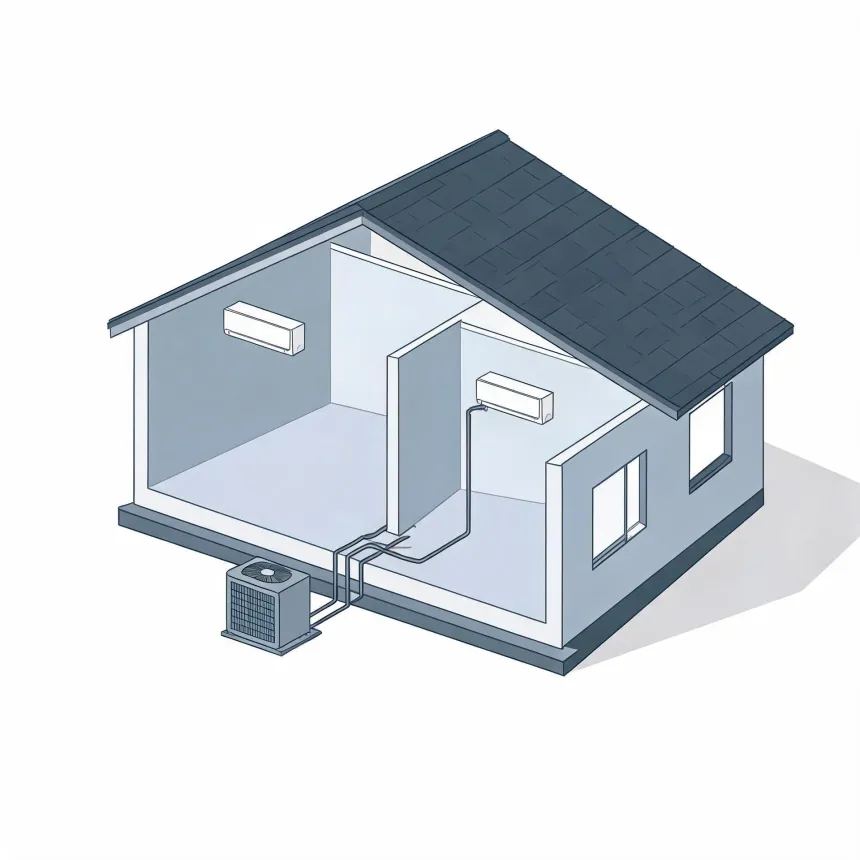
Isometric cutaway illustration of a small house with a dark shingled roof, showing two wall-mounted indoor units connected by lines running to an outdoor condenser unit beside the building.
Your system heats October through May and cools June through August.

NOAA nClimDiv, 1991–2020 normals

May is the month before cooling starts in Walworth County.

Get the mini split in before June, so install day is on your calendar, not forced by the first hot week.

A standard mini split, sized for this climate, handles what Walworth County asks of it

Cooling runs June through August
Summer afternoons average 81°F
74 damaging wind events from 2015 to 2024
A system sized for the room, not the houseHalf the homes in Walworth County were built in 1977 or earlier, half later, and the age of the house doesn't change what size a room needs.

A mini split here doesn't need to be oversized to earn its keep. A unit sized to the room cycles on and off the way it should, and that cycling is what pulls moisture out of the air. Go a size too big and it short-cycles instead, cooling the room fast but shutting off before the air actually dries out. That shows up on the electric bill, not just on the thermostat. Wisconsin homes paid 17.18 cents per kilowatt-hour in 2024, so a system working harder than it needs to costs more to run every month it's on. A contractor who sizes the head to the room and the compressor to match is sizing it to cost less to run, not just to fit.

Zone 5A sets the minimum. The tax credit rewards going past it.

Walworth County sits in climate zone 5A. Any mini split installed here has to meet the federal minimum for a split system, 14.3 SEER2 for cooling and 7.5 HSPF2 for heating. That's the floor a contractor designs to, not a suggestion. A federal tax credit is available on qualifying equipment, so ask which units meet it before you settle on a system.

Find a contractor
A man seen from behind in a backward cap, dark jacket and tan work pants carries a waxed canvas tote bag up steps toward a green front door, with a potted shrub beside the entry.
A white mini-split air conditioner outdoor condenser unit mounted on metal brackets against a beige stucco exterior wall, with a blue sky and scattered clouds in the background.

The rating is a season's worth of work, not one good day

The rating on the label is measured over a season, not one good day. A mini split works hardest on the coldest and hottest days and coasts the rest of the time, so the number reflects all that running averaged out. It tells you how well the equipment converts power into heating or cooling under test conditions, nothing more. It doesn't know about a dirty filter, a blocked outdoor unit, or a head that's the wrong size for the room it's in. Keep the coils clean and the airflow clear and the system has a real shot at running close to its rating for years. Neglect it and the equipment falls short of that number no matter how good the rating looked on the showroom floor.

The line set and where the outdoor unit sits

Refrigerant lines run from the outdoor unit to each indoor head through a hole drilled in the wall. A short, straight run costs less in materials and labor than one that has to snake around corners or climb a floor. Where the outdoor unit can sit, how far it is from each head, and whether the wall behind a head is easy to drill all change what the job takes.

One zone costs less than several

A single indoor head tied to one outdoor unit is the simplest install there is. Add zones and you add line sets, add wiring, and add a bigger outdoor unit to drive all of them at once. Each additional head is its own small job stacked onto the first, not a minor add-on to it.

Whatever gets pulled out, haul-away is part of the job, not an afterthought you arrange later. Refrigerant in the old system has to be recovered properly, not vented, and a licensed contractor has the equipment to do that. If the old system was ducted, those ducts might get reused for a furnace or left capped off, depending on what's replacing them. A window unit or old wall sleeve usually just comes out and goes to scrap. None of this is the hard part of the job. The real work is the new line set, the new wiring, and the new outdoor pad, and that's where the time on site actually goes.

Install day starts with the outdoor unit, usually set on a pad or mounted bracket somewhere the line set can reach each head without a long detour. Each indoor head gets mounted on the wall first, then a hole gets drilled through to the outside for the line set, the wiring, and the condensate drain to pass through. The lines get run, connected, and then the whole system gets pulled down to a vacuum before any refrigerant moves, which clears out moisture and air that would otherwise ruin the compressor. Once the system holds that vacuum, the contractor charges the lines, powers up each head, and checks that it's actually pulling heat or cooling the way it should. Every joint in the line set gets tested for leaks before the covers go on and the job is called finished.