




A row of dark-clad single-story houses with gabled roofs behind trimmed hedges, lawn and leafy trees under an overcast sky.

Mini Split Installation in West Bend, WI

Tell us about the job

Takes about a minute. No obligation.

New system or replacementMini-splitWashington County, WI
Step 1 of 2

What ZIP code is the job in?

Gas heats most homes in Washington County, close to seven in ten. A mini split works differently. It's electric, and it does both heating and cooling from the same unit. That makes it a common choice for additions, garages, and rooms a gas furnace's ductwork never reached. Some homeowners also use one to take the load off the furnace in fall and spring, or to cool a house that has gas heat but no central air.

8 months
October through May, your system heats
3 months
June through August, it cools
14°F
the average winter night it heats against
79°F
the average summer afternoon it cools against
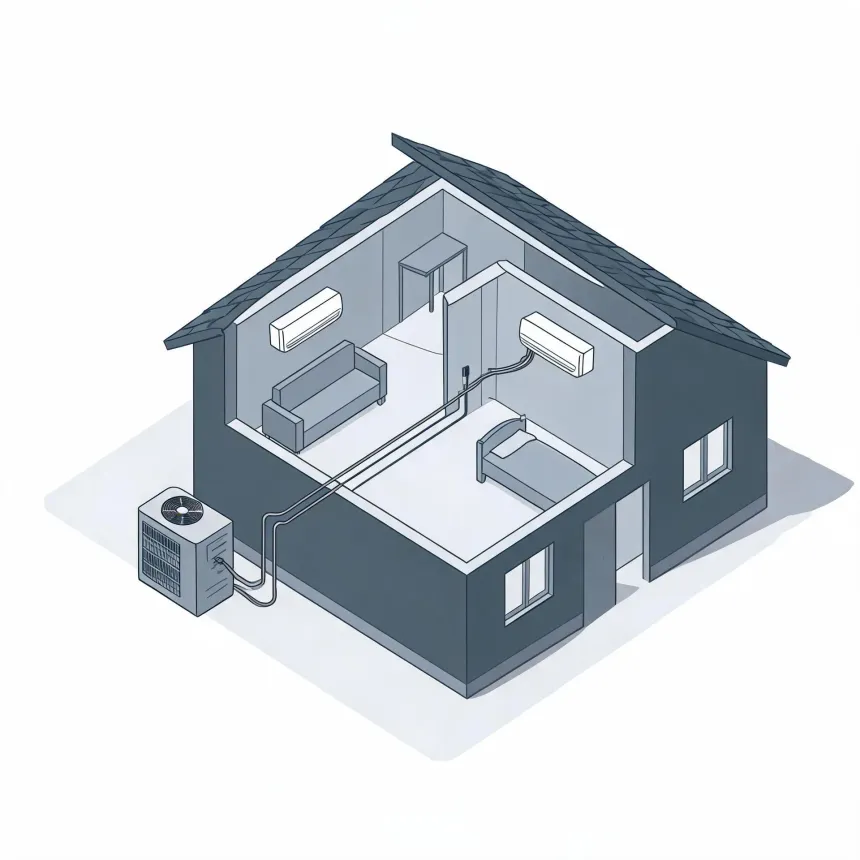
Isometric cutaway illustration of a small house showing two wall-mounted indoor air conditioning units connected by line sets to an outdoor condenser unit beside the exterior wall, with a sofa in one room and a bed in another.
Your system heats October through May and cools June through August.

NOAA nClimDiv, 1991–2020 normals

Summer here runs about three months, June through August.

A mini split in West Bend isn't working hard most of the year, so a reliable mid-tier system is enough.

Power outages and storms matter more here than heat or cold

124 severe weather events from 2015 to 2024
18% of homes statewide lost power a day or more in 2024
54 damaging wind events from 2015 to 2024

Cooling starts in June here, so May is the time to get a mini split installed. Done before the season starts, it happens on your schedule, not squeezed in after the first hot week. A contractor can take the time to size the unit and run the line set right, instead of rushing to get cold air on while you wait. Cooling in Washington County only runs June through August, so there's no reason to put this off until the heat is already a problem.

A right-sized mini split is all this job needs

At 17.18 cents per kilowatt-hour, a mini split that's sized right for the room it's heating and cooling is what keeps your electric bill reasonable. Nothing about running one here calls for oversizing or a premium unit. A standard system, installed correctly, handles West Bend's summers fine.

Find a contractor
A man in a cap, dark long-sleeved shirt and brown work pants carries a canvas tool bag as he climbs porch steps toward a green front door.
A white outdoor air conditioner condenser unit mounted on metal wall brackets against gray horizontal siding, with a blue sky and white clouds behind it.

Three months of work a year

Three months of cooling, afternoon highs around 79, isn't a hard pull for a compressor. Most of the strain on a mini split comes from long hours at extreme temperatures, and West Bend doesn't ask for that. A mid-tier unit, sized right, isn't being asked to prove itself against anything severe. Spend the money on a correct install instead of a higher-tier compressor.

What the rating actually measures

The efficiency number on a mini split's label is a ratio, how much heating or cooling it produces against the electricity it uses. A higher number means less electricity for the same comfort. It says nothing about how big a room the unit can handle. A high-efficiency unit sized wrong for the space still runs poorly.
Where the rating stops mattering

The rating is measured under set lab conditions, not whatever the thermostat is doing on a mild afternoon. A unit that's oversized for the room cycles on and off and never runs long enough to perform the way its label suggests. The install is what decides whether that number means anything day to day.

If this is replacing a window unit or baseboard heat, that equipment doesn't need to come out before the new work starts. An installer runs the line set and mounts the indoor and outdoor units first, then disconnects whatever was doing the job before. A window unit just comes out of the window once the mini split is running. Baseboard heaters and their wiring get capped or pulled after the new system is in and tested. If there's old ductless equipment to remove, the refrigerant gets recovered properly before the unit comes off the wall. None of that holds up the new install or changes how it gets sized and run.

Installation starts outside and in, at the same time. One installer mounts the outdoor unit on its pad or brackets while another sets the indoor head on the wall, usually high up where it can pull air across the whole room. The line set connecting them runs through a small hole drilled in the wall, insulated the whole way so it isn't losing energy to the space it passes through. Once both ends are in place, the line gets pulled down to a vacuum before any refrigerant moves through it. Any moisture or air left in that line turns into a problem for the compressor later, so this step doesn't get rushed. After that comes a pressure test, a check of the refrigerant charge, and a run through both heating and cooling before anyone calls it done. Most of the day is that line set and the vacuum, not the units themselves going up.