A row of dark-clad single-story cottages with gabled roofs behind trimmed hedges, with a mown lawn in the foreground and large leafy trees under an overcast sky.

Mini Split Installation in Sturgeon Bay, WI

Tell us about the job

Takes about a minute. No obligation.

New system or replacementMini-splitDoor County, WI
Step 1 of 2

What ZIP code is the job in?

LP gas is the most common heat here

Bottled or tank LP gas heats more homes in Door County than any other fuel, with utility gas close behind. A mini split works alongside either kind of furnace instead of replacing it, handling cooling and shoulder-season heat while the furnace covers the coldest months.

What that means for sizing this job

A mini split paired with an existing gas furnace only needs to cover part of the load, not the whole house through a Door County winter. That changes what size and how many zones a contractor will recommend compared to a home trying to heat entirely off electric strip heat or a heat pump alone.

9 months
September through May, your system heats
2 months
July through August, it cools
15°F
the average winter night it heats against
75°F
the average summer afternoon it cools against
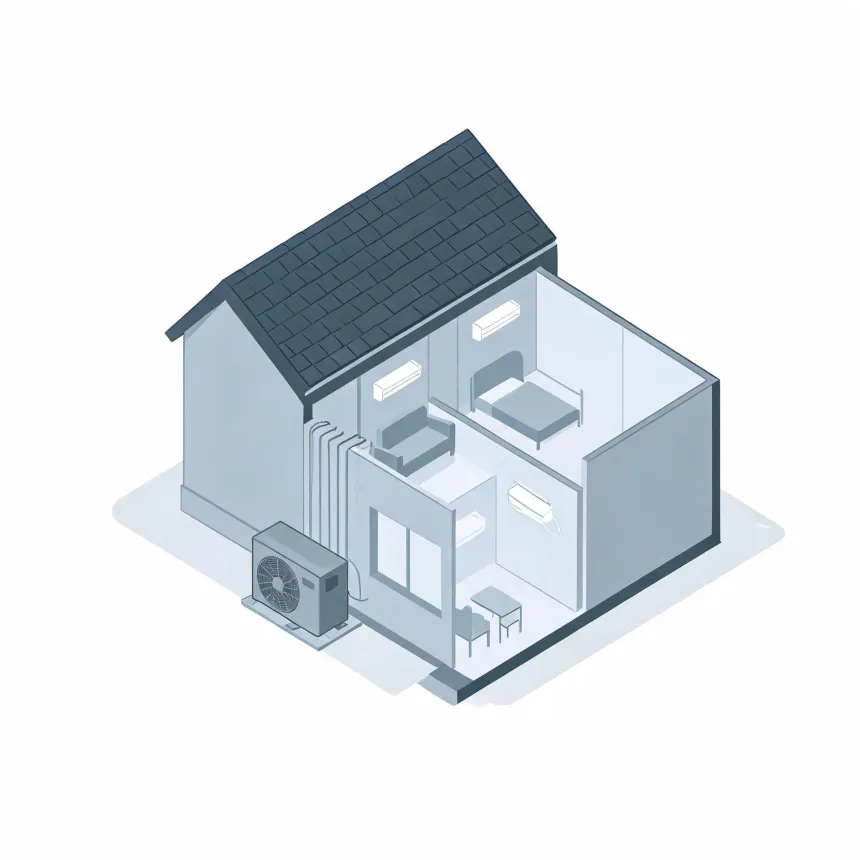
Isometric illustration of a cutaway house with a dark shingled gable roof, showing interior rooms with a bed, chairs and table, three wall-mounted mini-split indoor units connected by line sets to an outdoor condenser unit on a pad outside.
Your system heats September through May and cools July through August.

NOAA nClimDiv, 1991–2020 normals

Cooling in Sturgeon Bay runs about two months a year, with afternoon highs averaging 75°F even in July and August.

A mini split here isn't fighting heat all summer, so a well-built mid-range system holds up fine without reaching for the highest efficiency tier.

A standard mini split handles this fine

Power costs 17.18 cents a kWh statewide
Cooling runs July through August
Summer afternoons average 75°F

If the old equipment is a window unit or electric baseboard, a contractor pulls it out once the mini split is in place and running. If it's a ducted system that's being supplemented rather than replaced, the furnace and ductwork stay exactly as they are. Nothing about adding a mini split requires touching the existing heat source. Old window units usually just come out and go to scrap. Baseboard heaters get disconnected at the electrical box, and that circuit can often be repurposed or capped off by an electrician. None of this is part of the mini split installation itself. It's a separate, smaller step that happens around it.

Install in June, ahead of July and August

Cooling here only runs in July and August. June is the month before that starts, and it's the easiest time to get a mini split installed, since nobody's waiting on it to cool the house down that day. Get it in during June and it's already running the first warm week instead of being scheduled around one.

Find a contractor
A man in a cap, dark jacket and tan work pants walks up porch steps toward a green front door, carrying a worn canvas tool bag in his right hand, with a potted shrub beside the entry.
A beige split-system air conditioner outdoor condenser unit mounted on metal wall brackets atop a stucco wall.

What actually happens on install day

Installation runs most of a day, not an hour. The crew mounts a bracket on the exterior wall and sets the outdoor unit on a pad or brackets, leveled so the compressor inside isn't straining against a tilt. Inside, the indoor head goes up high on a wall or ceiling, over a small hole drilled through to the outside. The line set carrying refrigerant, the power wire and a condensate drain all run through that hole, then get connected on both ends. Once everything's joined, the line gets pulled down to a vacuum to clear out air and moisture before refrigerant is ever released into it. Skip that step and moisture left in the line turns to acid over time, eating at the compressor from the inside. After that it's a pressure test, a check of refrigerant charge against what the manufacturer specifies, and running the system through both heating and cooling before anyone calls it done.

Ask how many zones one outdoor unit really runs

One outdoor condenser can run several indoor heads, but each added zone splits its capacity thinner. A contractor comparing systems should say plainly how many rooms one unit is rated to cover well, not just how many it can technically connect to.

Ask what happens if one indoor head needs service

On a multi-zone setup, the indoor heads share a single outdoor unit and a single refrigerant circuit. If one head develops a fault or a refrigerant leak, find out whether the rest keep running or the whole system has to shut down for the repair.

Sizing a mini split starts with the heat loss and heat gain of the specific rooms it covers, not a rule of thumb based on square footage. A contractor works out how much heat each room loses in winter and gains in summer, accounting for windows, exterior walls and ceiling height, then matches that load to an indoor head rated to cover it. Oversize it and the unit short cycles, reaching the temperature too fast and shutting off before it's pulled any humidity out of the air, so the room feels clammy even when it reads cool. Undersize it and the compressor runs flat out without ever catching up on the coldest or hottest days. Either mistake shows up later as a comfort complaint, not an installation problem, which is why it's worth asking how the contractor arrived at the number instead of just trusting the label on the box.

What drives the cost of putting one in has less to do with the equipment and more to do with what it takes to get refrigerant line and power from outside to inside. A short, straight run through one exterior wall is a different job than a line set that has to travel up through a chimney chase or across an unfinished attic to reach a head on the far side of the house. Every extra foot of line set is material and labor, and every turn or penetration through framing adds time. The outdoor unit needs a dedicated electrical circuit, so if the panel is already full or sits far from where the condenser will go, that's added work before the mini split itself goes in. Multi-zone jobs multiply all of this, since each indoor head needs its own line run back to the outdoor unit. None of it shows up in the price of the equipment. It shows up in what the contractor has to do to connect it.