A white wall-mounted split air conditioning unit in a dimly lit modern room, with a full moon visible through the window at night.

Mini Split Installation in Stevens Point, WI

Tell us about the job

Takes about a minute. No obligation.

New system or replacementMini-splitPortage County, WI
Step 1 of 2

What ZIP code is the job in?

Gas heats most homes here

Utility gas heats 56.4% of occupied homes in Portage County. Another 18.1% run on bottled or LP gas. A mini split adds cooling, or heat for a room that stays cold now, without touching the furnace or the gas lines already in place.

What that means for the install

The furnace keeps doing the main heating load. The mini split handles one room or zone, cooling in summer and backup heat in the shoulder months, so the work is about running line and mounting units, not replacing a system that already works.

9 months
September through May, your system heats
2 months
July through August, it cools
10°F
the average winter night it heats against
79°F
the average summer afternoon it cools against
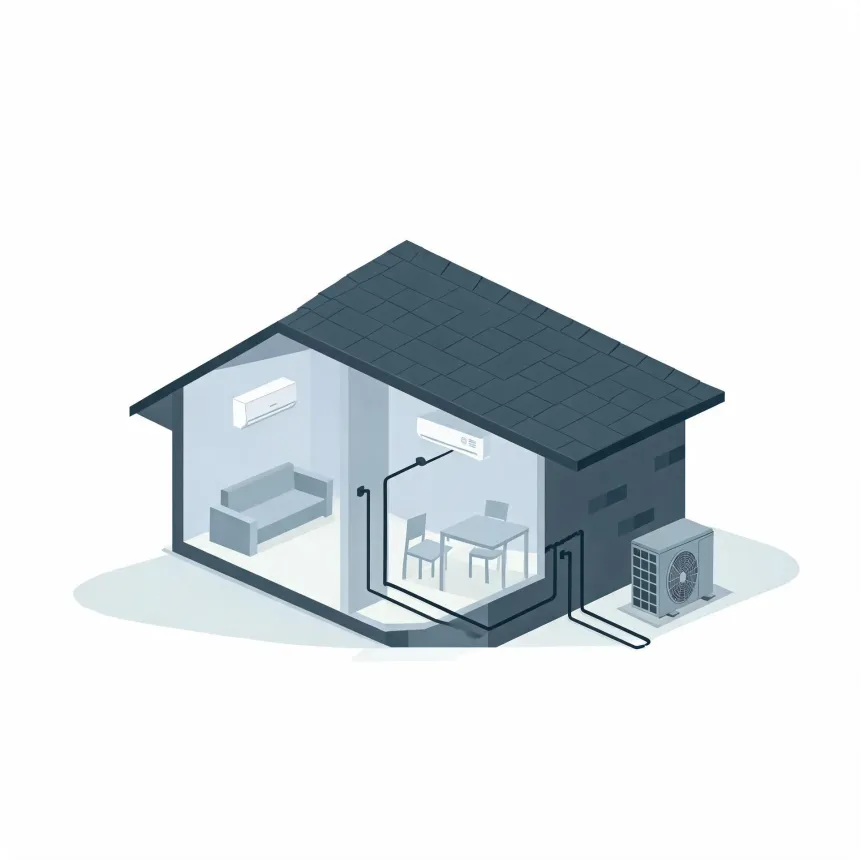
Isometric illustration of a cutaway single-story house showing two wall-mounted mini-split indoor units connected by line sets to an outdoor condenser beside the building, with a sofa, table and chairs inside.
Your system heats September through May and cools July through August.

NOAA nClimDiv, 1991–2020 normals

Electricity in Wisconsin ran 17.18 cents per kilowatt-hour in 2024.

A mini split sized right for one room keeps that cost down, so there's no reason to size up.

Two months of cooling a year, that's not much to ask of a mini split

Cooling runs July through August
Summer afternoons average 79°F
44 damaging wind events from 2015 to 2024

Portage County sits in zone 6A, a cold climate under the energy code. Any mini split going in here has to clear the federal split-system minimums, 14.3 SEER2 for cooling and 7.5 HSPF2 for heating. That rule treats ductless units the same as central systems. There's no separate, lower bar for a mini split just because it's small. A unit that clears those numbers is also worth checking against the federal energy efficiency tax credit before you buy.

Put it in before June is over

July and August are the only months this unit has to earn its keep. Get it mounted and running before July and the first hot day isn't a surprise.

Find a contractor
A white outdoor air conditioner condenser unit mounted on metal wall brackets against gray horizontal siding, with a blue sky and white clouds behind it.

Two months a year is a light workload

Two months of real work a year is not much wear on a compressor. Pick a reliable mid-range unit over the top-tier model. You will not run it long enough or hard enough to earn back the difference. Put the money into a correct install instead, the line set brazed right, the mounting solid, the unit sized to the room it serves.

One number for cooling, another for heating

SEER2 measures cooling efficiency and HSPF2 measures heating efficiency. They are not interchangeable, and a strong score in one says nothing about the other. If the room needs both cooling and backup heat, check both numbers, not just the one on the sticker that catches your eye.

The rating describes running cost, not sizing

A high efficiency rating tells you how much electricity the unit uses to do its job. It says nothing about whether the unit fits the room. An efficient unit that is too big for the space will short cycle, and one that is too small will run constantly trying to keep up. The rating only pays off when the sizing and the install behind it are done right.

Sizing a mini split comes down to a load calculation, not a chart that matches room size to unit size. The contractor looks at square footage, but also ceiling height, window area, insulation, and what's on the other side of each wall. A room with a lot of west-facing glass holds heat differently than one with none. Get it wrong on the large side and the unit cools the air fast, shuts off, and starts again before it pulls any moisture out of the room. That short cycling leaves the air cold but damp, even though the light yearly workload means the compressor itself isn't under much strain either way. Get it wrong on the small side and the unit never stops trying, running long hours without reaching the temperature set on the thermostat. Right sized, it runs long steady stretches at low output, which is how it keeps the room comfortable and pulls the moisture out of the air.

Install day starts outside, not in. The outdoor unit needs a spot with clear airflow on all sides and a solid, level pad to sit on, away from where snow slides off the roof. Inside, the mounting plate goes high on a wall, on a stud or with proper anchors, since the indoor unit hangs on that plate and nothing else. Then comes the hole through the wall for the line set, the refrigerant lines, the power wire, and the condensate drain, bundled together and run through a single sleeve. The lines get connected and brazed at both ends, then the whole system gets pulled into a vacuum to clear out air and moisture before any refrigerant moves through it. Skip that step or rush it and moisture sits in the lines, and that shows up later as a compressor problem, not a day-one problem. Once the vacuum holds, the system charges, the contractor checks the line set is pitched right so condensate drains out instead of back into the unit, and then it runs through a cycle to check it's cooling and heating on command.