Gas heats most homes here
74.3% of homes in Sheboygan County heat with utility gas. A mini split here usually goes in alongside that furnace, handling cooling and shoulder-season heat rather than replacing the gas system outright.
Takes about a minute. No obligation.
74.3% of homes in Sheboygan County heat with utility gas. A mini split here usually goes in alongside that furnace, handling cooling and shoulder-season heat rather than replacing the gas system outright.
Since gas already covers the coldest months for most houses, the mini split's job is cooling load and the mild stretches in spring and fall. Sizing it against what the furnace already handles matters more than sizing it to carry winter alone.
NOAA nClimDiv, 1991–2020 normals
Cooling runs about two months here, July and August, with afternoon highs around 78°F.
A mini split in Sheboygan County isn't working against months of heat, so a mid-range system holds up fine.



Half the homes in Sheboygan County were built in 1970 or earlier. A mini split going into one of these has to work with the house as it stands, not with open framing and a blank wall. Line sets often run through plaster or old lath instead of drywall, and the path from the outdoor unit to the indoor head may not be a straight shot. None of that rules out a mini split. It means the install has to account for the house instead of assuming a newer one.
Sheboygan County sits in climate zone 6A. Any mini split installed here, ductless or not, has to meet the federal minimum for a split-system heat pump. That means 14.3 SEER2 for cooling and 7.5 HSPF2 for heating, with no lower bar for going ductless. A federal tax credit is available for qualifying heat pump installations. Worth checking the system a contractor proposes against it.
Find a contractorA contractor who's worked on houses built in 1970 or earlier knows to check the wall before quoting the job. That means finding where the line set can actually run, and whether the path from the outdoor unit to the indoor head needs a few extra feet of line rather than a straight shot through drywall. Ask what they found when they looked at your walls, not just what unit they're proposing.
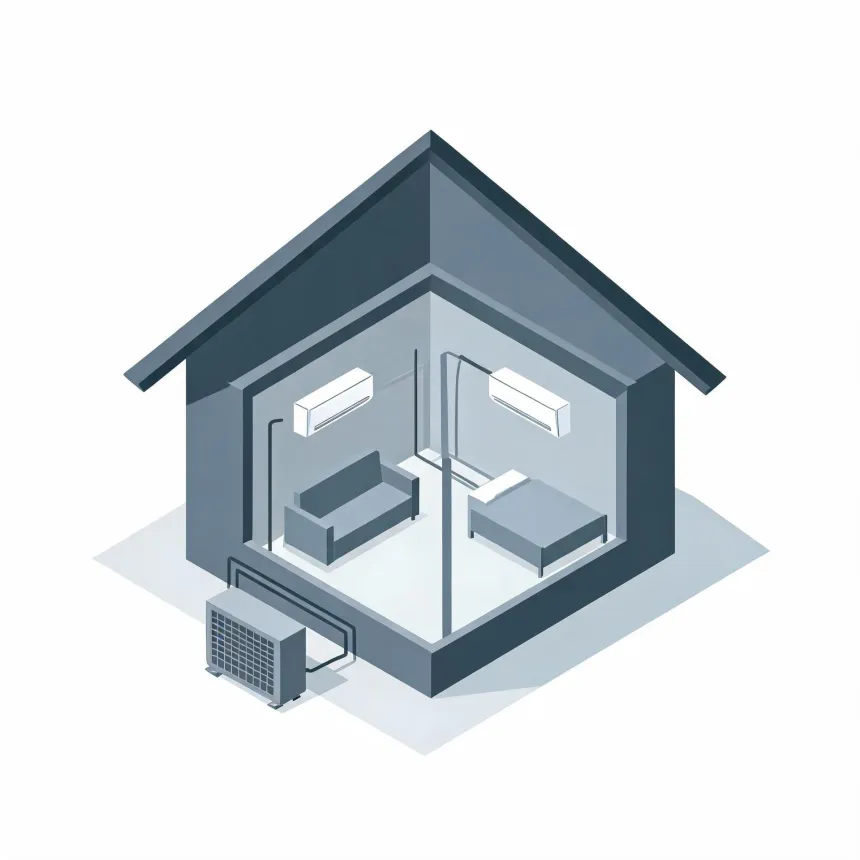
A single outdoor unit can run more than one indoor head, each one controlling its own room. Ask whether the quote is one zone or several, and what happens to the rest of the house if one head needs service. A multi-zone system splits its capacity across every head running at once, so the comparison isn't just the outdoor unit's rating.
Every heat pump loses capacity as the outside temperature drops, and the point where it can no longer keep up is different for every model. Ask what each system is rated to handle at low temperatures and what backup heat it assumes. A unit that looks the same on paper as another can fall off sooner once it gets cold.
Sizing a mini split isn't about matching square footage to a number on a brochure. A contractor works out the heat loss and heat gain for the specific room, how much warmth escapes through the walls and windows in winter, how much heat builds up from sun and appliances in summer. Too big and the unit short cycles. It reaches the set temperature fast and shuts off before it's pulled any humidity out of the air, so the room feels cool but damp. Too small and it runs flat out on the hottest and coldest days without ever catching up. The right size runs long, steady cycles most of the time. That's a better sign than a big number on the spec sheet.
Install day starts with the outdoor unit and the indoor head going up, but most of the time goes into the line set between them. That's the refrigerant lines, the wiring, and a condensate drain, all run through a hole drilled where the wall allows it, then sealed against the weather on the outside. The outdoor unit sits on a pad or bracket with room around it for airflow. Once the lines are connected, the system gets evacuated with a vacuum pump to pull out moisture and air before the refrigerant charge goes in. That step matters more than almost anything else on the job. A line set charged without a proper vacuum can mean a system that struggles for years without anyone knowing why. After the charge, a contractor checks the pressures, confirms the head is level, and runs the system through a cycle before calling it done.