






A row of illuminated two-story brick houses with front porches and mature trees photographed at twilight.

Mini Split Installation in Shawano, WI

Tell us about the job

Takes about a minute. No obligation.

New system or replacementMini-splitShawano County, WI
Step 1 of 2

What ZIP code is the job in?

Utility gas heats close to half the homes in Shawano County, and LP gas heats another 30 percent. Together that's most of the county running a furnace or boiler off a gas line or a tank. A mini split doesn't replace that heat source. It gets added alongside it, usually to cover a room the ductwork never reached well, or to take over cooling so the furnace system can stay focused on winter. If your home runs on LP, a mini split can also take pressure off the tank during the shoulder months when you don't need full heat.

9 months
September through May, your system heats
2 months
July through August, it cools
10°F
the average winter night it heats against
78°F
the average summer afternoon it cools against
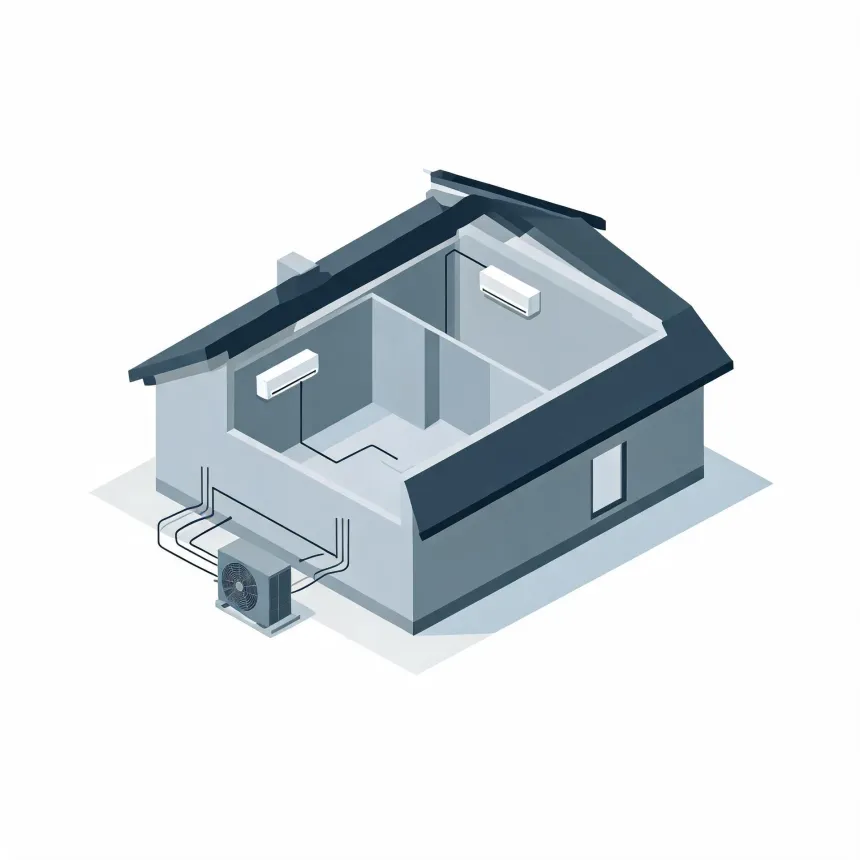
Isometric illustration of a cutaway house showing two wall-mounted indoor air conditioning units connected by line sets to an outdoor condenser unit on the ground outside.
Your system heats September through May and cools July through August.

NOAA nClimDiv, 1991–2020 normals

A mini split runs on electricity, nothing else.

At 17.18 cents a kilowatt-hour, sizing it right is what keeps the bill predictable.

A normal-size system is all this county needs

Half the homes here were built by 1975
Cooling runs July through August
Summer afternoons average 78°F
Two months of real work a yearAfternoon highs average 78°F in June, July and August, the only stretch cooling runs.

Cooling in Shawano County only runs July through August. That's a short window, which is exactly why installing before it starts matters. Get the mini split in during June and it's got refrigerant lines set, the line set insulated, and the indoor head mounted without anyone sweating through the job. Wait until July and you're competing with every other homeowner whose AC just quit, booking whatever slot is open instead of whatever slot works for you. A furnace replacement can wait for a cold snap to force the issue. Cooling here has a start date you can see coming.

Zone 6A sets the minimum for what goes in

Shawano County falls in climate zone 6A. Any mini split installed here has to meet the federal minimum. That's 14.3 SEER2 for cooling and 7.5 HSPF2 for heating, the same floor set for every split-system heat pump made since January 2023, ductless included. A federal tax credit is available on qualifying equipment. That narrows the field to the systems worth comparing in the first place.

Find a contractor
A man in a cap, dark long-sleeve shirt and tan work pants walks up porch steps toward a green front door, carrying a worn canvas duffel bag, with a potted shrub and wall lantern beside the entry.
A white outdoor air conditioner condenser unit mounted on metal wall brackets against gray horizontal siding, with a blue sky and white clouds behind it.

Built to last past the install

Two months of light work a year does not wear out a compressor. Pick a mini split sized for the room it is covering, not the biggest unit on the lot. The extra capacity has nowhere to go when the afternoon high tops out at 78°F, and it will just cycle on and off more than a right-sized unit would.

Ask what the room needs, not what the brand recommends

A contractor should size the indoor head to the room it's covering. That means the square footage, the window area, how well it holds heat. A unit picked off a chart without those details can end up too big. It cools the air fast and shuts off before it pulls the moisture out, and the room ends up cold and damp instead of comfortable.
Ask where the line set is running

The refrigerant lines between the outdoor unit and the indoor head need insulation along the whole run, not just the part you can see. A gap anywhere, behind a wall or through an attic, costs efficiency for as long as the system runs. Ask to see the route before it gets closed up, not after.

What drives the price of a mini split installation is mostly what it takes to connect the outdoor unit to the indoor head. A short, straight line set run costs less to install than one that has to cross an attic, drop through a chase, or route around framing to reach the other side of the house. Every extra foot of refrigerant line and every penetration through a wall adds labor. The electrical side matters too. A mini split needs its own dedicated circuit, and if the panel has room and capacity already, that's a simple hookup. If it doesn't, running new wire or upgrading the panel adds to the job. The number of indoor heads also changes the scope. A single zone is a simpler install than a multi-zone system feeding several rooms off one outdoor unit, since each head needs its own line set and its own mounting work. Where the outdoor unit can sit matters as well. A spot close to the indoor head with easy access keeps the work straightforward. A spot that's hard to reach or far from where the indoor head needs to go adds time no matter how simple the equipment itself is.

This is an addition, not a swap, so the old system usually stays right where it is. If the furnace or boiler still runs, there's nothing to replace. The mini split takes on the room or the season it's assigned, and the existing equipment keeps doing the rest. Where a wall unit or window AC is being retired in favor of the new head, a contractor can haul that off as part of the job. The one thing worth asking about ahead of time is refrigerant. Older window units and some early split systems used a refrigerant that's no longer produced, and disposing of it correctly isn't something to leave to chance.