Most of Racine County heats with gas
Utility gas heats 75.6% of occupied homes in Racine County. Electricity comes in second at 18.0%, with LP gas and fuel oil making up the rest.

Takes about a minute. No obligation.
Utility gas heats 75.6% of occupied homes in Racine County. Electricity comes in second at 18.0%, with LP gas and fuel oil making up the rest.
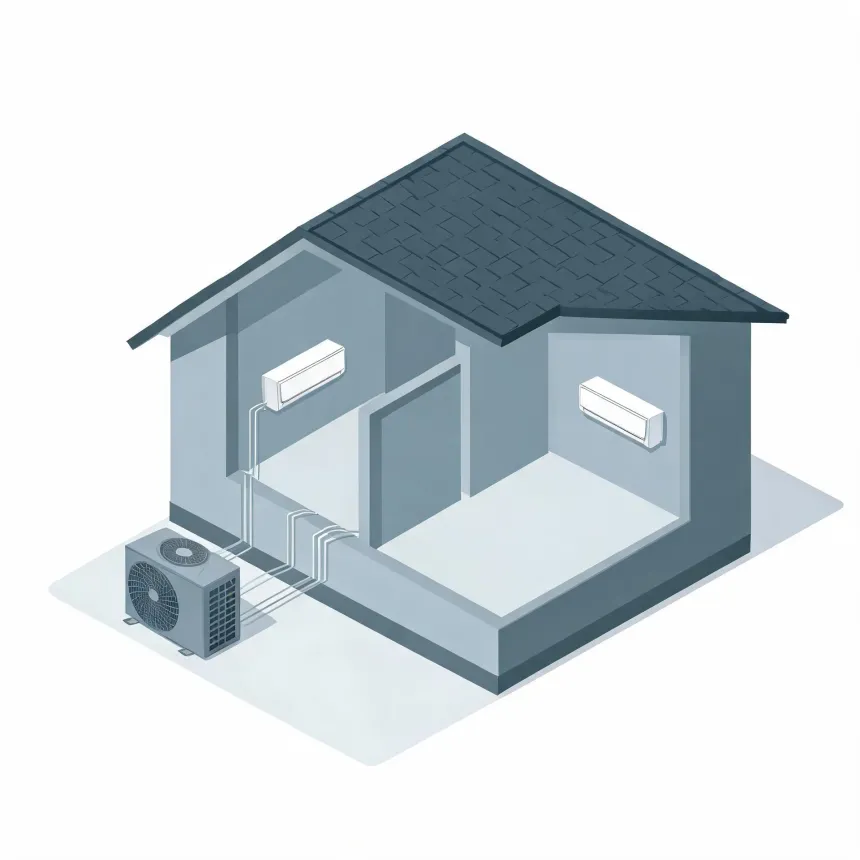
Most homes here keep a furnace for the coldest months and add a mini split for the rooms that need their own heating and cooling, like an addition, a garage, or a space the ductwork never reached.
NOAA nClimDiv, 1991–2020 normals
Cooling runs about three months here, June through August, with afternoon highs around 80°F.
A mini split in Racine County isn't working against a long, brutal summer, so a mid-range system holds up fine.




A standard mini split, sized to the room and installed correctly, is enough for a Racine home. Wisconsin homes paid 17.18 cents per kilowatt-hour for electricity in 2024, nothing that pushes you toward a pricier or more efficient unit than you'd buy anywhere else. Since the unit is covering one room or an addition rather than the whole house, the power it draws stays modest no matter which mid-range model you pick. Spend on the installation, the sizing and the placement of the indoor unit. That's what decides whether the room is comfortable, not a higher efficiency number on the spec sheet.
Every mini split installed here, ductless included, has to clear 14.3 SEER2 for cooling and 7.5 HSPF2 for heating under the federal standard. That floor applies everywhere, not just in zone 5A. A contractor can show you which units clear it and qualify for the federal tax credit.
Find a contractorThat line set on an old house still needs a spot to send condensate, a wall that can take it, and a breaker panel with room on it. None of that is a given in a house built in 1968 or earlier. A contractor who walks the room before quoting will catch it before it's a problem on install day.
Adding a mini split to a room means a new indoor unit on the wall and a line set running outside. Your furnace, your ducts, the rest of your heating stays exactly as it was. Nobody is pulling out equipment or capping anything off, because the mini split isn't there to take over, it's there to cover a room the rest of the system wasn't reaching.
If you're replacing central air or a furnace with mini splits instead of adding one on, that's a different job. The old equipment gets disconnected, drained if it's a refrigerant system, and hauled off. Old ductwork can stay in place for now or come out later, but either way that's a conversation about the whole house, not the single room most mini split installs are solving for.
A few numbers on a spec sheet won't tell you which system is right, so ask what matters more. Start with the number of zones you need and how many indoor heads that means, since each room with its own head runs independently instead of forcing one setting on the whole space. Ask where the outdoor unit will sit and how long the line set run to each indoor head will be, because a longer run can affect performance. Ask about the sound rating of the indoor unit, since some sit near a bed or a desk and the compressor hum matters up close. Ask what happens if one indoor head needs service, whether the rest keep running or the whole system shuts down. And ask who is doing the vacuum and charge on the line set, since a mini split that isn't charged correctly will never hit the comfort or the efficiency it's rated for, no matter how good the unit is.
Sizing a mini split starts with the room, not a chart. A contractor measures the space, checks the windows, checks how many outside walls it has, and checks what's on the other side of the ceiling, because a room under an attic loses and gains heat differently than one with another room above it. Too big and the unit short cycles, reaching the set temperature and shutting off before it's pulled any humidity out of the air, leaving the room feeling cool but damp. Too small and it runs flat out all afternoon without ever catching up. Either way you feel it, not on the spec sheet, but sitting in the room. The right size isn't the biggest head that fits the wall. It's the one matched to the heat the room actually gains and loses.