Storms come through often
Grant County logged 186 severe weather events between 2015 and 2024, including 113 damaging wind events, 36 hail events and 7 tornadoes. That's the backdrop for any outdoor unit installed here.
Takes about a minute. No obligation.
Grant County logged 186 severe weather events between 2015 and 2024, including 113 damaging wind events, 36 hail events and 7 tornadoes. That's the backdrop for any outdoor unit installed here.
18% of Wisconsin households went at least 24 hours without power in 2024. A mini split runs on electricity for both heat and cooling, so an outage here is worth planning for before the install, not after.
NOAA nClimDiv, 1991–2020 normals
Cooling in Platteville starts in June.
Installing before May gives the work time to get done before the first hot week.




Grant County sits in climate zone 5A, which the 2021 energy code treats as cool with heating as the bigger job. Any mini-split installed here has to be a heat pump built for that, not just a cooling unit with a backup strip. Federal rules back this up directly. A split system heat pump manufactured from 2023 onward has to deliver at least 7.5 Btu of heat for every watt-hour it uses over the winter, and at least 14.3 Btu of cooling per watt-hour over the summer. Those are floors, not targets, so a contractor sizing a system for this area is already working within them.
Pick the install spot with outages in mind. A mini split needs power to heat and cool, so a generator hookup or at least a clear plan for a bad outage belongs in the same conversation as the install. The outdoor unit also needs a spot clear of falling ice and branches, not just convenient ductwork.
Find a contractorHalf the homes in this county went up in 1973 or earlier. If that includes yours, the install is less about picking a unit and more about figuring out where the lines and the outdoor pad actually work with a house that age. A contractor sizing the system will want to see the electrical panel before anything else, since a mini split needs a dedicated circuit and an older panel may not have one free. None of that shows up in a time-lapse, but it's the first thing that decides how the job goes once the crew is on site.
A mini split won't run without power, and standard installs don't include battery backup. Ask whether the system can be wired to work with a generator or a battery backup, and whether that has to be planned now or can be added later. Some outdoor units also need a soft start or specific breaker setup to run on generator power at all, so this is worth settling before the lines go in, not after.
A heat pump's cooling capacity and its heating capacity aren't the same number, and the heating side is what matters most in a cold climate. Ask what the unit is rated to deliver at low outdoor temperatures, not just at mild ones, and whether it holds output as the temperature drops or starts to taper off. A system sized only off a summer load calculation can come up short the first hard freeze.
What drives the cost of a mini split install is mostly hidden work, not the unit on the wall. Running line sets and wiring from the outdoor condenser to each indoor head takes labor, and that labor scales with how far apart they are and how many walls or floors the lines have to cross. A single-zone system with a short run costs less to install than a multi-zone setup feeding several rooms, because each indoor head needs its own line set, its own mounting, and its own spot on the electrical circuit. The electrical work matters too. If the panel has room for a dedicated circuit, that's straightforward, but a panel that's full means adding capacity before the mini split can even be wired in. Mounting the outdoor unit also varies. A ground pad is simple, but a wall bracket or a roof mount takes more time and material. None of this shows up in the price of the equipment itself, but all of it shows up in the invoice.
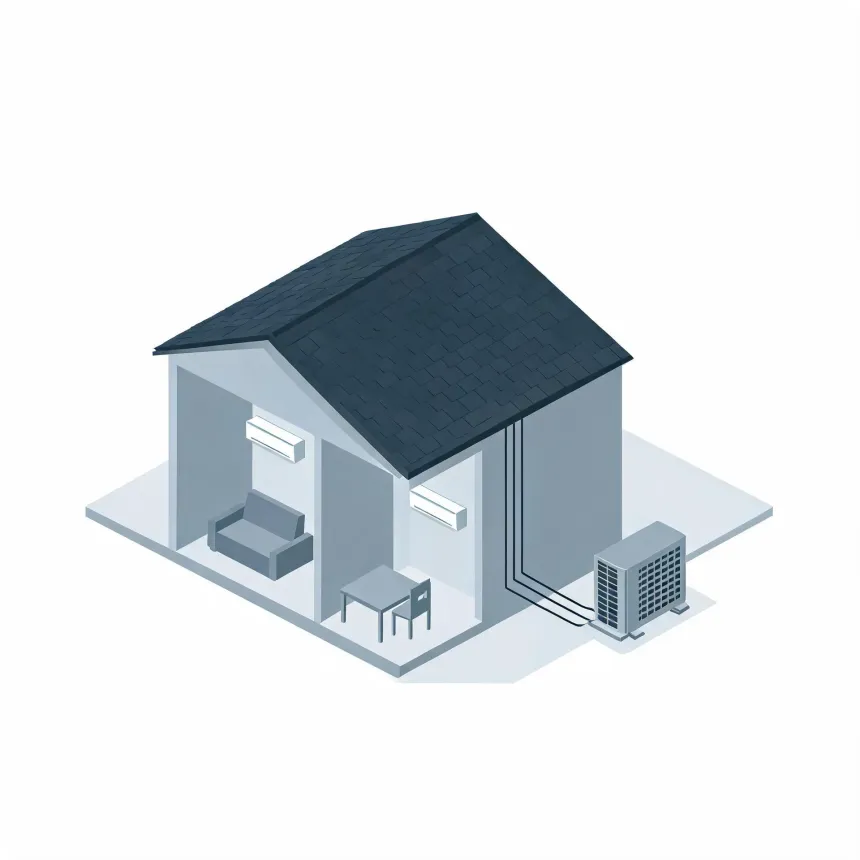
Installation starts with a survey, not a drill. A contractor walks the space, picks the indoor head locations, and traces where the line set and drain line will run to reach the outdoor unit. Once that's settled, the crew mounts the indoor unit's bracket, cores a hole through the wall at a slight downward angle so condensation drains outside instead of back in, and feeds the line set, drain line and electrical wiring through it. Outside, the condenser gets set on its pad or bracket, the lines get connected, and the whole system gets vacuumed down to pull out moisture and air before any refrigerant moves through it. That step matters: trapped air or moisture in the lines can damage the compressor once the system runs. From there it's a pressure test to check for leaks, a charge of refrigerant if the line length calls for it, and a run-through of heating and cooling modes before the crew calls it done.