






A quiet suburban street at twilight featuring two-story brick homes with illuminated windows and large trees lining the sidewalk.

Mini Split Installation in Monroe, WI

Tell us about the job

Takes about a minute. No obligation.

New system or replacementMini-splitGreen County, WI
Step 1 of 2

What ZIP code is the job in?

Just over half the homes in Green County heat with utility gas, and most of the rest run on LP gas or electricity. A mini split doesn't compete with that setup, it adds to it. In a house with a gas furnace, a mini split handles cooling and takes over heating on the mild days in spring and fall, so the furnace only has to run when it's actually cold. In a home that heats with electric resistance or LP, a mini split can carry more of the load, since it moves heat rather than making it. Either way, check what your house already has before deciding how many zones you need and where they should go.

8 months
October through May, your system heats
3 months
June through August, it cools
15°F
the average winter night it heats against
81°F
the average summer afternoon it cools against
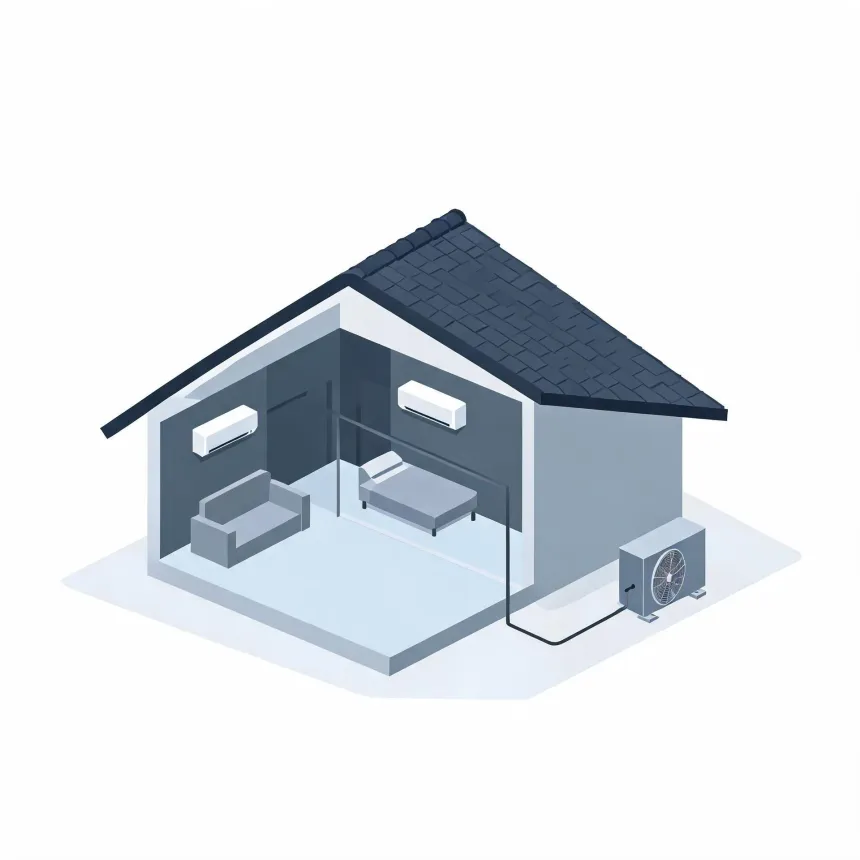
Isometric illustration of a cutaway house showing two wall-mounted indoor air conditioning units connected by a line to an outdoor condenser unit beside the building, with a sofa and bed inside.
Your system heats October through May and cools June through August.

NOAA nClimDiv, 1991–2020 normals

Electricity here runs 17.18 cents per kilowatt-hour.

A standard-size mini split keeps that cost in check. There's no reason to size up.

Half the homes in Green County were built by 1972. A mini split still has to match the one you've got.

Half the homes here were built by 1972
Cooling runs June through August
Summer afternoons average 81°F
Cooling starts in June hereGet it installed by May, before Green County needs it.

Green County is zone 5A, a cool climate where the furnace carries more of the year than the air conditioner does. Any mini split installed here still has to meet the federal minimum for a split-system heat pump, since the standard doesn't treat ductless units as their own category. That means 14.3 SEER2 for cooling and 7.5 HSPF2 for heating, for any unit built from 2023 on. A system rated below that can't legally go in. That's separate from whether gas or electric makes more sense for your house, but it means the units on the table are already held to a real floor, not just whatever a supplier has on hand.

Three months of cooling a year. Size for that, not more.

Summer here runs June through August, with afternoon highs averaging 81°F. That's three months of mild work, nothing like the load a mini split carries in a hot climate. The rest of the year, Green County leans on heat more than cooling, so this is a system that gets an easy summer and an easier life than it would somewhere hotter. A unit built to the federal minimum and sized for your rooms will handle what this place asks of it.

Find a contractor
A man in a dark T-shirt and brown work pants carries a canvas tool bag up wooden porch steps toward a green front door, beside a potted shrub.
A white outdoor air conditioner condenser unit mounted on metal wall brackets against gray horizontal siding, with a blue sky and white clouds behind it.

The new system goes in. The old one doesn't disappear on its own

An old system doesn't get hauled off the moment the new one goes in. Whoever installs the mini split still has to deal with what's on the wall or in the closet already, whether that's a window unit, a baseboard system, or a furnace staying put for backup heat. If a furnace or boiler stays, the mini split just takes over part of the load and the old equipment runs less than it used to. If something is actually coming out, like an old through-the-wall unit or electric baseboard, that removal is its own step, and it's worth asking whether it's included in the quote or billed separately. Refrigerant from an old system can't just get vented. It has to be recovered properly, so if what's coming out is itself a heat pump or an air conditioner, ask how that part gets handled. None of this is complicated, but it's easy to assume it's included when it isn't.

SEER2 and HSPF2 are separate jobs

SEER2 is the cooling number and HSPF2 is the heating number. A mini split carries both because it does both jobs, pulling heat out of the house to cool it and pulling heat in from outside to warm it. A higher number on either side means the compressor moves more heat for the electricity it draws, not that the unit cools or heats faster.
The rating comes from a lab, not your living room

SEER2 and HSPF2 are measured under fixed test conditions, not in the house the unit ends up in. A unit sized right for the room and installed with a clean, properly charged line set gets close to that rating. One with a long or kinked refrigerant line, or a head that doesn't match the room, won't. The label says what the equipment can do. The install decides how much of that you get.

What drives the price isn't just the indoor head on the wall. It's the line set run between that head and the outdoor unit, how far it has to travel, how many walls or floors it crosses, and whether that path is simple or has to thread around framing and finished surfaces. More heads means more cost, since each zone needs its own indoor unit, its own line set, and its own spot on the outdoor unit's capacity. The electrical work matters too. Some systems need a dedicated circuit, and whether your panel has room for that changes the job. Where the outdoor unit sits counts as well, since a long walk from panel to pad or awkward mounting adds labor without adding anything you can see. None of this shows up in the sticker price of the equipment itself. It shows up once someone's measured your walls and your panel and knows what the install actually asks for.

Install day starts outside, deciding where the outdoor unit sits and where the line set can run to reach it without a long detour through framing or finished walls. Indoors, the installer mounts a bracket for the head, drills a single hole through the wall for the line set, and runs the refrigerant lines, the condensate drain and the electrical whip through that one opening. The lines get connected at both ends, then the system gets evacuated with a vacuum pump to pull out air and moisture before any refrigerant moves through it. That step matters more than it looks. Moisture or air left in the lines shows up later as a loss of capacity or a compressor that wears out early. Once the vacuum holds, the refrigerant charge gets set to match the length of the line run, and the system gets powered up and tested on both heating and cooling before anyone calls it done.