





A row of dark-sided single-story houses behind a long trimmed hedge, with mown lawn, a paved path and large leafy trees under an overcast sky.

Mini Split Installation in Chippewa Falls, WI

Tell us about the job

Takes about a minute. No obligation.

New system or replacementMini-splitChippewa County, WI
Step 1 of 2

What ZIP code is the job in?

Gas heats close to half the homes in Chippewa County, and another quarter run on LP gas, since not every home here has a gas line to the street. A mini split doesn't replace either one. It takes over the cooling that a furnace was never built to do, and in spring and fall it can carry the heating on its own, so the furnace sits off until the cold really sets in. That matters for a propane furnace as much as a gas one, since both are built the same way and both can take a break while the mini split handles the milder months. You're adding the one thing your current system doesn't do, not swapping out what already works.

9 months
September through May, your system heats
2 months
July through August, it cools
8°F
the average winter night it heats against
78°F
the average summer afternoon it cools against
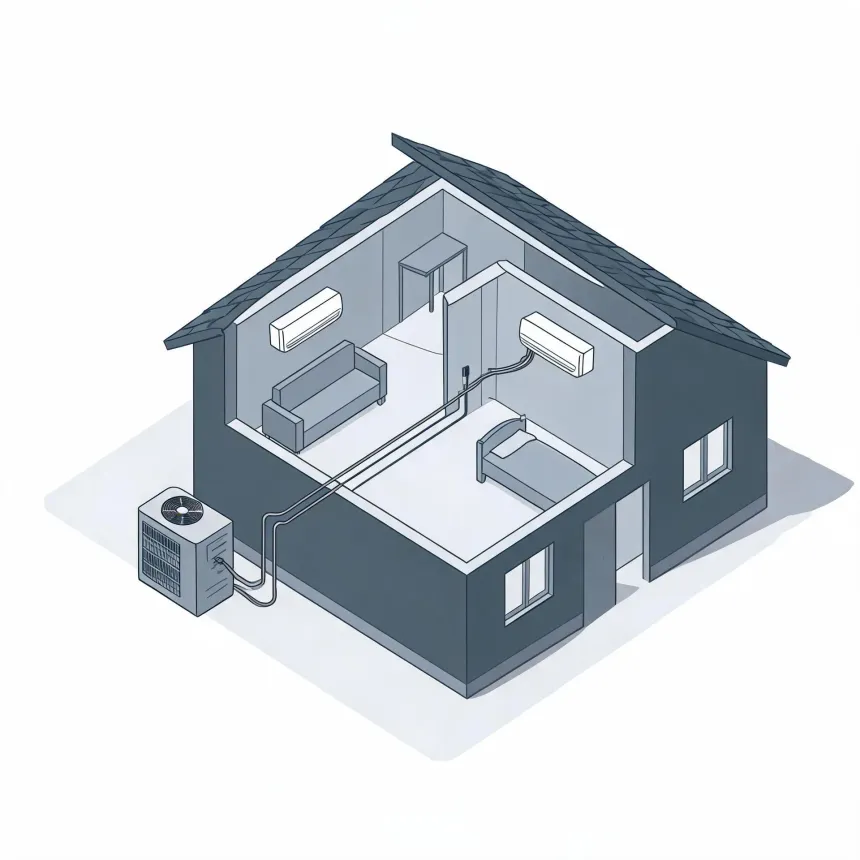
Isometric cutaway illustration of a small house showing two wall-mounted indoor air conditioning units connected by line sets to an outdoor condenser unit beside the exterior wall, with a sofa in one room and a bed in another.
Your system heats September through May and cools July through August.

NOAA nClimDiv, 1991–2020 normals

Cooling in Chippewa Falls runs about two months, July and August, with afternoons around 78 degrees.

A mini split here isn't fighting a long, brutal summer, so a mid-range system holds up fine.

78°F afternoons and two months of cooling don't call for anything bigger than standard

Power costs 17.18 cents a kWh statewide
Cooling runs July through August
Summer afternoons average 78°F
Have it in before JulyCooling starts in July here, so June is the month to get a mini split installed.

Half the homes in Chippewa County were built in 1978 or earlier, half in 1978 or later. That split doesn't point an install one way or another. What decides the size of a mini split is the room it's conditioning, not when the house went up. An older home might lose a bit more heat through the windows on a cold night, but that's the furnace's job, not the mini split's. Sized to the room, a standard single-zone or multi-zone system handles the cooling load here regardless of when the house was built.

Meet the standard here

A new system here has to meet this region's minimum efficiency, which limits what can go in.

Find a contractor
A man in a cap, long-sleeve shirt and brown work pants carries a worn canvas tool bag up porch steps toward a green front door, with a potted shrub beside the entry.
A beige split-system air conditioner outdoor condenser unit mounted on metal wall brackets atop a stucco wall.

Light duty, most of the year

Two months of real cooling load a year is not much wear. The compressor outside spends most of its life idle, and even in July and August it's cycling against 78 degree afternoons, not running flat out. A mid-range mini split holds up fine against that kind of year. The wind and hail that come through this county are harder on the outdoor unit than the cooling ever will be, so a storm is more likely to bring it in for service than the summer heat is.

Sized to the room, not the house

A contractor works out mini split size with a load calculation on the room it's conditioning. Square footage, window area, which way the room faces, what's above and below it all factor in. A bedroom over a garage loses and gains heat differently than one over a heated basement. Get the size wrong and comfort suffers either way. Too big and the unit cools the air fast, shuts off, and leaves the room clammy because it never ran long enough to pull moisture out. Too small and it runs flat out on the hottest afternoons and still can't catch up.
More zones means more math, not more guessing

A multi-zone system splits one outdoor compressor across several indoor heads. Each head still gets sized to its own room the same way a single zone would. The outdoor unit then gets matched to the total of all the zones running together, not just added up on paper. A contractor who skips that step and eyeballs the whole house ends up with some rooms freezing and others never quite comfortable, no matter how good the equipment is.

When you're comparing quotes, ask what's actually being compared. A contractor should walk every room getting a head and explain why that spot, not just hand over a price for a box on the wall. Ask what happens to the line set and the drain line, since those run through a wall or up an exterior side and a sloppy install shows on the outside of the house for years. Ask where the outdoor unit sits and why there, because clearance for airflow and service access matters more than keeping it out of sight. If it's a multi-zone quote, ask how they sized the outdoor unit against the total load of all the heads running at once, not just the sum of each room on paper. And ask who services it after the install, since a mini split still needs the coils and filters checked like any other system.

Installation day starts outside, with the outdoor unit set on a pad or wall bracket somewhere it can get clean airflow on all sides. Inside, each indoor head gets mounted high on a wall, usually near the spot the line set can reach without too many bends, since every bend makes the refrigerant work harder to move. The line set, the drain line and the electrical run all go through a single small hole in the wall, then get sealed against weather and pests. Once the lines are connected, the system gets evacuated with a vacuum pump to pull out moisture and air, because any left behind damages the compressor over time. Only after it holds a vacuum does refrigerant go in. The last step is running it through both heating and cooling, checking the temperature split at each head, and confirming the drain line actually clears condensation before anyone calls it done.