





A dark, minimalist bedroom featuring a sleeping cat on a grey-quilted bed, a wall-mounted air-conditioning unit, warm cove ceiling lighting, and a pendant lamp illuminating the bedside table.

Mini Split Installation in Baraboo, WI

Tell us about the job

Takes about a minute. No obligation.

New system or replacementMini-splitSauk County, WI
Step 1 of 2

What ZIP code is the job in?

Utility gas heats 56.1% of the homes in Sauk County, with LP gas and electricity splitting most of the rest. A mini split doesn't replace a gas or LP furnace, it adds a way to cool rooms that system never reached, and heat them without running ductwork to get there. In a gas or LP home, the furnace stays as backup for the coldest stretch of winter and the mini split carries the shoulder months on its own. In an electric home, it can end up doing most of the work year round, since it moves heat instead of generating it from resistance coils.

8 months
October through May, your system heats
3 months
June through August, it cools
13°F
the average winter night it heats against
80°F
the average summer afternoon it cools against
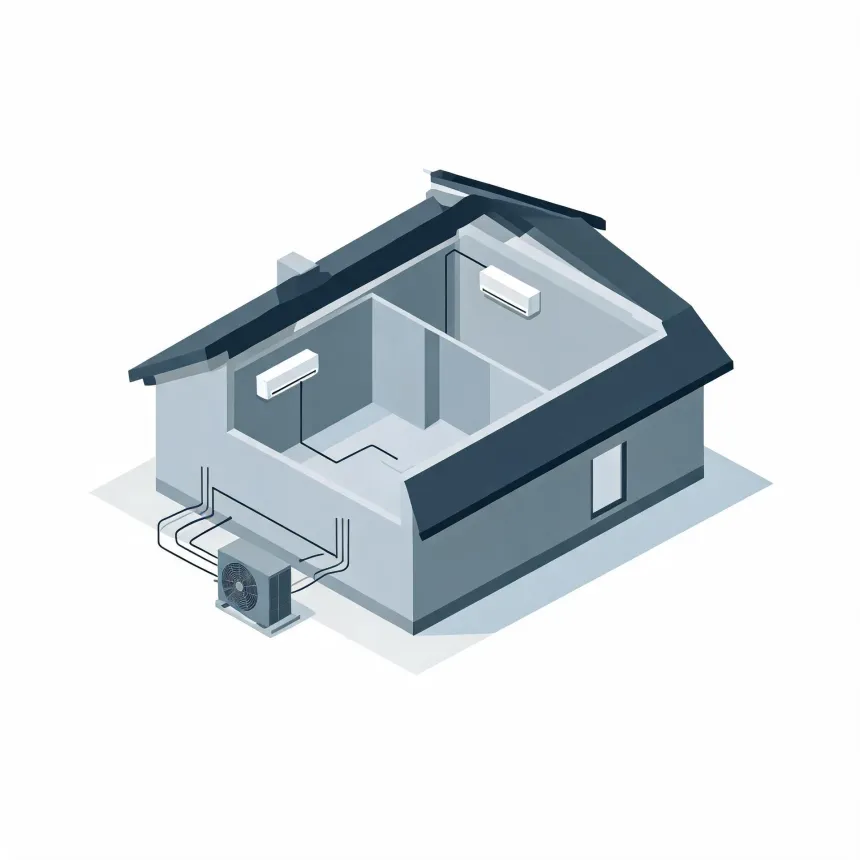
Isometric illustration of a cutaway house showing two wall-mounted indoor air conditioning units connected by line sets to an outdoor condenser unit on the ground outside.
Your system heats October through May and cools June through August.

NOAA nClimDiv, 1991–2020 normals

Cooling runs June through August here.

Get the mini split in before June and it's running on the first warm day, not partway through one.

Three summer months don't ask much of a mini split's outdoor unit

Cooling runs June through August
Summer afternoons average 80°F
61 damaging wind events from 2015 to 2024

Ask how many zones the system is actually sized for, not just how many heads it has. Every indoor head needs its own number for the room it serves, based on the windows, the ceiling height and what's on the other side of the walls. If a contractor gives you one number for the whole house and splits it evenly across heads, that's a shortcut, not a design. Ask what happens to the line set and the drain line, and where they'll run outside, since that's often the difference between a clean install and one with a conduit box bolted to the siding where you'll see it every day. Ask what the warranty covers if something other than the installing contractor ever opens the system up. Ask how the outdoor unit is rated to perform at the coldest temperature your winters actually reach, not just its listed capacity at a mild outdoor temperature, since that number drops as it gets colder outside.

A right-sized mini split is the one to install here

At 17.18 cents per kilowatthour, a correctly sized system matters more than an oversized one. A unit sized to the room cools and heats it without working harder than it needs to. There's nothing about the electric rate here that calls for a bigger system or a higher-end one, just one sized right for the space it's covering.

Find a contractor
A man seen from behind in a backward cap, dark jacket and tan work pants carries a waxed canvas tote bag up steps toward a green front door, with a potted shrub beside the entry.
A white mini-split air conditioner outdoor condenser unit mounted on metal brackets against a beige stucco exterior wall, with a blue sky and scattered clouds in the background.

Sized for the room, not guessed at

A mini split gets sized room by room, not by a rule of thumb. The contractor measures the room the head will serve. Floor area, ceiling height, how many windows it has and which way they face, whether it shares a wall with a garage or attic that isn't heated or cooled. All of that goes into a load calculation for that specific room, and the result is what size head belongs there. Skip that step and you end up with a head too big for its room, which sounds harmless but isn't. An oversized head cools the room fast, shuts off, then kicks back on a few minutes later. It never runs long enough to pull moisture out of the air, so the room ends up cold and damp at the same time. A head sized right runs longer, steadier cycles and actually dries the air while it cools it. Undersized works against you too, since it runs constantly and still can't keep up on the hottest afternoon. The fix isn't a bigger unit bolted on later. It's getting the number right for each room before anything goes on the wall.

The old furnace or AC doesn't have to go anywhere

A mini split can go in alongside an existing furnace or central air system without either one being pulled out. If the old system still runs, it can keep serving the rooms it already covers while the mini split takes on new zones. Nothing about adding a mini split forces a decision on equipment that still works.
A full replacement is a different job

If the plan is to take out a central air system entirely and move to mini splits for the whole house, the old outdoor condenser, the indoor coil and the ductwork tied to cooling all come out or get capped off. That's a bigger scope than adding a zone, and it changes what the contractor needs to account for in the install, not just what equipment goes in.

What makes one installation cost more than another usually comes down to the install itself, not the equipment. Running the line set and the drain line in a straight, short path costs less than snaking them through a wall cavity or across a long stretch of siding to reach the outdoor unit. A mounting spot that already has a clear path for the electrical whip and an easy place to set the outdoor unit costs less than one tucked where the crew has to work around a deck or dig a trench. The number of indoor heads matters too, since each one needs its own run of line set and its own spot on the wall or ceiling calculated for that room. A multi-zone system with heads spread across different parts of the house takes more time to install than a single head doing one room, even with the same total capacity.

Installation day starts with the outdoor unit and the indoor heads going up in the spots marked out ahead of time, not decided on the fly. The line set gets run first, connecting each indoor head back to the outdoor unit. Then it gets pressure tested before anyone touches the refrigerant, left to sit and hold for a while. A line set that holds pressure means no slow leak waiting to show up down the road. Once it passes, the system gets evacuated to pull all the moisture and air out of the lines, then charged with refrigerant to the weight the manufacturer specifies for that length of line. Last comes commissioning, checking that each head reads the room correctly and responds to its own thermostat or remote. A contractor who skips the vacuum step is the reason some mini splits freeze up or quit working within the first year.