





A row of dark-sided single-story houses with gabled shingle roofs behind a long trimmed hedge, with mown lawn in the foreground and large leafy trees overhead under an overcast sky.

Mini Split Installation in Amery, WI

Tell us about the job

Takes about a minute. No obligation.

New system or replacementMini-splitPolk County, WI
Step 1 of 2

What ZIP code is the job in?

Most homes in Polk County run on bottled, tank or LP gas, 42% of them. Another third are on utility gas. A mini split does not replace that system. It gives you a way to heat or cool one room, or a few, without running new ductwork off a furnace that is already doing its job. That matters here because so few homes have central air to begin with. Electric heat only covers 14% of the county, so most of these houses were never built to cool themselves. A mini split fills that gap directly, with its own line set and its own outdoor unit, whatever fuel is already in the house.

9 months
September through May, your system heats
3 months
June through August, it cools
7°F
the average winter night it heats against
79°F
the average summer afternoon it cools against
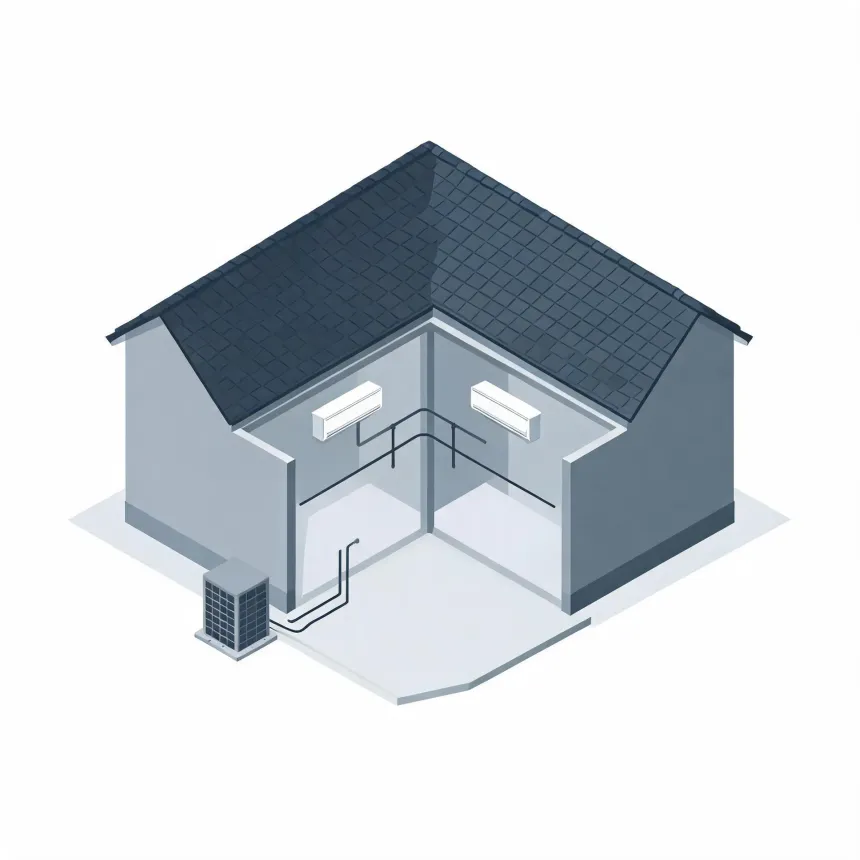
Isometric illustration of a cutaway gray house with a dark shingled roof, showing two wall-mounted indoor air conditioning units connected by piping to an outdoor condenser unit on the ground outside.
Your system heats September through May and cools June through August.

NOAA nClimDiv, 1991–2020 normals

A mini split sized by square footage alone is already wrong.

The load depends on how many walls face outside, how much glass is in the room, and what's above and below it, so a contractor works that out room by room, not off a chart.

Cooling starts in June here. Get the mini split in before it does.

Cooling runs June through August
Summer afternoons average 79°F
42 damaging wind events from 2015 to 2024
Three months of real workAfternoon highs average 79°F here, June through August. That's what the system has to meet.

A mini split for one or two rooms doesn't need an oversized unit to do its job here. Wisconsin's electricity ran 17.18 cents per kilowatt-hour in 2024, and the size a contractor settles on after the room by room check is the size that keeps a unit running efficiently against that rate. Going bigger doesn't heat or cool the room faster. It just cycles on and off more, which wastes power rather than saving it. There's nothing about Amery that calls for a larger unit or a higher-end one. The standard sizing works the way it's supposed to here.

Any new system here has to clear zone 6A's minimum

A new mini split here has to meet the federal split-system minimums, 14.3 SEER2 for cooling and 7.5 HSPF2 for heating. That's what Polk County's zone 6A rating requires for units built from 2023 on, and it narrows what can legally go in. A federal tax credit is available on top of that for units that qualify.

Find a contractor
A man in a dark shirt and tan work pants, seen from behind, climbs porch steps toward a green front door while carrying a waxed canvas tool bag, with a potted evergreen shrub to the left.
A beige split-system air conditioner outdoor condenser unit mounted on metal wall brackets atop a stucco wall.

Three months, not a hard season

Three months of cooling a year, June through August, is not much time for a mini split to work against. The outdoor unit sits idle most of the year and only has to meet 79°F afternoons for that one stretch. That's a light enough load that a reliable, standard unit sized to the room handles it fine. You don't need to pay up for a bigger compressor or a top-tier model to cover Amery's summers.

Ask what each number means

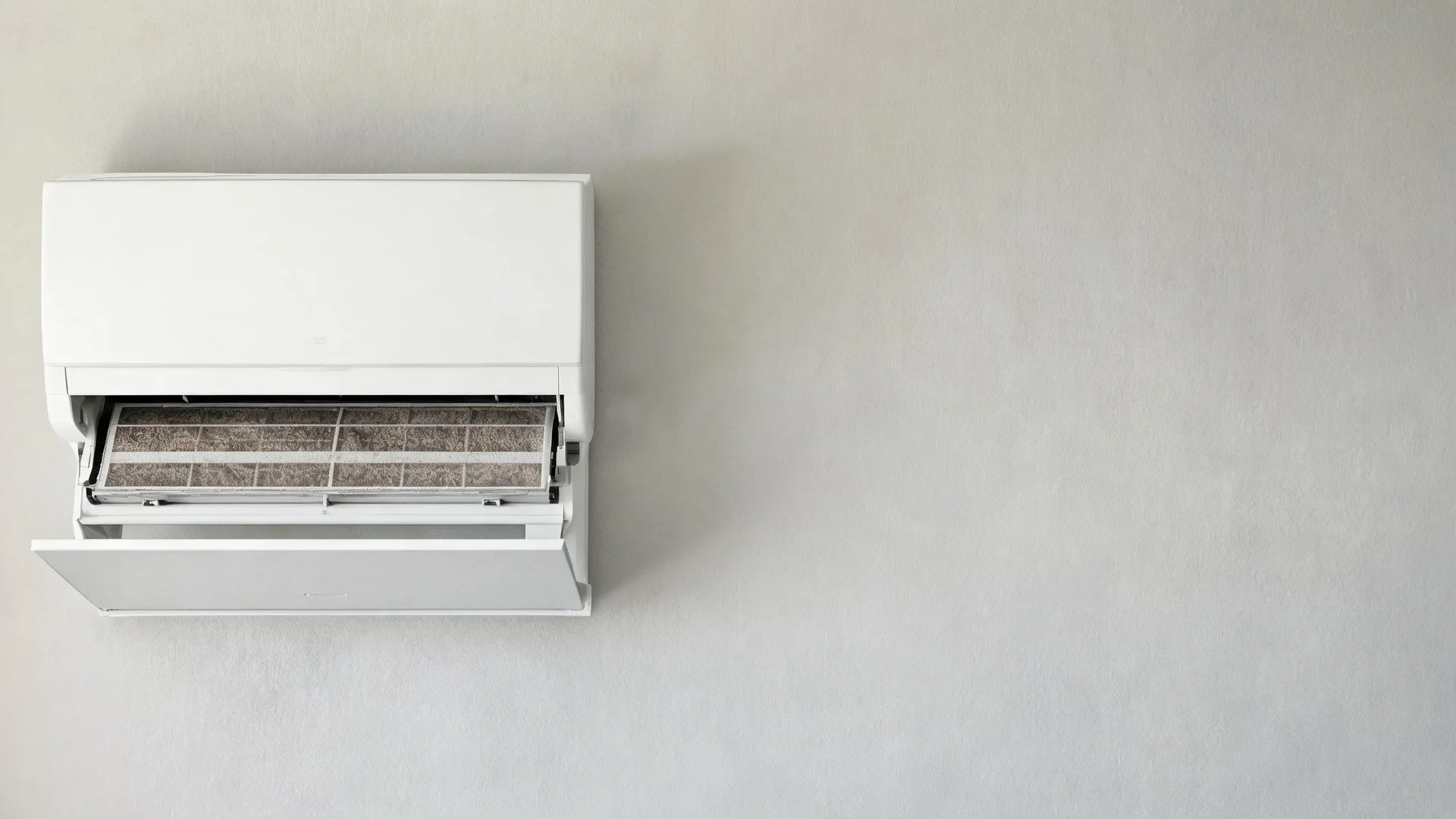
A quote should list the outdoor unit's capacity and the indoor head's capacity separately, not just a brand and a price. Ask what SEER2 and HSPF2 numbers the system carries, since those decide what it costs to run, not just whether it meets the minimum. Ask how many indoor heads the outdoor unit can support, since a single-zone and a multi-zone outdoor unit look alike but aren't interchangeable.
Ask what happens after the install

Ask who services the line set and the refrigerant charge if something goes wrong, since not every contractor who installs a mini split also handles warranty repair on it. Ask what the warranty covers if the unit was never registered, because some manufacturers shorten coverage automatically when that step gets skipped. Ask where the condensate line drains to, since a mini split that's only vented indoors can back up over time.

SEER2 and HSPF2 are ratios, not a guarantee of what you'll pay. They compare the heat moved to the power it took to move it, so a higher number means less electricity for the same cooling or heating. They don't tell you how many hours the unit runs or how hard it has to work in your rooms, so a home with more sun on the windows or more people in and out of a room can see a different result than the label suggests. The rating also only holds if the unit is sized and charged correctly. An oversized unit with a high rating still cycles on and off more than it should and loses the efficiency the label promises. The number describes the equipment, not the installation.

Installation day starts with the walls, not the box. The indoor head needs a clear run to the outdoor unit for the line set, so the contractor picks the spot, drills through, and runs the refrigerant lines, the condensate drain, and the electrical whip together through that one hole. The line set gets connected at both ends, then the system is pressure tested before anything is charged, to catch a bad flare fitting while it's still easy to fix. After that it's pulled down to a vacuum to clear out moisture and air, since either one left behind keeps the system from running the way it's rated to. Only then does the refrigerant get released into the lines. The outdoor unit goes on a pad or wall brackets, leveled so condensate drains the way it should, and the whole thing gets powered up and run through both heating and cooling before the contractor calls it done.