Running clear
This is what a mini split looks like when it's keeping up. Air moves freely across the coil, the fan turns without strain, and the unit cycles on and off as the room calls for it. Nothing on the case hints at trouble underneath.

Send one request and you're done looking
A frozen mini split in a Green Bay winter usually means the system can't pull heat the way it needs to. Ice on the coil or the outdoor unit points to a handful of causes, and the fix depends on which one it is. Instead of calling around Brown County to find someone who can look at it, send the form once and let a contractor come to you.
Send my requestA frozen mini split usually means ice has built up on the outdoor unit's coil, and once that happens the system can't move heat the way it should. In a Green Bay winter, the outdoor unit works hard pulling heat from air that's already near freezing, and frost forms faster than normal defrost cycles can clear it. A few things cause this: a defrost control that's failed, a fan that's not turning, low refrigerant, or a coil that's dirty enough to trap frost instead of shedding it. Running the system while it's iced over doesn't thaw it out. It strains the compressor and can shorten the life of the unit. The ice itself tells you something is wrong with the cycle, not that the cold outside is simply too much for the system to handle. Until the cause is found, the unit won't heat the way it's supposed to, no matter how long it runs.




Cooling runs July through August
Two months of cooling is a short stretch, which is why a frozen outdoor unit in winter catches people off guard here.
Heat runs September through May
Nine months of heat means your mini split spends most of the year pulling warmth from cold air, and that strain is where freezing starts.
Power here costs 17.42 cents per kilowatt-hour
At 17.42 cents per kilowatt-hour, a mini split icing up and running inefficiently shows up fast on your power bill.
NOAA nClimDiv 1991-2020 · EIA-861 2025

This is what a mini split looks like when it's keeping up. Air moves freely across the coil, the fan turns without strain, and the unit cycles on and off as the room calls for it. Nothing on the case hints at trouble underneath.

Dust built up on the casing and vents like this usually means buildup inside too, on the coil and the filter behind it. That buildup blocks airflow, and a coil that can't breathe is more likely to ice over once temperatures outside drop toward freezing.
You'd notice it on the outdoor unit first, a white or gray crust over the coil, sometimes thick enough to cover the fan blades. Inside, the room near the indoor head feels off, blowing cool or barely moving air even with the heat turned up. You might hear the fan straining or catch a hum that wasn't there before. Left alone through a Green Bay winter, that ice keeps building, and the compressor ends up working against it instead of heating your home. A unit that runs like that for long can end up damaged, and you're left with a bigger repair than the one you started with.
The outdoor unit senses coil temperature dropping toward freezing.
A defrost cycle starts and the reversing valve switches direction.
The system briefly runs in cooling mode to push heat through the coil.
The outdoor fan slows or stops so heat isn't carried away.


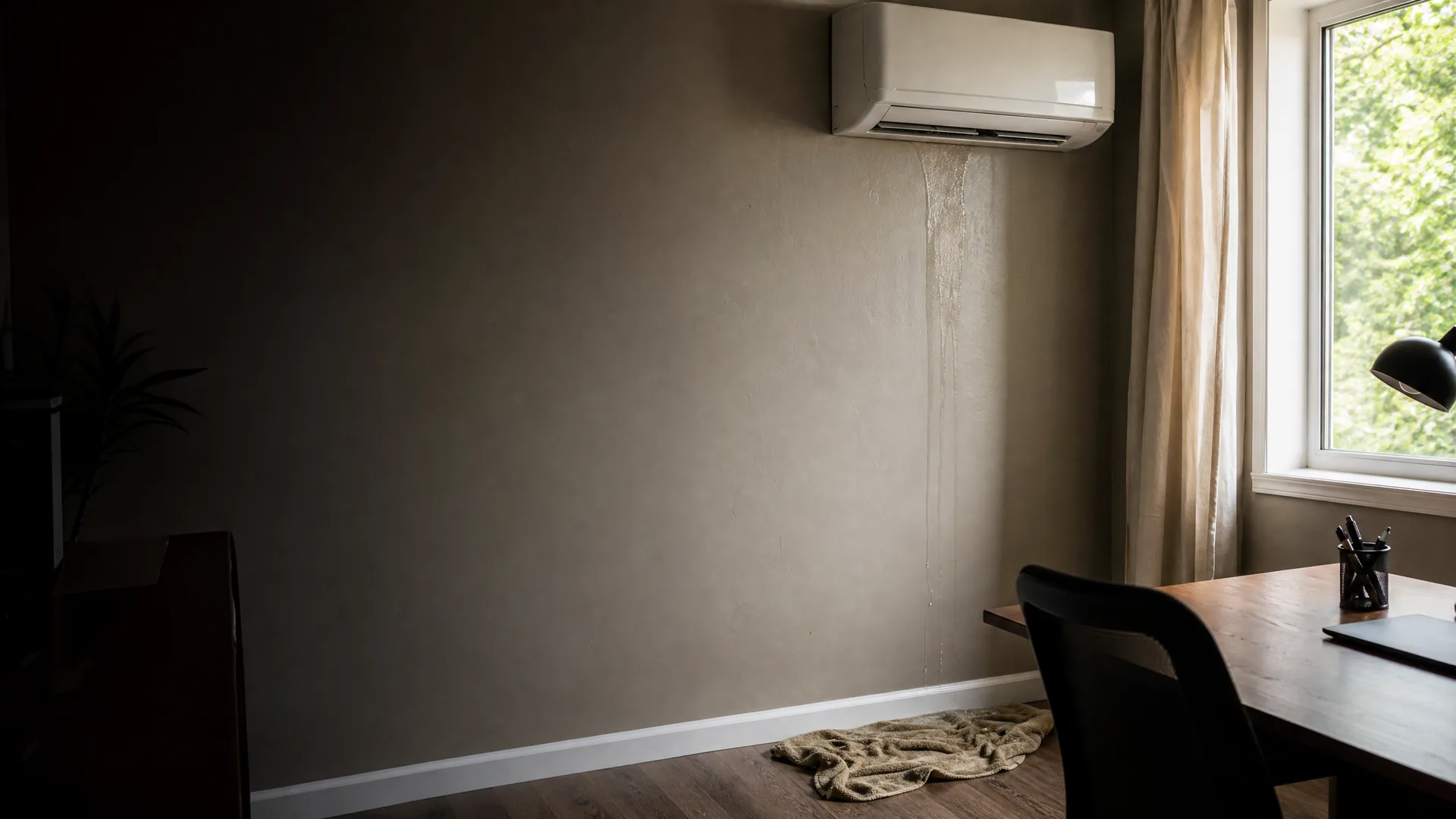
It's late afternoon, a July heat wave outside, and you're at your desk in the home office when you notice the carpet feels damp under your chair. You look up and see it: a wet streak running down the wall below the indoor unit, starting at the bottom corner and spreading toward the baseboard. You grab a towel from the hall bathroom and lay it on the floor, then pull the desk chair back so the cord isn't sitting in the wet spot. The unit's still blowing, but the air coming out feels weak, barely cool against your hand. Outside, Brown County is having one of its few real summer afternoons, and the last thing you expected was water coming from the unit instead of cold air.

This is a mini split moving air without a fight. The wall unit sits high and clean, no streaking on the casing, and the room below it holds a steady temperature. Nothing about it asks for attention.

Yellowing and dust built up on the casing like this hold moisture against the unit instead of letting it dry. That film is where ice gets its start on the coil behind it, and it's worth a look before the unit freezes up on you.


A frozen mini split doesn't thaw itself out and stay fixed. Even if the ice clears, it points to something that needs a look, a defrost cycle not kicking in right, a low refrigerant charge, a fan that's lost its nerve in the cold. Figuring out which one means someone who knows the system has to see it, and that's the part that eats your evening: searching for a contractor who works on mini splits in Brown County, calling a few, describing the ice and the cold room to each one, then sitting with quotes trying to guess who actually knows what they're doing. Send the request once and that work is done. One contractor gets it, not five, and finding them stops being on you. Your mini split is still frozen tonight, and winter here isn't letting up. Getting someone looking at it sooner means fewer nights without heat where you need it.
A mini split's defrost cycle depends on the reversing valve switching cleanly and the outdoor fan cutting back at the right moment, both controlled by a sensor reading coil temperature.
When that sensor misreads, or the valve sticks, the system keeps running as if nothing's wrong while ice keeps building, which is why the unit can look fine from a few feet away and still be frozen solid underneath.
Two months of cooling means your mini split spends the other ten doing something else, and here that something else is heat. The same outdoor unit icing up on you now is the one that ran nearly nonstop since fall, so the parts under strain in winter have had a lot more time to wear than the ones that cool your house in July.
NOAA nClimDiv 1991-2020
You can shut the system down and let the ice melt without touching anything, which usually just means time. If the coil iced up because a filter was clogged or the outdoor unit had snow piled against it, clearing that once the ice is gone might be all it needed. But if the defrost cycle itself isn't kicking in right, or the refrigerant charge is low, the coil will just start icing again the next time it gets cold enough to run hard. You won't know which one you're dealing with just by looking at a bare coil. And every cycle running wrong in the meantime is wear on a compressor that already has nine months of Brown County winter ahead of it to get through.
A contractor checks the sensor that reads coil temperature, the reversing valve, and the refrigerant charge, the three things that actually cause a coil to freeze instead of defrosting on schedule. That tells you whether the system just needs a part replaced or whether it's been low on charge for a while, which is the kind of thing that keeps coming back until someone finds it. Instead of calling around Brown County hoping to reach someone who works on mini splits specifically, then waiting to hear back, then explaining the same ice-on-the-coil problem to the next one, sending one form here means the search part is no longer something you have to do yourself.



Ice on the outdoor unit tells you the system is struggling, not why. It could be the defrost cycle not kicking in, a low refrigerant charge, a sensor reading the coil wrong, or a fan that's slowed down in the cold. Some of those a homeowner can rule out by clearing snow or changing a filter. The rest need someone who can check the sensor, the valve and the charge, and in a Green Bay winter that system has to come back reliably, not just once.
Finding that person is usually the slow part, calling around Brown County, explaining what the unit is doing to one contractor after another, waiting on quotes to compare. None of that gets your mini split running again any faster. Once you're matched with a contractor, that work is done, and you're waiting on a diagnosis instead of waiting on a callback.


Let someone else find the pro