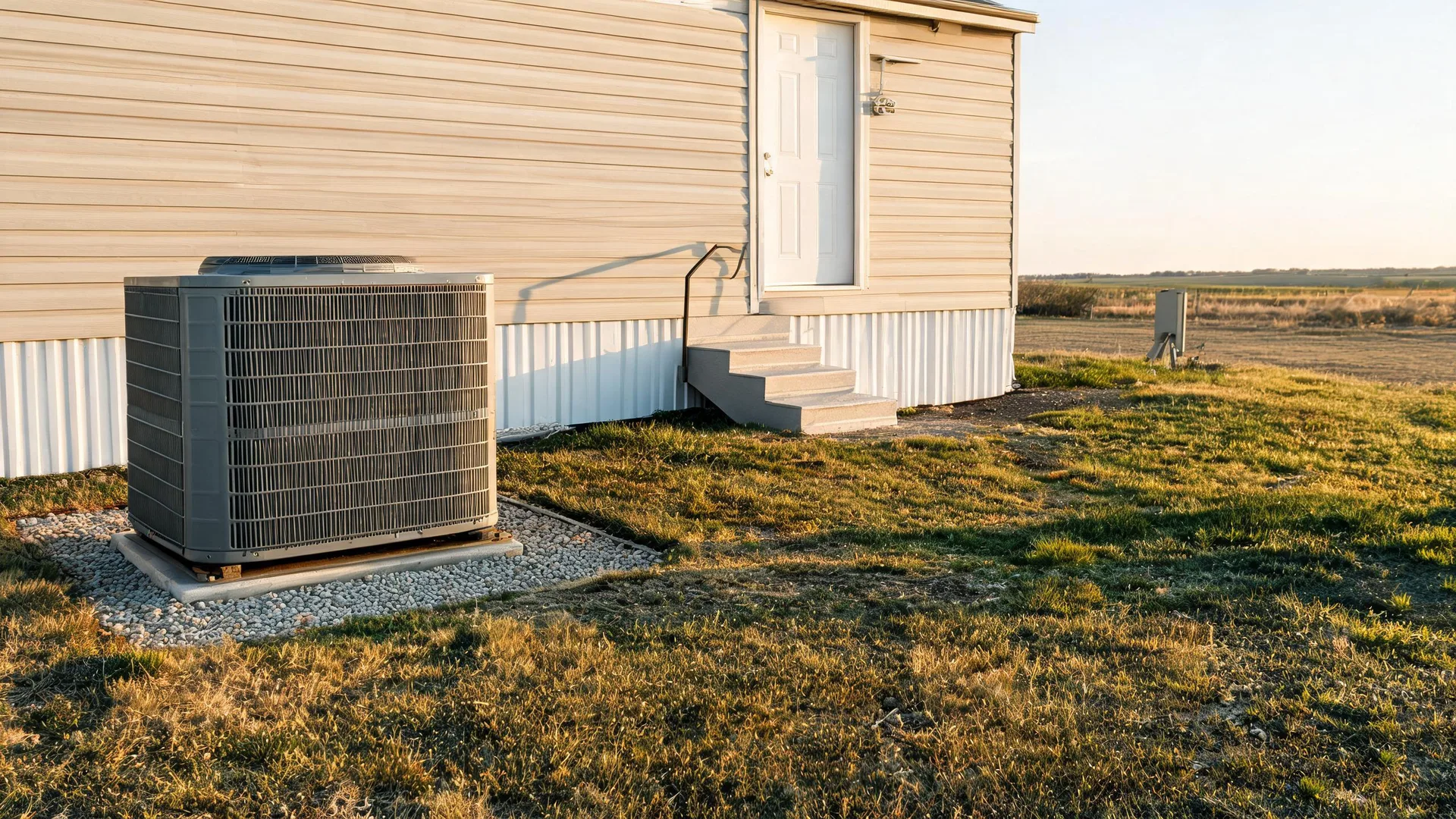
Cold winters don't break heat pumps
Overnight lows here average 11°F across December, January and February, and a heat pump is built to run through all of that. Long, cold winters alone don't explain a unit that stops heating or won't stop cycling.
Takes about a minute. No obligation.
Overnight lows here average 11°F across December, January and February, and a heat pump is built to run through all of that. Long, cold winters alone don't explain a unit that stops heating or won't stop cycling.
A failing defrost control, a low refrigerant charge, a dirty outdoor coil, a worn contactor. These are the problems a tech sees everywhere, in any cold climate, and they're the likely reason a heat pump in Waupaca County needs attention now. Find which one it is before assuming the system is done for.

NOAA nClimDiv, 1991–2020 normals
Heat here runs September through May, nine months out of the year.
A heat pump that's been struggling along often finally gives out when August turns to September and it has to carry the load again.
Weather here is not the reason a heat pump quits. Waupaca County sees damaging wind, hail, the occasional tornado, winter storms with heavy snow and ice, but an outdoor unit is built to sit outside and take that. What a storm can do is knock out power, and about 18% of Wisconsin households lost power for 24 hours or more at some point in 2024. If the unit came back on and still is not heating or cooling right, the outage did not cause that. Something inside it needs a look, same as it would any other week of the year.
Electricity in Wisconsin ran 17.18 cents per kilowatthour in 2024, on the higher side for this part of the country. A heat pump that's cycling too much or struggling to hold temperature is burning power the whole time it runs that way. Whatever's wrong gets found and fixed the same either way, but it costs less once it stops running bad.
Find a contractorCheck the thermostat is set to heat and the temperature actually calls for it. Look at the outdoor unit. If the coil is caked in ice beyond what a normal defrost cycle clears, or buried in leaves and debris, that will stop it from working right. Check that the outdoor fan is spinning when the system runs. Inside, pull the air filter and hold it up to light. If you can't see through it, it's choking the airflow and the system will struggle no matter what else is fine. Check your breaker panel for a tripped breaker on the unit, and check any disconnect switch near the outdoor unit is pushed in. If the system is running but the air coming out doesn't feel warm, that's not something to chase down yourself. That points to the refrigerant side or the reversing valve, and both need gauges and training to touch.
The reversing valve, the defrost control board, the contactor, the capacitor. These wear out from years of starting and stopping, not from any one cold snap or heat wave. A stuck reversing valve will leave a system blowing cold air in heating mode. A bad defrost board lets frost build up on the outdoor coil until the unit can't pull heat from the air at all.
A heat pump is a sealed system. If the charge is low, there's a leak somewhere in the lines or the coil, and topping it off without finding the leak just means doing it again later. Low charge shows up as weak heating, weak cooling, or a system that runs long cycles without getting the house to temperature.
A heat pump in trouble tells you in ways you can feel. The air coming out of the vents feels lukewarm or even cold when the system is supposed to be heating. It short cycles, running for a few minutes, shutting off, then starting again before the house ever gets comfortable. Or it runs and runs without ever reaching the set temperature, racking up long cycles that don't accomplish much. Sometimes you hear it before you feel it. A relay clicking over and over, a hum from the outdoor unit that never turns into a running compressor, a buzz that wasn't there before. Ice building up on the outdoor coil beyond what a normal defrost clears is worth paying attention to as well, since that coil is supposed to shed frost on its own as part of how the system runs.
A diagnostic visit starts outside, at the unit itself. A tech checks the refrigerant pressures with gauges, since that number tells him things a thermostat reading never will. He'll check the amp draw on the compressor and the fan motor, because a motor pulling too many amps is a motor working harder than it should to do its job. He'll run the system in both modes, heating and cooling, and watch whether the reversing valve actually switches when it's told to. Electrical connections get checked too, since a loose wire or a pitted contactor can cause the exact same symptom as a bigger, costlier problem. None of this is guesswork. It's working through the system piece by piece until the one part that's actually failing shows itself.