





Three lit brick homes on a tree-lined residential street photographed at dusk.

Heat Pump Repair in Superior, WI

Tell us about the job

Takes about a minute. No obligation.

RepairHeat PumpDouglas County, WI
Step 1 of 2

What ZIP code is the job in?

Your heat pump isn't struggling because Superior is unusually hard on it. Winters here are cold and long, with overnight lows averaging 6°F through December, January and February. That's within what these systems are built to handle. When a heat pump in this area breaks down, it's usually the same failure a tech would find anywhere else. A worn contactor. A failing defrost board. Low refrigerant charge. A capacitor on its way out. The cold doesn't cause those failures. It just means the unit runs more hours, so a weak part gives out sooner. The fix isn't anything exotic. It's finding which part actually failed and replacing it.

9 months
September through May, your system heats
1 months
July through July, it cools
6°F
the average winter night it heats against
76°F
the average summer afternoon it cools against
Isometric illustration of a cutaway single-story house showing interior ductwork, an indoor air handler and simple furniture, connected by lines to an outdoor condenser unit beside the building.
Your system heats September through May and cools July through July.

NOAA nClimDiv, 1991–2020 normals

Heat here starts in September, with August the last quiet month.

A heat pump that struggled last winter will show the same weak part again once the load hits it.

A heat pump that's struggling costs more to run here, at 17.18 cents a kWh

Power costs 17.18 cents a kWh statewide
Climate zone 6A
Cooling runs July through July

Douglas County gets its share of rough weather, with 54 winter storms and 54 damaging wind events recorded over the past decade. None of that is aimed at a heat pump. The outdoor unit sits outside through all of it, built to take wind, snow and cold. What matters more is what happens after the power goes out. Most heat pumps come back on by themselves once power is restored, no switches to flip, no reset needed. If yours doesn't, the storm probably isn't why. Something inside failed, and that's worth a look regardless of what the weather was doing that day.

In a county this old, that repair might be a sign the unit is done

Half the homes in Douglas County were built in 1969 or earlier. If your heat pump came with a house that old, it's worth finding out how much life is left in it before you put money into a repair.

Find a contractor
A gray outdoor HVAC unit mounted on a concrete pad beside a house with gray lap siding and a stone foundation.

Ask for the unit's age before you approve the repair

If your heat pump is original to the house, ask the contractor for its age before approving any repair. A tech can read it off the nameplate in a few minutes while they're out for the diagnosis. That number is what tells you whether a repair is worth doing or whether the unit is near the end of what it can give you.

The reversing valve is often the first to go

A heat pump switches between heating and cooling by reversing refrigerant flow through a valve that a regular air conditioner doesn't have. That valve cycles constantly, and when it sticks, the system can get stuck in one mode or stop heating altogether. It's one of the more common repairs on these units simply because it's a part central air conditioners never have to rely on.
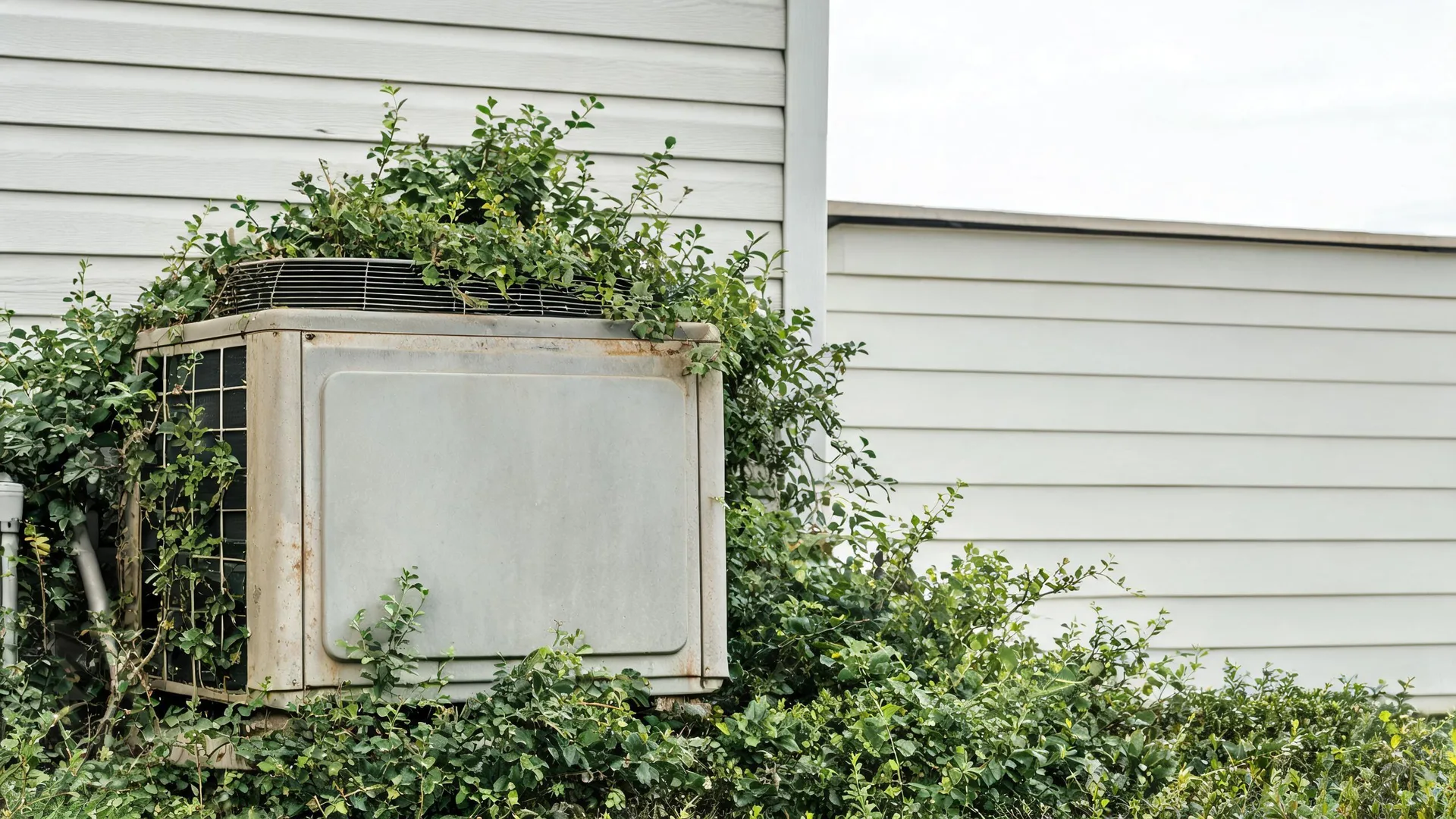
A failed defrost cycle looks like a bigger problem than it is

The outdoor coil frosts up in cold weather, and the system is built to sense that and clear it automatically. When the defrost sensor or control board fails, frost builds up and keeps building, and the unit loses the ability to pull heat from the outside air. From the inside, it just feels like the heat stopped working, but the part at fault is usually small.

Before calling anyone, look at the outdoor unit. If it's caked in ice or snow all the way around the coil, not just a light frost on top, that's worth mentioning when you call. Check the indoor air filter next. A clogged filter chokes airflow and can make the whole system struggle even when every part is working fine. Go to the thermostat and see if it's calling for heat and showing a normal display, not blank or frozen. Listen for the outdoor fan while the indoor side is blowing. If the fan is silent and the air coming out is room temperature instead of warm, that tells a tech something before they even step out of the truck. None of this fixes the unit, but it gives whoever shows up a head start on what's actually wrong.

A repair is worth doing when the part that failed is small next to the unit it's part of. A contactor, a capacitor, a defrost sensor, these cost little and bring the whole system back once they're swapped. Replacement starts to make sense when the compressor itself is failing, since that's the part that actually moves refrigerant and does the heating and cooling. A compressor job can cost close to a new unit, so most techs will tell you straight when you've hit that line. Age matters too, but only alongside the failure. An old unit with a cheap part failing is still worth fixing. The harder call is a unit that's needed a few repairs already. That pattern usually means the parts around it are wearing out together, not that one thing keeps going wrong by chance.