Dark-sided single-story buildings with gray shingled roofs behind trimmed hedges, a mown lawn, and large leafy trees overhead.

Heat Pump Repair in Sheboygan, WI

Tell us about the job

Takes about a minute. No obligation.

RepairHeat PumpSheboygan County, WI
Step 1 of 2

What ZIP code is the job in?

Winters here are long, not harsh on the machine

Sheboygan County runs cold from December through February, with overnight lows averaging 15°F. A heat pump here runs steady for months at a time, but steady running is not hard running. It's the sharp swings, hot to cold and back, that wear parts out fast, and that isn't the pattern in this county.

So a repair is usually worth doing

When a heat pump here starts acting up, the cause is more often a part that's aged out or a system that missed a service visit, not a unit worked past what it can handle. That's worth knowing before you decide whether to fix it or replace it.

9 months
September through May, your system heats
2 months
July through August, it cools
15°F
the average winter night it heats against
78°F
the average summer afternoon it cools against
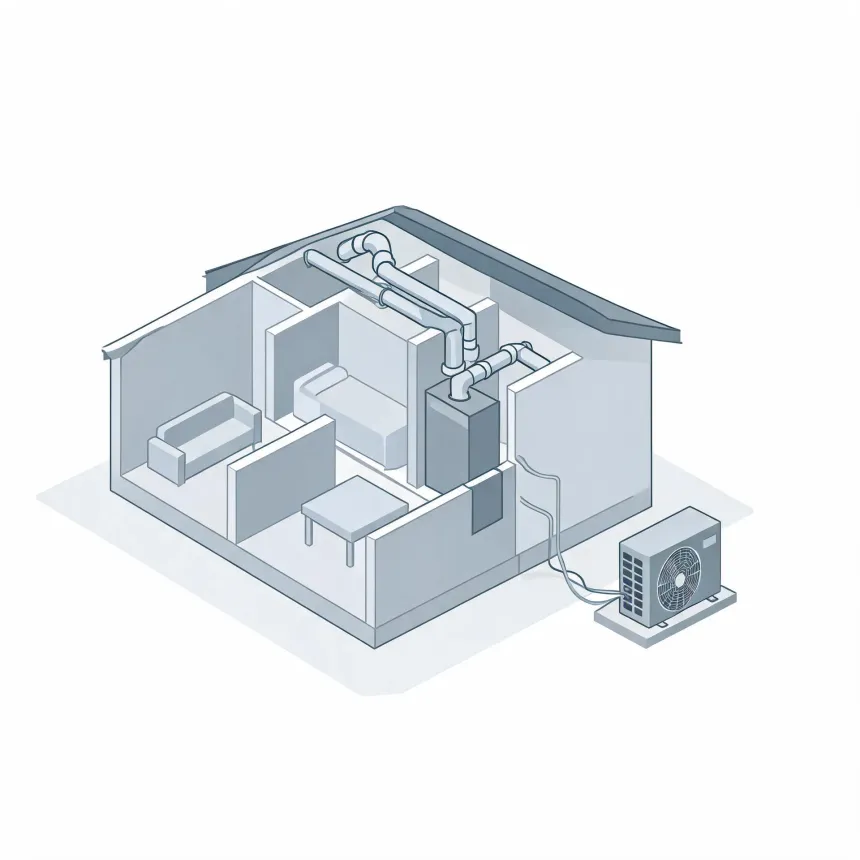
Isometric line illustration of a cutaway house showing interior rooms with furniture, ceiling ductwork connected to an indoor air handler, and a line running outside to an outdoor condenser unit.
Your system heats September through May and cools July through August.

NOAA nClimDiv, 1991–2020 normals

Heat pump season here runs nine months, September through May.

August is the month to get a weak part found and fixed, before the system has to run steady for the winter ahead.

Half the homes in this county were built by 1970

Half the homes here were built by 1970
46 damaging wind events from 2015 to 2024
22 hail events from 2015 to 2024

Electricity in Wisconsin ran 17.18 cents per kilowatthour in 2024, and a heat pump leans on electricity for every hour it runs. When one is low on charge or struggling to defrost, it draws power without delivering the heat it should, and that difference shows up on your bill before it shows up anywhere else. A unit that's cycling too often, running longer than it used to, or blowing air that's not quite warm enough is already costing you more than a working one would. That cost doesn't wait for the coldest week to arrive. It starts the day the part fails and keeps adding up until someone fixes it.

Get it checked before it has to work hard

A heat pump that's not worn past its limit here is usually a heat pump worth fixing. Get the real cause found now, while the weather isn't asking much of it yet.

Find a contractor
A man in a gray long-sleeve shirt and brown pants, seen from behind, carries a canvas tool bag up wooden steps toward a green front door.
A white mini-split heat pump outdoor unit mounted on a concrete pad beside a gray-sided house, surrounded by gravel and green shrubs.

How old is the unit, not just the house

If your heat pump came with an older house, ask the contractor straight out how much life is left in it before you pay for a major repair. A cracked heat exchanger or a compressor on its way out isn't worth fixing on a unit that's already past where it should be. A weak capacitor or a bad defrost board is a different story, and worth repairing on any unit, old or new. The diagnosis should tell you which one you're looking at.

What you can look at yourself

Check the outdoor unit first. If snow or ice has built up around the coil or the fan can't spin freely, clear it away. Look at the air filter and swap it if it's gray or clogged, a dirty filter chokes airflow and makes the whole system work harder. Walk through the house and check that every supply vent is open and nothing is blocking them. At the thermostat, make sure it's set to heat and the temperature is actually above room temperature, not sitting at the same number by mistake.

What tells you to stop and call

A layer of frost that doesn't clear on its own during the defrost cycle means something's off, that's not for you to chase down. Ice building up on the indoor coil, a burning smell, or a breaker that trips more than once are reasons to shut the system off and wait for a contractor rather than keep resetting it. If the outdoor unit is running but no warm air is coming from the vents, or you hear grinding or clicking that wasn't there before, that's a part failing, not something a filter change will fix.

Most heat pump failures trace back to a handful of parts. The reversing valve is one. It's what lets the unit switch between heating and cooling, and when it sticks, the system can't shift properly and ends up stuck in one mode or blowing air that's not the temperature you asked for. The defrost board is another. It's supposed to melt off the frost that builds on the outdoor coil during cold weather, and when it fails, that frost turns to ice and chokes off airflow entirely. Capacitors wear down too, usually slowly, until the day the fan or compressor won't start on its own. And refrigerant doesn't get used up, so if a system is low, it's leaking out somewhere, and that leak won't seal itself. None of these are things you can see from across the yard. They're also not reasons to assume the worst about a unit that's otherwise sound.

A heat pump rarely fails all at once. It's usually one part that's given out while the rest of the system is still sound, which is exactly why repair makes sense more often than people expect. The compressor is the one part that changes the math. It's the most expensive thing in the unit, and when it's failing, the diagnosis will show signs like a unit that trips breakers, hums without starting, or runs weak on both heating and cooling. If the compressor is still good, almost everything else is a straightforward fix, not a reason to start pricing a new system. A unit that's heating unevenly, cycling oddly, or running longer than it should is still, more often than not, a unit worth repairing.