A tall trimmed hedge in the foreground borders a mown lawn beside a row of dark single-story houses with shingled roofs, surrounded by large leafy trees under an overcast sky.

Heat Pump Repair in River Falls, WI

Tell us about the job

Takes about a minute. No obligation.

RepairHeat PumpPierce County, WI
Step 1 of 2

What ZIP code is the job in?

August and May are when it breaks

Heat here switches on in September and stays on through May, and cooling takes over in June. A heat pump that was already struggling tends to fail right as that switch happens, in August or May, when it suddenly has to carry the full load.

Get it looked at before the switch

A heat pump with a weak part often still limps along in mild weather. Once the season turns and it has to run hard, that same part gives out. Having it checked before August or before May catches the problem while it is still a small fix.

9 months
September through May, your system heats
3 months
June through August, it cools
9°F
the average winter night it heats against
79°F
the average summer afternoon it cools against
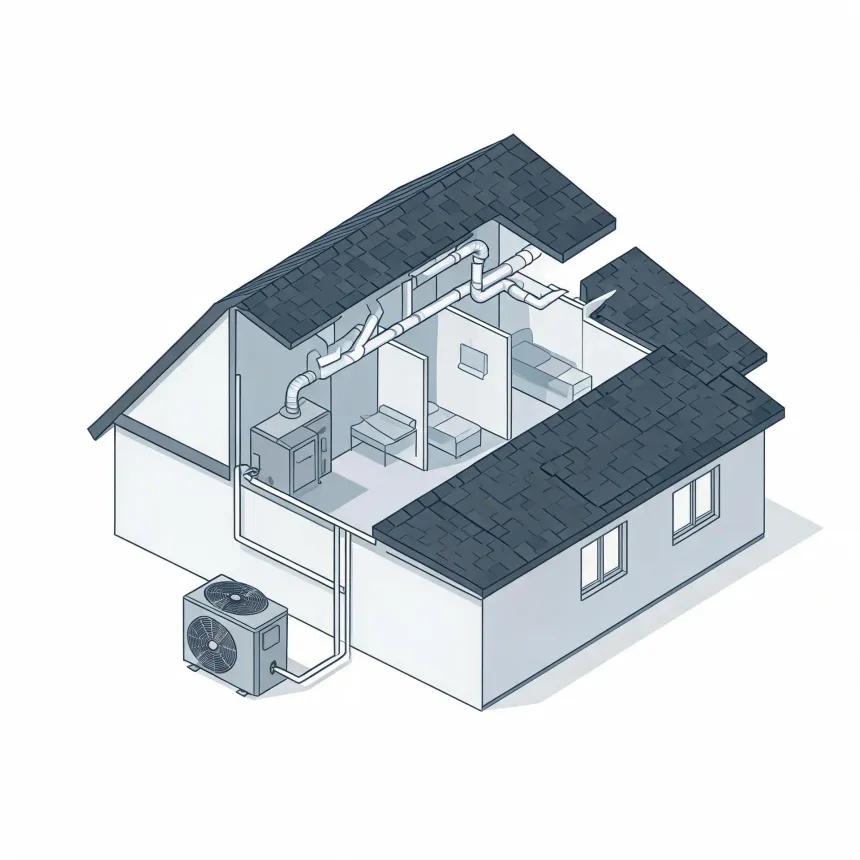
Isometric line illustration of a cutaway single-story house showing interior ductwork, an indoor air handler unit, and an outdoor condenser connected by refrigerant lines, with a dark shingled roof.
Your system heats September through May and cools June through August.

NOAA nClimDiv, 1991–2020 normals

Pierce County winters average 9°F overnight through December, January and February.

A heat pump works hardest on cold nights like that, and a weak part shows itself fast.

At 17.18 cents a kWh, a heat pump running wrong keeps billing you for it

Power costs 17.18 cents a kWh statewide
Climate zone 6A
Cooling runs June through August
Built newer, worth fixingHalf the homes in Pierce County were built in 1980 or later, so a lot of heat pumps here still have years of life in them.

A heat pump that's short on refrigerant or running on a failing compressor doesn't just work harder, it pulls more power doing less heating or cooling. At 17.18 cents a kWh, that difference shows up on the next bill whether or not you've had someone look at it. Waiting through another month of that is waiting to pay for a problem you haven't fixed yet. Getting the cause diagnosed now stops the bleeding either way, whether it turns out to be a simple fix or something bigger.

Worth fixing, not replacing

If your heat pump has years left in it, a repair makes more sense than starting over. Get the cause diagnosed and fixed.

Find a contractor
A man in a cap, dark long-sleeve shirt and tan work pants walks up porch steps toward a green front door, carrying a worn canvas duffel bag, with a potted shrub and wall lantern beside the entry.
A gray heat pump outdoor unit mounted on a concrete pad next to a residential house with lap siding and stone accents.

Running it doesn't fix it

A heat pump that's low on refrigerant or struggling to defrost doesn't fail outright. It keeps running, just worse, and every hour it runs that way adds wear somewhere else. The compressor works harder to move the same heat. Oil meant to lubricate it circulates poorly when charge is low. Ice that should melt off the outdoor coil during a defrost cycle builds up instead, blocking airflow and making the next cycle work harder too. None of this shows up as the system shutting off. It shows up as the system running longer to do less, right up until the part that was already weak finally gives out.

What you'll actually notice

Air coming out of the vents that's warm but not hot, a unit that runs long stretches without shutting off, or ice on the outdoor coil that isn't melting during the day. Sometimes it's a smell when the system kicks on, or a hissing from the lines. Sometimes it's just that a room that used to heat fine now doesn't.

Noise and cycling tell you the most

A heat pump that clicks on and off more than it used to is struggling to satisfy the thermostat and giving up early. A new rattle, buzz or grinding from the outdoor unit usually means a motor bearing or a loose part, not something that fixes itself. Either one is worth a call before it turns into a bigger repair.

A slow refrigerant leak at a fitting or coil is one of the most common causes of poor heating or cooling, and it rarely shows up all at once. The system keeps running, just weaker, as charge drops a little at a time. The reversing valve is what switches the unit between heating and cooling, and when it sticks, the unit blows air that's the wrong temperature for what was asked of it. The outdoor fan motor and the compressor both wear on their bearings over years of starting and stopping, and that wear shows up as noise well before the part actually fails. Defrost controls fail in a quieter way. A sensor or board stops telling the system to melt ice off the outdoor coil, so the coil stays iced over and airflow drops. None of these start as a breakdown. They start small, and they get worse under load.

So how do you tell what's worth fixing? A repair history matters more than how dramatic the symptom looks. A single part failing on a system that's otherwise been reliable is usually a straightforward repair, even if the part is an expensive one like the compressor. A system that's needed repeat visits for different problems is telling you something else, even when each visit was minor on its own. The question isn't just what broke, it's whether the rest of the system is still sound around it. A tech who's already inside the unit can usually tell you how the coils and wiring look, not just whether the one failed part can be swapped.