A row of dark-painted single-story houses with gabled shingle roofs behind a trimmed hedge and mown lawn, surrounded by large leafy trees under an overcast sky.

Heat Pump Repair in Rhinelander, WI

Tell us about the job

Takes about a minute. No obligation.

RepairHeat PumpOneida County, WI
Step 1 of 2

What ZIP code is the job in?

Winter here is long but not unusual

Oneida County is rated zone 6A, a cold climate, and overnight lows average 6°F across December, January and February. Your heat pump leans on its auxiliary heat strips more during those months than one in a milder state would. That's normal operation, not a sign of trouble by itself.


That doesn't change what's likely wrong

A heat pump working hard all winter fails the same ways any heat pump does. A weak capacitor, a low charge, a frozen coil, a bad defrost sensor. Cold months don't create new problems, they just make an existing one show up sooner and matter more once you notice it.

9 months
September through May, your system heats
1 months
July through July, it cools
6°F
the average winter night it heats against
76°F
the average summer afternoon it cools against
Isometric grey-toned illustration of a cutaway house showing interior rooms, ceiling ductwork and an air handler, connected by lines to an outdoor condenser unit beside the building.
Your system heats September through May and cools July through July.

NOAA nClimDiv, 1991–2020 normals

Heat here runs September through May, nine months, after sitting idle since cooling stopped in July.

August is when a heat pump due for trouble shows it, the first cold snap finding whatever part was already weak.

At 17.18 cents a kilowatt-hour, a heat pump running wrong costs you all year

Power costs 17.18 cents a kWh statewide
Climate zone 6A
Cooling runs July through July

Oneida County has logged 114 severe weather events over the years tracked, between wind, hail and winter storms. That sounds like a lot, but spread out over time, and none of it is what usually takes down a heat pump. Wind and hail go after the cabinet and the fins on the outdoor unit. A bent fin or two won't stop it from running. What actually calls for a repair is almost always inside, a weak capacitor, a low charge, a stuck reversing valve. The one thing worth checking after a bad storm is whether the outdoor unit still has power. A heat pump that's lost power needs to be turned back on at the breaker or the switch by the unit before it'll run again.

Half the homes here were built in 1980 or later. Repair makes sense for a system that age.

Half the homes in Oneida County were built in 1980 or later. A heat pump that came with a newer house still has working life ahead of it. When something goes wrong, fixing what failed usually makes more sense than replacing the whole system.

Find a contractor
A gray outdoor HVAC unit mounted on a concrete pad beside a house with gray lap siding and a stone foundation.

Know the age before you decide anything

If your heat pump came with the house and the house is newer, get the failed part diagnosed before anyone talks replacement. A technician can tell you from the model number and a look at the unit how old it actually is. That number matters more than anything else for deciding whether to fix what broke.

A refrigerant leak doesn't hold still

A heat pump low on charge will still run, and still move some heat, so it's tempting to leave it alone. But the compressor is built to pump a sealed, specific amount of refrigerant. Run it low for long and the compressor runs hotter than it should every single cycle. That shortens its life, and a compressor failure usually means a new outdoor unit, not a repair.

A frozen coil feeds on itself

Once ice starts building on the outdoor coil, less of it is exposed to the air, so it pulls less heat and runs longer to keep up. Longer runtime means more frost. Left alone, the coil can ice over completely and the system stops moving heat at all, even though it's still running and still drawing power.

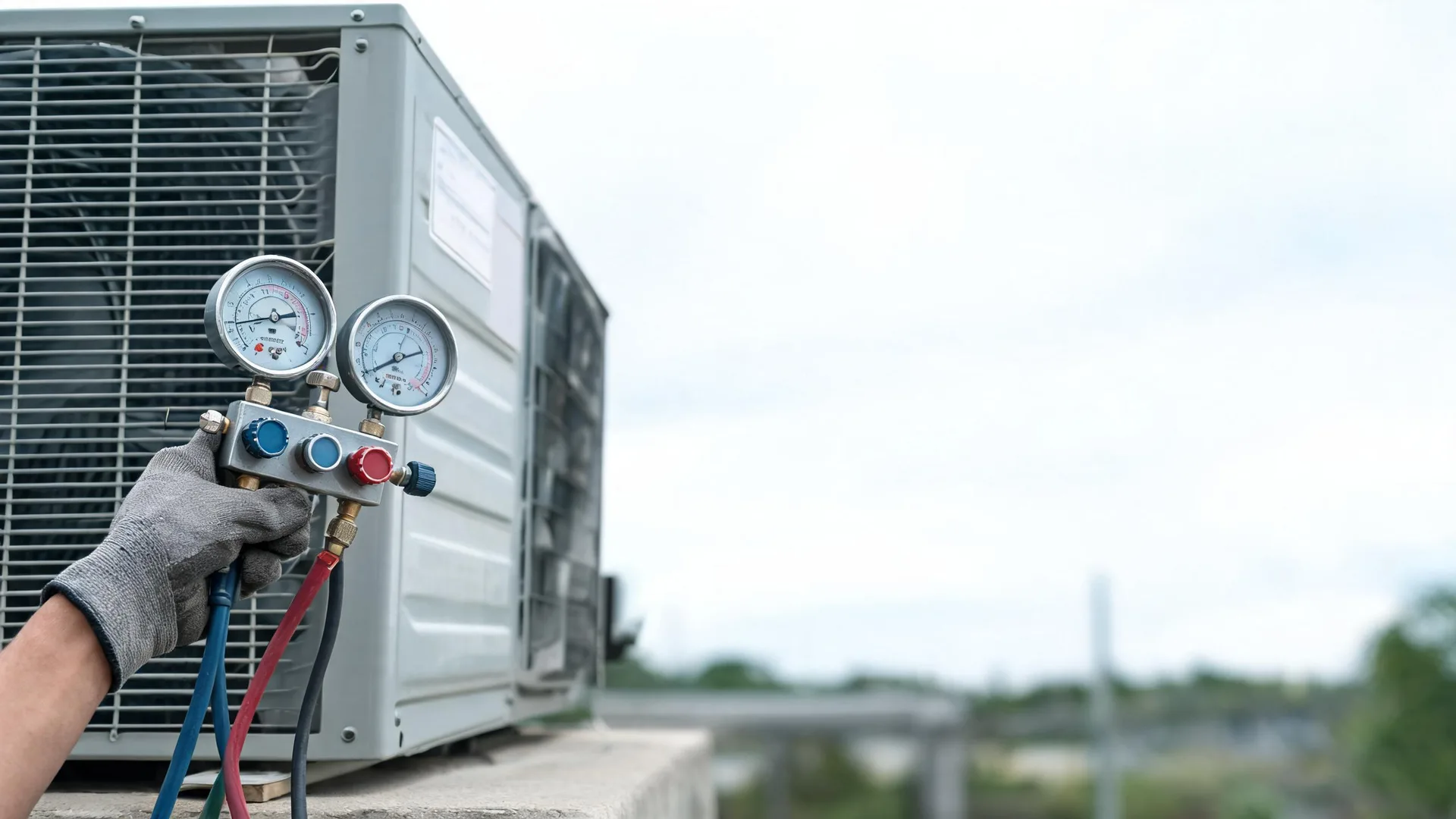
Before anyone comes out, there are a few things worth checking yourself. Go outside and look at the unit. If the fan isn't turning and you don't hear anything, check the breaker and the disconnect switch mounted near the unit, both need to be on. Inside, check the thermostat is set to heat and the temperature is actually set above room temperature, not sitting at the current reading. Check your air filter too. A filter clogged with dust blocks airflow, and a heat pump starved for airflow can ice up or trip a safety switch. Look at the outdoor coil while you're out there. If it's coated in ice or snow is packed around the base, that's worth mentioning when you call, it points toward a defrost problem rather than something electrical.

Age matters, but so does what actually broke. A compressor or a reversing valve going bad on an older unit is a real question mark, parts get harder to find and the rest of the system isn't far behind. A capacitor, a contactor, a blown fuse, a bad sensor, those fail on new and old systems alike and cost little to put right regardless of the unit's age. The repair itself tells you something too. If a technician is already pulling the system apart to get at the failed part, that's different from a problem that's quick to reach and quick to fix. Ask what failed and whether that part tends to take others down with it. That answer is worth more than a guess about how many years are left in the unit.