A row of dark-sided cottages with brown shingled roofs behind a trimmed hedge, beside a mown lawn and large leafy trees under an overcast sky.

Heat Pump Repair in Portage, WI

Tell us about the job

Takes about a minute. No obligation.

RepairHeat PumpColumbia County, WI
Step 1 of 2

What ZIP code is the job in?

September is when a weak heat pump shows itself

Heat in Columbia County starts in October, and the switch over from cooling usually happens fast. A heat pump that limped through a mild September gets asked to hold a house warm for the first time in months, and whatever was already worn, a weak contactor or a low charge, tends to give out right then.

Get it looked at before the cold settles in

A heat pump that struggles in early October is likely to keep struggling through a Wisconsin winter, not work itself out. Finding the actual cause now, while it's still fixable on a mild day, beats waiting until the system is trying to keep up during a hard freeze.

8 months
October through May, your system heats
3 months
June through August, it cools
13°F
the average winter night it heats against
80°F
the average summer afternoon it cools against
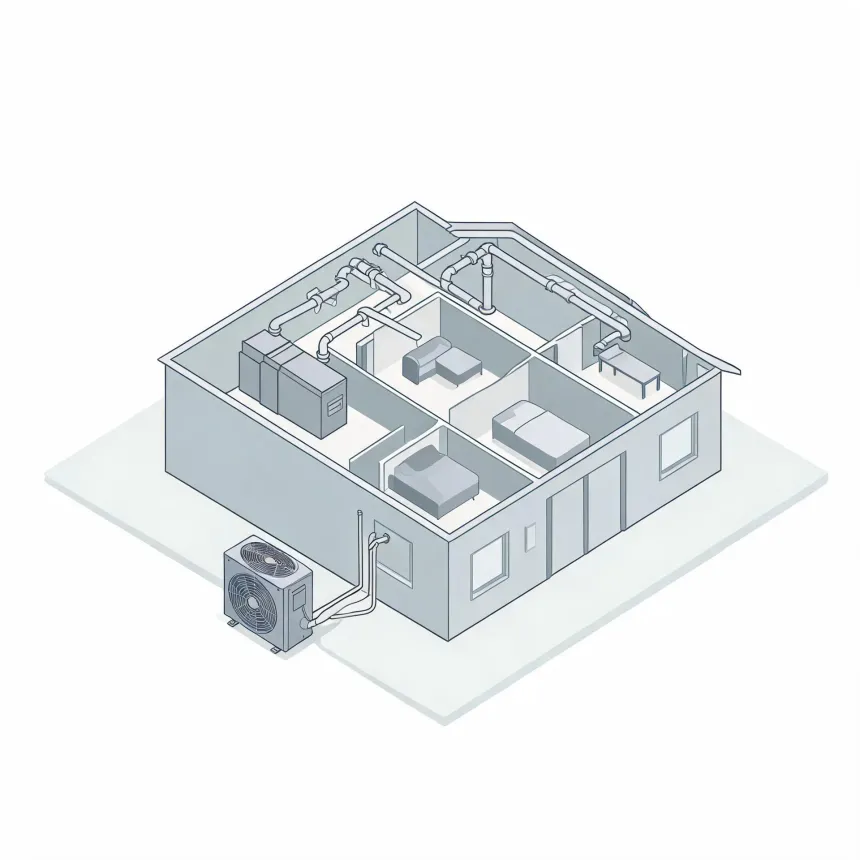
Isometric line illustration of a cutaway single-story house showing interior rooms with beds and furniture, ceiling ductwork connected to an indoor air handler, and an outdoor condenser unit linked by refrigerant lines.
Your system heats October through May and cools June through August.

NOAA nClimDiv, 1991–2020 normals

Winter here runs cold, with overnight lows averaging 13°F in January.

A heat pump that's already struggling won't hold up through that. Whatever's wrong is worth finding now.

Electricity here runs 17.18 cents a kilowatt-hour, so a heat pump working harder than it should shows up on every bill until it's fixed

Power costs 17.18 cents a kWh statewide
71 damaging wind events from 2015 to 2024
30 hail events from 2015 to 2024

Columbia County has seen 122 severe weather events over the past decade, wind, hail, winter storms, even a few tornadoes. None of that points to anything unusual going on with a heat pump that's acting up. Wind can knock debris into an outdoor unit and a bad storm can trip a breaker, but most of the time a heat pump that's struggling has a cause that has nothing to do with the weather that week. A refrigerant leak, a failing capacitor, a dirty coil, a stuck reversing valve. These show up in calm weather as easily as rough weather, and they don't fix themselves. The county's storm history doesn't change the diagnosis. It just means the outdoor unit is worth a quick look after anything severe comes through, the same as anywhere else.

Nothing about this county makes your heat pump problem unusual

Columbia County splits about evenly between homes built before 1976 and after. Neither age points to anything particular going wrong with a heat pump. Whatever's causing the trouble is likely the same thing it would be anywhere. A failing part, a refrigerant leak, a stuck valve. Worth having someone find the actual cause and fix it.

Find a contractor
A gray heat pump condenser unit mounted on a concrete pad against the gray lap-siding exterior wall of a house.

Keep running it and the small problem becomes the big one

A refrigerant leak is the clearest case. A system low on charge still runs, so nothing shuts it off and forces the issue. But the compressor is built to handle a certain amount of refrigerant moving through it, carrying oil along for lubrication. Run it low long enough and it starts running dry in spots, and that wear doesn't reverse once the leak gets fixed. A stuck reversing valve works the same way from a different angle. The system keeps running in whatever mode it got stuck in, heating or cooling, and either does a poor job of what you actually need or forces the compressor to work against itself trying to switch. A weak capacitor is the other common one. It still starts the compressor, just slower and with more strain each time, until one day it doesn't start at all. None of these fix themselves by running more. They just move the wear from a part that's simple to replace to the one that isn't.

What a tech checks first

A diagnostic visit starts outside, at the unit itself. Gauges go on to read the refrigerant pressure, a meter checks the capacitor and the contactor, and the reversing valve gets tested both directions. Inside, the tech looks at the air coming off the vents and checks the temperature split between return and supply. Most of what's wrong shows up in that first pass, before any panel comes off for a closer look.

What decides repair or replace

Age and history matter less than what's actually failed. A bad capacitor or a stuck contactor is a straightforward swap on a system that's otherwise sound. A compressor on its way out, or a refrigerant leak in the coil itself, is a different conversation. The diagnosis tells you which one you're dealing with. Guessing without it means paying to fix the wrong thing.

Most heat pump problems announce themselves before the system quits. Warm air blowing when it should be hot, or the unit running nonstop without catching up to the thermostat setting, usually means it's losing the fight, not winning it slowly. Ice on the outdoor coil in weather that isn't especially cold points to a reversing valve or a refrigerant charge that isn't right. A unit that switches on and off in short bursts instead of settling into a steady run is hard on the compressor and worth a look. Listen for it too. A new rattle, a hum from the outdoor unit that wasn't there before, or a clicking that doesn't lead to the system starting, all mean something inside is wearing out, not just acting up for a day.

A repair decision usually comes down to one part versus the whole system. A failed capacitor, a stuck contactor, a bad fan motor, these are single parts that get replaced on their own, and the rest of the unit keeps running the way it was built to. A compressor is different. It's the one part that's expensive enough and central enough that fixing it starts to compete with the cost of a new system, and when a compressor fails, it's often because something upstream, a refrigerant leak or years of running low on charge, wore it down. Fixing the leak without asking why the compressor failed just sets up the same failure again. The other thing worth weighing is what shape the rest of the unit is in. A system that keeps needing separate repairs, each one small and reasonable on its own, is telling you something the single repairs don't.