October is when a weak system shows itself
Your heat pump sits idle most of the summer, then has to carry the house starting in October. If a part was already marginal, this is when it gives out, not in the middle of winter.
Takes about a minute. No obligation.
Your heat pump sits idle most of the summer, then has to carry the house starting in October. If a part was already marginal, this is when it gives out, not in the middle of winter.
A heat pump that struggles in September or early October will only work harder as temperatures drop through the eight-month heating stretch. Catching the cause now means it's not fighting the coldest months on a bad part.

NOAA nClimDiv, 1991–2020 normals
Winter here runs on the overnight low, which averages 13°F across December, January and February.
A heat pump that can't keep up on a 13°F night usually has one bad part behind it, not a design that's failing.



Half the homes in Winnebago County were built in 1975 or earlier, half in 1975 or later. That split doesn't point to one likely cause over another. A heat pump acts up the same way whether the house around it is old or new. What matters is what the system is doing right now. Short cycling, running nonstop without warming the house, blowing air that's not quite hot enough, or not coming on at all. Whichever one it is, a contractor is looking for the same handful of usual suspects. A low charge, a failing defrost control, a weak capacitor, a stuck reversing valve. The age of the house doesn't change that list.
At 17.18 cents a kilowatt-hour, a bad capacitor or a stuck reversing valve doesn't just leave the house cold. It keeps costing you until someone finds the part that's actually failing. Get it looked at.
Find a contractor
A heat pump that's been running for years without trouble doesn't fail all at once. Parts wear in a particular order. The reversing valve sticks before it fails outright, so you get a few cycles of blowing cold air in heating mode before it quits for good. A capacitor weakens over seasons of starting and stopping the compressor, and you'll hear the unit hum and struggle to start before it won't start at all. The defrost board usually goes quietly, you just notice the outdoor coil icing over and staying iced instead of clearing on its normal cycle. None of these show up as a sudden break. They show up as the system doing its job a little worse each week until it's not doing it at all.
The outdoor unit is what wears first. It sits through rain, sits through frost, and the fan motor and coil take the brunt of it. A failing run capacitor shows up here before anywhere else, usually as a compressor that hums but won't start. Dirt and ice packed against the outdoor coil make the whole system work harder, which shortens the life of whatever's already weak.
A furnace doesn't have one, which is why heat pump failures often look different from what a homeowner expects. The reversing valve is what switches the system between heating and cooling, and when its coil or the valve itself starts to stick, you get warm air that isn't warm enough, or cold air blowing during a heating cycle. It's a mechanical part with a coil driving it, and either piece can fail on its own.
A heat pump that's struggling still moves heat, just not enough, so it's easy to let it ride. That's the wrong call. A compressor straining to start on a weak capacitor builds heat in the windings every time it tries, and each failed start adds a little more damage until it doesn't start at all. Ice left on the outdoor coil because the defrost control isn't cycling right keeps building, blocking more airflow and forcing the system to run longer to do less. A reversing valve that sticks partway gets worse with every cycle, not better, because the same pressure that's causing the stick is working on it each time it switches. None of these fix themselves by running longer. They just fail on your schedule instead of theirs.
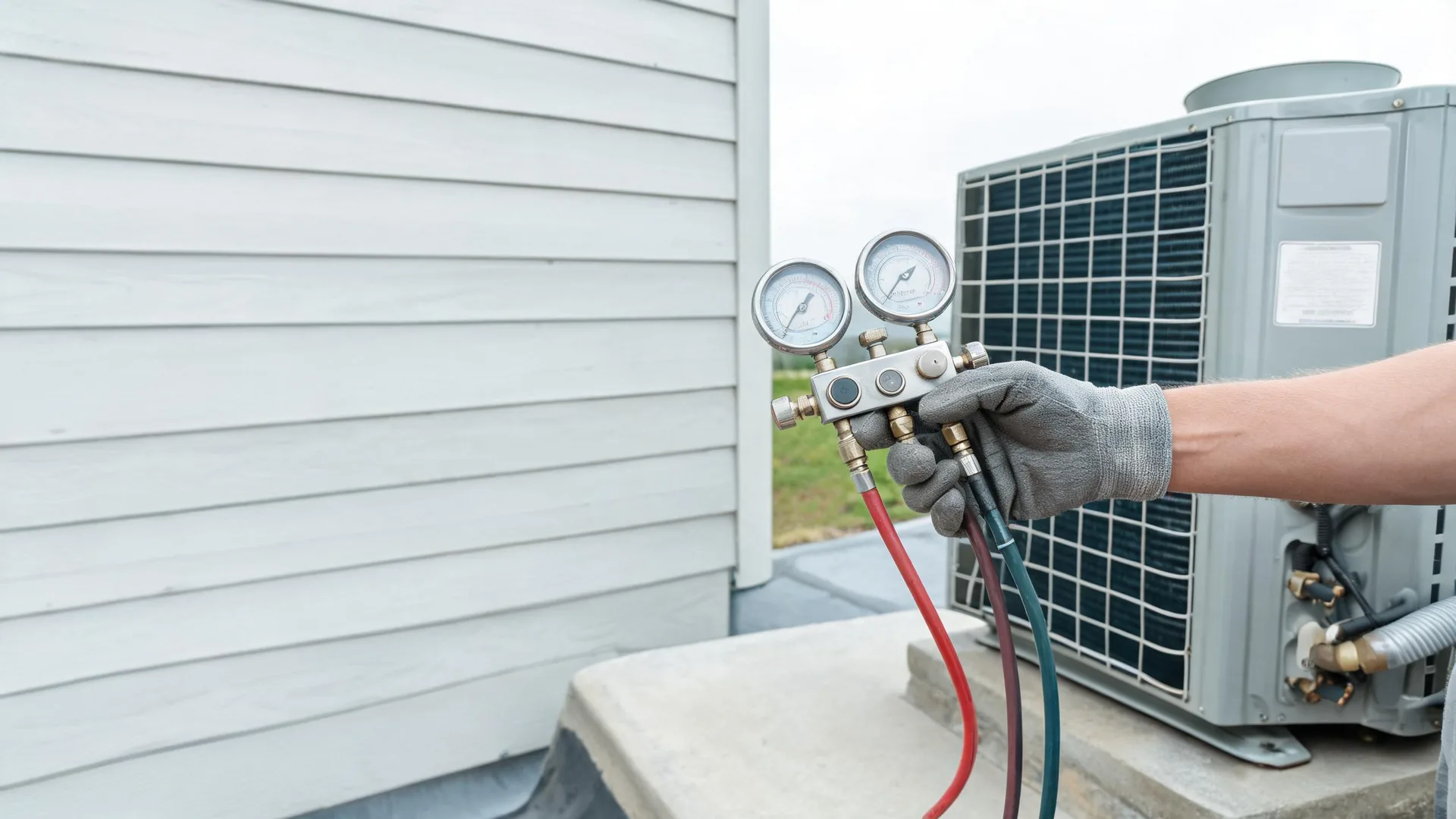
A diagnostic visit starts outside at the condenser, since that's where most heat pump trouble begins. A gauge set on the refrigerant lines shows whether the charge is right, because low refrigerant looks like other problems until it's measured. The contractor runs the system in both heating and cooling and watches what the reversing valve actually does when it's told to switch. A capacitor gets tested under load, not just looked at, since a capacitor can read fine sitting still and still fail to start the compressor. Amp draw on the compressor and fan motors tells its own story. A motor pulling high draw while barely moving air is a motor on its way out. The defrost board gets checked against the coil sensor, because a board that's not reading the coil right will never call for defrost when it should. By the end there's usually one part that doesn't match what the rest of the system is doing, and that's the one that gets replaced.