




A low-angle view across a mown lawn and trimmed hedge toward a dark two-story house with a covered porch, framed by large leafy trees under an overcast sky.

Heat Pump Repair in Oconto, WI

Tell us about the job

Takes about a minute. No obligation.

RepairHeat PumpOconto County, WI
Step 1 of 2

What ZIP code is the job in?

Winters here average 11°F overnight in December, January and February, so your heat pump works hard those months. That's normal. It's built for this. When one stops keeping up with the cold, the cause is usually something ordinary. A thermostat set wrong for cold-weather operation. A frozen outdoor coil that isn't defrosting on schedule. Low refrigerant, or a reversing valve stuck in one position. None of that comes from anything unusual about Oconto's climate. It comes from a part that's worn, a setting that's off, or a repair that didn't quite finish the job. Find which one it is and the fix is usually straightforward.

9 months
September through May, your system heats
2 months
July through August, it cools
11°F
the average winter night it heats against
78°F
the average summer afternoon it cools against
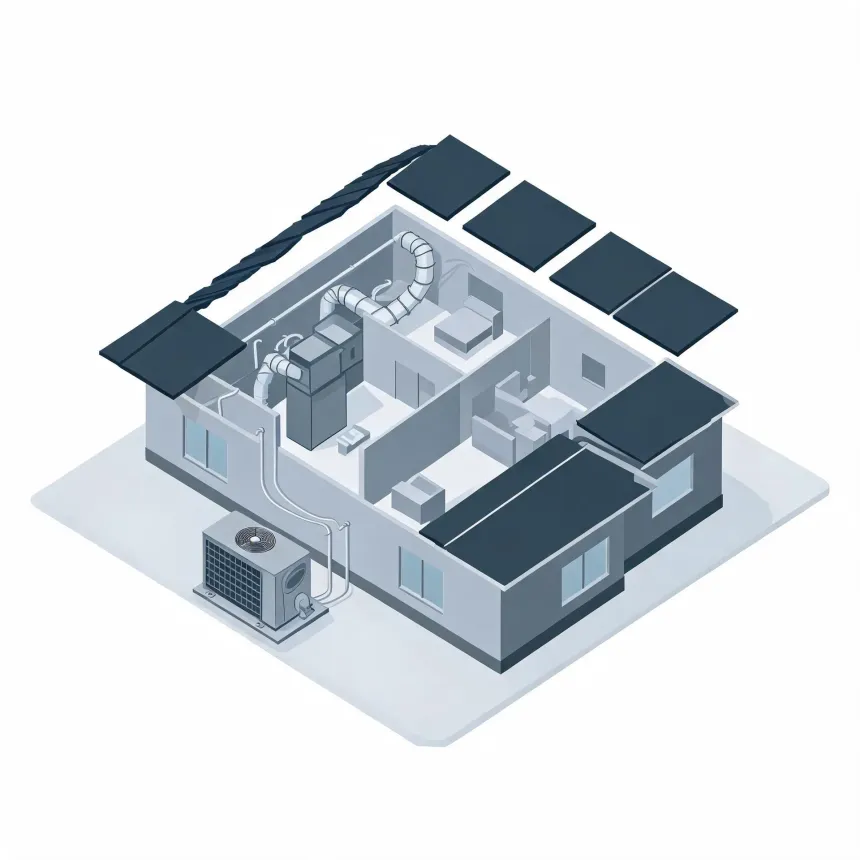
Isometric grayscale illustration of a cutaway single-story house showing interior rooms, ductwork and an air handler, an exterior condenser unit connected by lines, and dark solar panels on the roof.
Your system heats September through May and cools July through August.

NOAA nClimDiv, 1991–2020 normals

Heat here runs September through May, starting right after August.

August is when a weak part is still holding on. Once the cold settles in for good, it won't.

Half the homes in Oconto County were built in 1981 or later

Half the homes here were built by 1981
30 hail events from 2015 to 2024
48 winter storms from 2015 to 2024
Oconto's weather isn't the problem48 winter storms between 2015 and 2024, and a heat pump built to handle them anyway

Wisconsin homes paid 17.18 cents per kilowatthour in 2024, and a heat pump leaning on its backup heat strips to make up for a problem burns through that fast. A heat pump that's low on refrigerant or stuck in one mode runs longer to hit the same temperature, and it costs more every day it keeps running that way. The bill is the first sign most people notice, before they ever see frost on the coil or feel a room that won't warm up. Waiting doesn't save money. It just adds the cost of a few more weeks on top of whatever the repair runs.

A high bill is the signal to get it looked at

If the bill is already climbing, that's the heat pump telling you something's off before you can feel it in the house. Getting a tech out now finds the cause while it's still a simple fix.

Find a contractor
A white mini-split heat pump outdoor unit mounted on a concrete pad beside a gray-sided house, surrounded by gravel and green shrubs.

Check the system's age before you replace it

If the heat pump came with the house, that points toward repair over replacement. A newer compressor or control board is worth fixing rather than tearing out. Check when yours was installed before you decide. One that's older, or has already had other repairs, is a different call than one still within its working life.

What you'll actually notice

A room that won't hold its temperature, air coming out of the vents that feels barely warm, or the outdoor unit running nonstop without seeming to get anywhere. Sometimes it's a clicking sound when the system tries to switch between heating and cooling modes and doesn't quite make it. Any of these means something inside isn't doing its job, even if the unit never fully shuts down.
Why it's worth a look now

A heat pump that's struggling doesn't fix itself. The part causing the trouble, whether it's a sensor, a valve, or a failing motor, keeps working against itself every time the system cycles on. The longer it runs that way, the more strain it puts on everything else connected to it, which is how a small repair turns into a bigger one.

A heat pump fails the same ways almost anywhere, and most of it traces back to a handful of parts. The reversing valve is a common one. It's what switches the system between heating and cooling, and when the coil inside it wears or the solenoid controlling it quits, the unit gets stuck in one mode or starts making that clicking sound without completing the switch. The defrost control board is another. It tells the system when to melt frost off the outdoor coil, and when it fails, ice builds up and blocks airflow until the unit is running hard for very little heat. Capacitors weaken over years of starting and stopping the compressor and fan motors, and a weak one shows up as a unit that hums but won't start, or shuts off on its own. Low refrigerant almost always means a leak somewhere in the line set or coil, not normal use, since the system is sealed and isn't supposed to lose charge at all. None of these are rare or strange failures. They're the ordinary wear points on any heat pump, and most of them show symptoms well before the system quits entirely.

A diagnostic visit starts outside, at the unit itself. A tech checks refrigerant pressure, looks at the reversing valve, and watches how the outdoor coil looks for frost or ice buildup. Capacitors get tested under load. Contactors get checked for pitting. The defrost board gets checked to see if it's cycling on schedule. Inside, the thermostat settings get checked against how the system is actually set up to run, since a heat pump needs different settings than a furnace does. Airflow gets checked too, since a blocked return or a clogged filter can look like a failing part when it isn't one. Most of this takes less time than people expect, because the failure points are well known and a tech knows where to look first.