A illuminated two-story red brick house on a quiet residential street at dusk, flanked by mature trees under a deep blue evening sky.

Heat Pump Repair in Mequon, WI

Tell us about the job

Takes about a minute. No obligation.

RepairHeat PumpOzaukee County, WI
Step 1 of 2

What ZIP code is the job in?

September is when a weak heat pump shows itself

Heat in Mequon starts up in October, and September is the month to catch trouble before the cold settles in. A unit that struggled last winter will usually show the same strain again once it has to run for hours at a stretch.


A problem found now is easier to fix right

Once heat pumps are running daily through the winter, a contractor is working around a system already under load. Calling before October means the diagnosis happens without that pressure, and the fix holds for the eight months ahead.

8 months
October through May, your system heats
2 months
July through August, it cools
16°F
the average winter night it heats against
78°F
the average summer afternoon it cools against
Isometric cutaway illustration of a single-story house showing interior ductwork, an indoor air handler, and an outdoor condenser unit connected by lines along the exterior wall.
Your system heats October through May and cools July through August.

NOAA nClimDiv, 1991–2020 normals

A tech starts by asking what the system is doing. Short cycling, running nonstop, blowing cold air, not starting at all, these each point somewhere different.

The answer to that question narrows the job down before a single panel comes off.

Electricity here runs 17.18 cents a kilowatt-hour, so a heat pump working harder than it should costs you every month it's ignored

Power costs 17.18 cents a kWh statewide
Climate zone 5A
Cooling runs July through August
Your home isn't the problemHalf the homes in Ozaukee County were built in 1978 or earlier, half in 1978 or later. Either way, age isn't what's wrong with your heat pump.

A heat pump that's short cycling or running nonstop is drawing power the whole time it does that, not just when it finally heats the house. At 17.18 cents a kilowatt-hour, that difference shows up on the bill before it shows up anywhere else. Waiting until the system fails outright usually means paying for the strain and the repair. A diagnosis now catches the cause while it's still one bad part, a stuck valve or a failing sensor, rather than a system that's worn itself out trying to compensate.

Get it looked at early

Problems tend to show up in the first weeks of the season, when the load hits a part that was already weak.

Find a contractor
A man in a cap, dark work shirt and tan pants carries a worn canvas tool bag up gray steps toward a green paneled front door of a shingled house, with a potted shrub beside the entry.
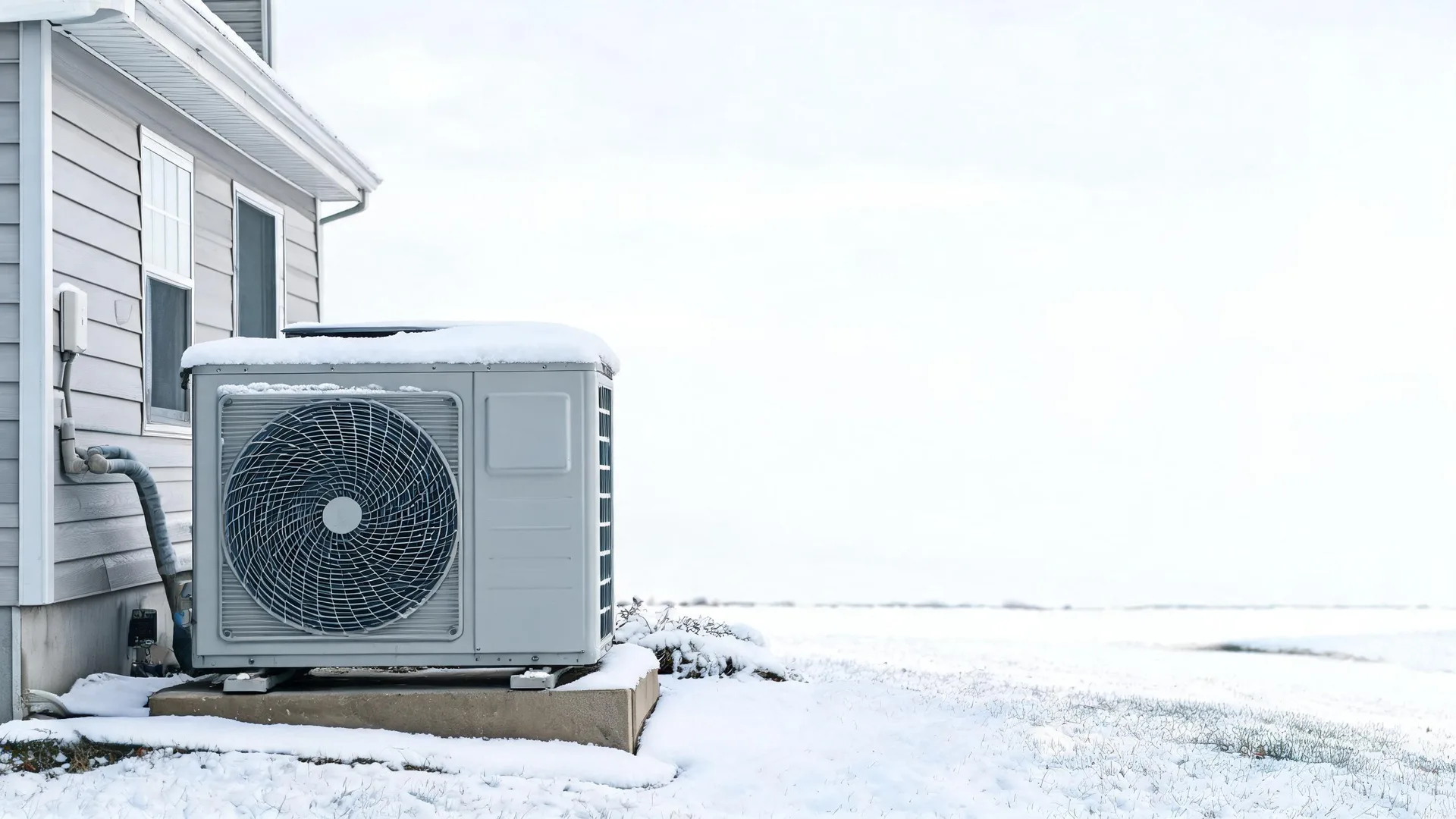
A residential heat pump outdoor unit mounted on a concrete pad next to a house with gray vinyl siding.

What actually wears out in a heat pump

A heat pump moves heat instead of making it, so the parts that wear are the ones doing that work. The reversing valve is a common failure point. It's what lets the system switch between heating and cooling, and a valve that sticks will leave you with a unit that runs but blows the wrong temperature air, or gets stuck in one mode. The defrost cycle is another. Outdoors, the coil picks up frost through the colder months, and the system has to melt it off on a timer. A failed defrost board or a bad sensor means that frost builds up until the coil is blocked solid and the unit can't pull heat from the air at all. Capacitors weaken over years of starting the compressor and fan motor, and a weak one shows up as a system that hums but won't start, or one that short cycles. The compressor itself is the part you don't want to hear about, because by the time it's failing, everything upstream of it has usually already been stressed for a while. Catching the smaller failures, the valve, the sensor, the capacitor, is what keeps a compressor from getting there.

Check the thermostat and the breaker first

Make sure the thermostat is set to heat and the temperature is actually above room temperature. Then check the breaker box. A heat pump has more than one breaker, one for the outdoor unit and one for the air handler, and if either has tripped the system can seem dead when it isn't.

Look at the outdoor unit and the filter

Walk outside and see if the outdoor coil is caked in ice beyond what a normal defrost cycle would leave, or if anything is blocking airflow around it, like leaves or snow piled against the sides. Inside, pull the filter and hold it up to light. A filter clogged enough to block light will choke airflow and can make the system struggle no matter what else is wrong.

Most calls start with one of a few complaints. Air coming out of the vents that doesn't feel warm, even though the system is running. A unit that kicks on and off every few minutes instead of settling into a steady cycle. Ice on the outdoor coil that doesn't go away between defrost cycles. A system that hums outside but never actually starts. Each of these points at something specific rather than the system as a whole. Warm air that feels lukewarm often means the unit is stuck trying to heat and cool at once, which is a reversing valve problem. Short cycling points at a weak capacitor or a thermostat sensing something wrong. Ice that keeps building means the defrost cycle isn't firing when it should. None of these get better by running the system longer or turning the thermostat up higher.

A heat pump worth repairing usually tells you so. One part failed, the rest of the system is sound, and the fix brings it back to where it was. That's true for a reversing valve, a capacitor, a defrost sensor, even a fan motor. What changes the math is a compressor going bad. The compressor is the part that costs the most on its own, and putting a new one into an old system often isn't worth it. The other thing worth asking is how the system has been running lately. A unit that needs a repair every season isn't failing at random, it's wearing out, and each fix after the last one buys less time than the one before. A system that's run clean for years and now has one specific complaint is a different situation than one that's been limping along through repair after repair.