An outdoor HVAC condensing unit on a concrete pad next to a beige single-story house with a dark shingle roof.

Heat Pump Repair in Manitowoc, WI

Tell us about the job

Takes about a minute. No obligation.

RepairHeat PumpManitowoc County, WI
Step 1 of 2

What ZIP code is the job in?

The tech checks both modes, not just one

A heat pump that struggles in heating can still look fine in cooling, so the tech runs the system both ways. That means watching refrigerant pressures and airflow at the indoor coil, then switching the system over and watching the reversing valve do its job. A reversing valve that sticks often only shows itself when it's asked to switch, so testing just one side misses it.


Expect the outdoor unit to come apart

Most of what causes a heat pump to underperform is sitting outside in the compressor, the outdoor coil, or the fan motor. The tech will pull the access panel, inspect the coil for buildup or damage, and test the fan motor and capacitor directly. Reading the thermostat tells you something is wrong. Opening the unit tells you what.

9 months
September through May, your system heats
2 months
July through August, it cools
15°F
the average winter night it heats against
77°F
the average summer afternoon it cools against
Isometric illustration of a cutaway single-story house showing interior ductwork and vents connected to an outdoor condenser unit beside the building, on a white background.
Your system heats September through May and cools July through August.

NOAA nClimDiv, 1991–2020 normals

Short cycling wears a heat pump out faster than steady running does

If yours kicks on and off every few minutes, that is a sign worth having a tech look at before it strands you without heat

Half the homes in Manitowoc County date to 1964 or earlier, and a heat pump installed with the house is running on borrowed time

Half the homes here were built by 1964
52 damaging wind events from 2015 to 2024
24 hail events from 2015 to 2024

Manitowoc County isn't unusually hard on a heat pump. Winter here gets cold, with overnight lows averaging 15°F in December, January and February, but that's within what a heat pump built for this area is designed to handle. Wind and hail show up most years, and winter storms roll through a couple times a year, but none of that points to anything specific being wrong with your system. So when a heat pump here is underperforming or won't hold a cycle, the cause is almost always the ordinary stuff. A dirty coil. A failing capacitor. A reversing valve that's starting to stick. The fix is finding which one it is, not guessing at what the weather did to it.

Your heat pump's problem is likely ordinary, and it has an ordinary fix

Severe weather hits this county the same as anywhere else in the state, with wind and the occasional hail storm most years. None of that explains a heat pump that won't hold a cycle. A coil that needs cleaning or a capacitor on its way out will act up whether the week's been calm or not. Get the actual cause checked before guessing at a fix.

Find a contractor
A man seen from behind in a backward cap, dark jacket and tan work pants carries a waxed canvas tote bag up steps toward a green front door, with a potted shrub beside the entry.
A gray heat pump outdoor unit mounted on a concrete pad next to the stone-accented exterior wall of a house.

How old is the system, not just the house

If yours was installed when the house was built, and the house is one of the older ones here, it may already be past the point where repair makes sense. A tech can tell you where it stands before you pay for a repair that outlives the unit by a year.

Check the thermostat settings first

Make sure it's set to heat, not cool, and that the set point is actually above room temperature. A thermostat bumped into the wrong mode or a dead thermostat battery looks exactly like a broken heat pump.

Look at the outdoor unit

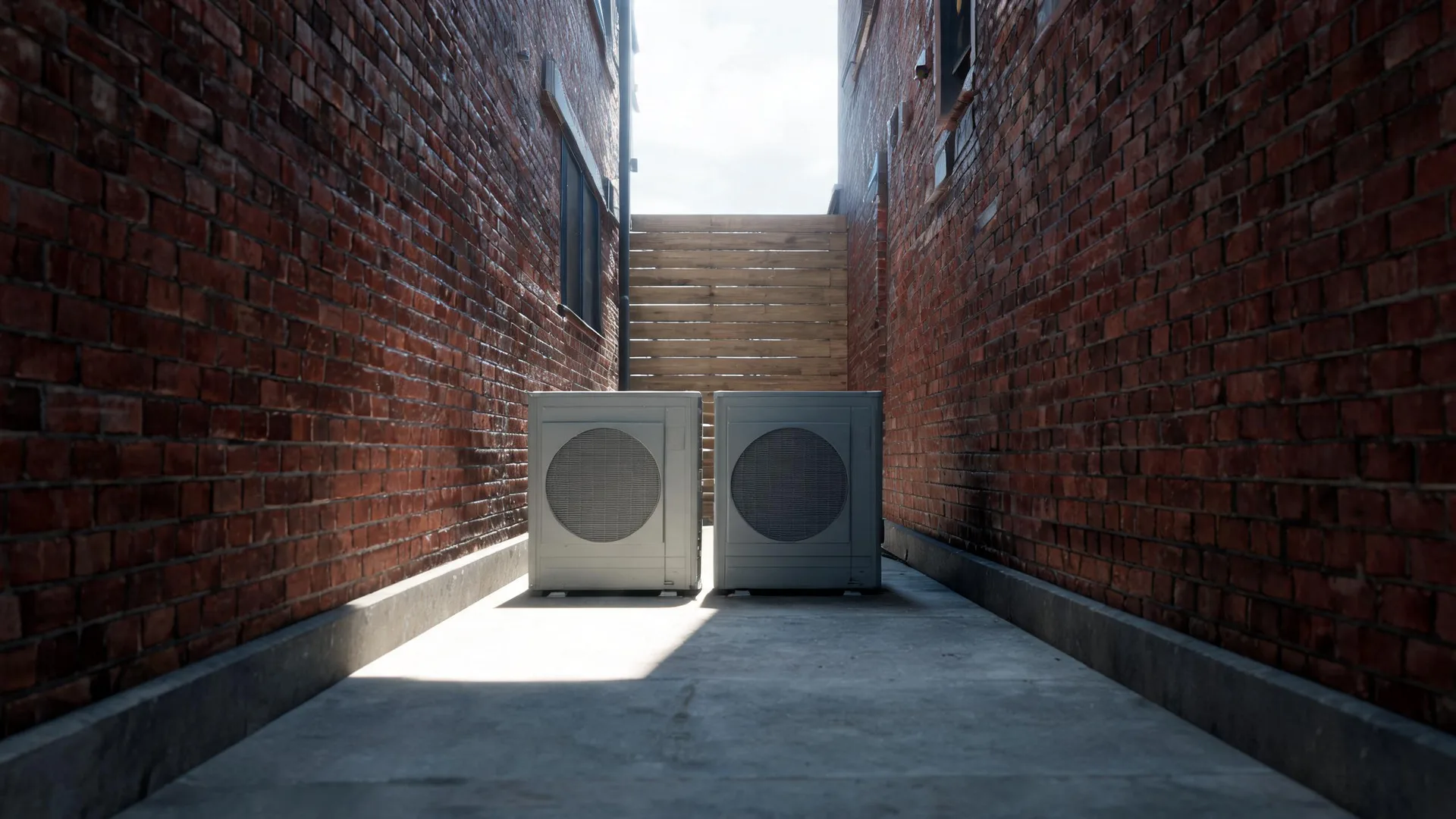
Clear away leaves, snow or anything blocking the coil or the fan. A heat pump that can't pull air through the outdoor coil will struggle to heat or cool no matter what else is working right. If the coil is caked with ice beyond what a normal defrost cycle clears, that's worth a call rather than a wait.

Most heat pump failures trace back to a handful of parts. The capacitor is a common one. It gives the compressor and fan motor the jolt they need to start, and it weakens over time until the start fails outright. A failing run capacitor often shows up as a fan that hums but doesn't spin, or a compressor that tries and gives up. The reversing valve is another. It's what lets the system switch between heating and cooling, and when the coil inside gets stuck it can leave the unit blowing cold air when it should be heating, or stuck in one mode no matter what the thermostat asks for. Refrigerant leaks cause trouble too, usually at a fitting or a worn coil, and a system low on charge will run long and still underheat. None of these fail because of a hard winter. They fail because they're wearing parts, and they wear out whether the system had an easy year or a rough one.

A cheap fix is worth doing almost every time. The harder call comes when the repair is a big one, a compressor or a coil, because that's real money going into a system that's already used up part of its life. Weigh the repair against how much life the unit likely has left, not against what a new one costs. An old compressor failing is a different situation than a young one failing, even though the repair looks the same on paper. If a heat pump keeps needing attention, one small fix after another, that pattern is telling you something the single repairs don't. A unit that's been reliable for years and then throws one bad part is usually worth fixing. A unit that can't string together a season without a service call is a different story.