







A row of dark-clad gabled houses with gray shingle roofs behind trimmed green hedges, mown lawn, and leafy trees under an overcast sky.

Heat Pump Repair in Kenosha, WI

Tell us about the job

Takes about a minute. No obligation.

RepairHeat PumpKenosha County, WI
Step 1 of 2

What ZIP code is the job in?

Winter nights here average 18°F, and that's the main work a heat pump in Kenosha County does, heating steadily through the cold months. It isn't fighting the kind of summer swings a unit faces further south. The county does get rough weather, 43 damaging wind events over the past decade among them, but that's weather hitting the house, not the compressor wearing itself out. Day to day, this is a manageable load for a system built for a zone 5A winter. So if yours is acting up, the cause is usually something specific. A failed part, a refrigerant leak, a thermostat that's lost its calibration. Not a machine that's been run past what it can handle.

8 months
October through May, your system heats
3 months
June through August, it cools
18°F
the average winter night it heats against
80°F
the average summer afternoon it cools against
Isometric grayscale illustration of a cutaway house showing interior rooms, ceiling ductwork connected to an indoor air handler, and an outdoor condenser unit beside the exterior wall.
Your system heats October through May and cools June through August.

NOAA nClimDiv, 1991–2020 normals

Heat in Kenosha County runs from October through May, about eight months a year.

A heat pump with a weak part going into October will show the same fault once it has to carry the load every day.

House age here is a mixed bag. It doesn't explain a heat pump acting up

Half the homes here were built by 1975
43 damaging wind events from 2015 to 2024
17 hail events from 2015 to 2024
Power here isn't cheapWisconsin electricity ran 17.18 cents per kilowatt-hour in 2024, so a heat pump working harder than it should costs you every month it runs that way.

Get a technician to find the actual cause before anything gets replaced. A heat pump that's had a manageable load for years usually has a lot of life left in it, so chasing down the real fault is worth doing. Check the outdoor unit while you're at it. Hail has hit the county 17 times in the past decade, and a bent fin or a dented cabinet can affect airflow without being the reason it stopped working. Two different problems can show up at once. Let the diagnosis sort out which one you're actually dealing with.

Fix it now, not after another month of bills

A heat pump that's not running right doesn't wait for a good time to cost you. At 17.18 cents a kilowatt-hour, every day it runs on a bad part is a day you're paying more than you should. Get the real cause found and fixed.

Find a contractor
A man in a cap, dark shirt and brown work pants, seen from behind, climbs wooden porch steps toward a green front door while carrying a worn canvas bag.
A gray heat pump outdoor unit mounted on a concrete pad next to the stone-accented exterior wall of a house.

What a heat pump tells you before it quits

A heat pump doesn't give you one dramatic failure most of the time. It gives you small ones that add up while it keeps running through the clip above, day into night, month after month. It stops defrosting the outdoor coil properly and you notice ice building up on it even when it's not that cold out. The reversing valve starts sticking and the air from your vents feels wrong for the setting, cool air when it should be warm, or warm air that never gets hot enough. Short cycling shows up next, the unit kicking on and off more than it used to instead of running a steady stretch. You'll hear it too. A hum with no airflow behind it means the compressor is trying and failing. Grinding or squealing from the outdoor unit usually means a motor bearing is going. None of these fix themselves by running longer. The part that's struggling now is the part that fails outright once the system has to carry its full load every day.

Most failures start in one part, not the whole system

A capacitor weakens and the compressor struggles to start. A contactor pits and burns until it stops making contact. A low refrigerant charge, usually from a slow leak at a fitting or coil, makes the system run long and hard without ever catching up. These are specific, separate failures. A heat pump rarely just wears out everywhere at once.
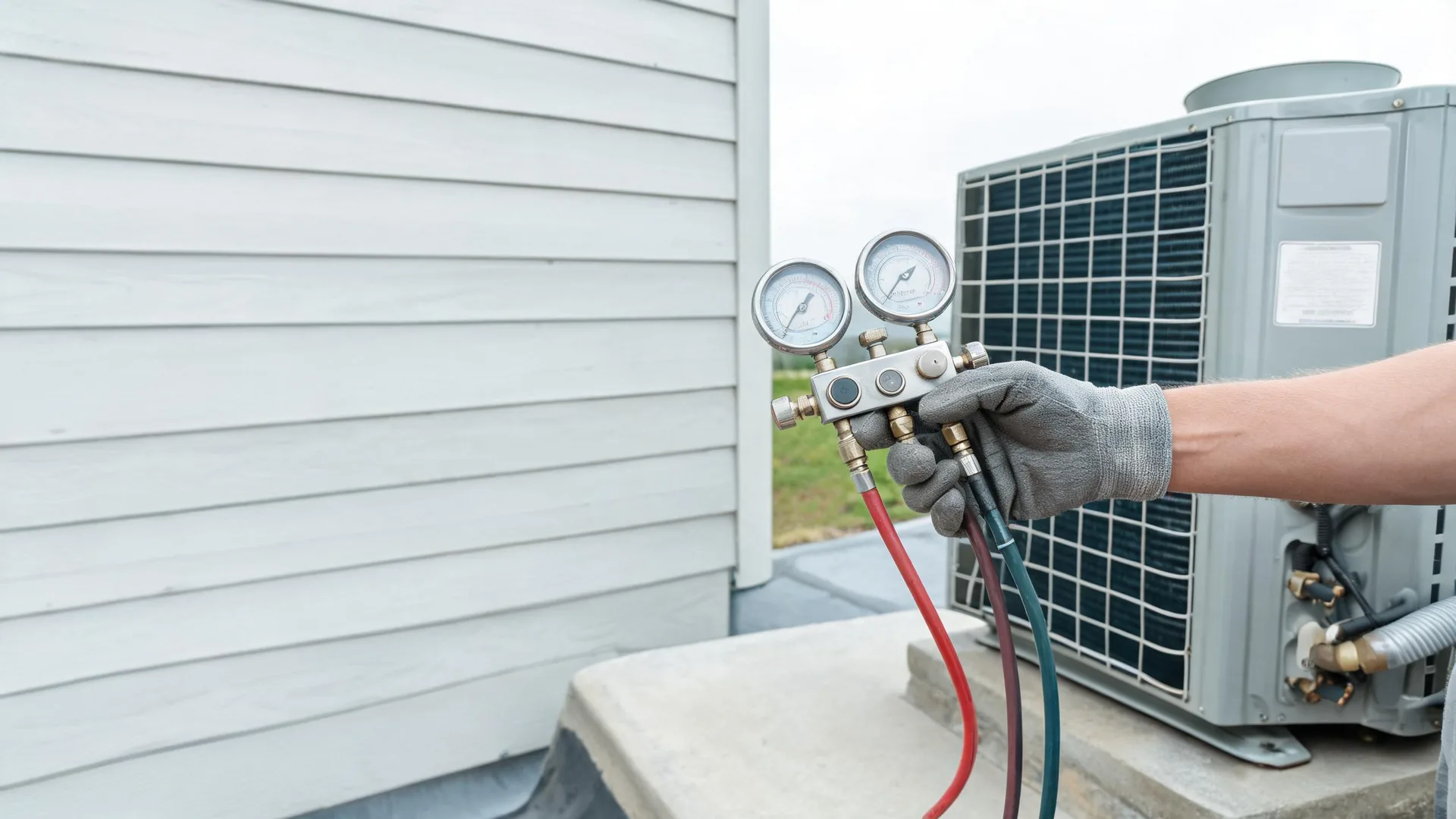
The outdoor unit takes the brunt of it

The outdoor unit sits outside year round, so its fan motor, defrost sensor and coil see every bit of weather while the indoor side stays sheltered. A failing defrost sensor leaves the coil icing over. A struggling fan motor can't pull air through a coil that's otherwise fine. When a heat pump acts up, the outdoor unit is usually where to look first.

Before anyone comes out, there are a few things worth checking yourself. Look at the thermostat first. If it's set to heat and the temperature is set above room temperature, that part's ruled out. Check the circuit breaker for both the indoor air handler and the outdoor unit. A tripped breaker will stop a heat pump cold and it's a quick fix if that's all it is. Walk outside and look at the unit itself. If it's buried in snow or ice has built up past what you'd expect from a normal defrost cycle, that's blocking airflow and worth clearing if you can reach it safely. Check the air filter too. A filter clogged with dust restricts airflow on the indoor side and can make the whole system struggle even when nothing's actually broken. If the breaker's fine, the thermostat's set right, and the filter's clean, the problem is inside the system, and that's where it needs a technician.

Repair usually wins. A compressor failure is the exception, and most of what sends a heat pump into trouble isn't the compressor at all. It's a capacitor, a contactor, a defrost sensor, a refrigerant leak at a fitting. Those are straightforward swaps for a technician, and fixing one doesn't put the rest of the system at risk. Replacement makes more sense when the compressor itself is failing, or when a refrigerant leak is in the coil rather than at a fitting, since a coil isn't something you patch and trust going forward. Age matters less than what's actually broken. A system that's carried a manageable load for years and is now failing in one specific part is usually a system worth fixing, not swapping out.