






A quiet residential street at dusk lined with illuminated two-story brick houses and mature trees.

Heat Pump Repair in Hudson, WI

Tell us about the job

Takes about a minute. No obligation.

RepairHeat PumpSt. Croix County, WI
Step 1 of 2

What ZIP code is the job in?

Heat pumps here work nine months of the year, September through May, which is most of the year for this machine. That long stretch means a weak part usually waits for a trigger, not a reason to appear out of nowhere. August is when yours switches over from cooling to heating, and that first cold snap is when a tired capacitor or a low-charge system finally gets asked to do real work. If your heat pump is struggling to keep up or short cycling once the weather turns, that is the usual pattern, not a sign something unusual is wrong with it. Getting it looked at before the switch, rather than after it fails on a cold morning, is worth doing.

9 months
September through May, your system heats
3 months
June through August, it cools
9°F
the average winter night it heats against
79°F
the average summer afternoon it cools against
Isometric line illustration of a cutaway single-story house showing interior rooms, ceiling ductwork and an indoor air handler, connected by a line to an outdoor condenser unit on a pad beside the building.
Your system heats September through May and cools June through August.

NOAA nClimDiv, 1991–2020 normals

Winter lows here average 9°F, and that's normal for a heat pump to handle.

The cold isn't what breaks a heat pump. A worn part that was already failing is what breaks when the cold asks it to work harder.

St. Croix County gets its share of wind, hail and snow. None of it singles out a heat pump.

121 severe weather events from 2015 to 2024
18% of homes statewide lost power a day or more in 2024
28 damaging wind events from 2015 to 2024

Half the homes in St. Croix County were built in 1993 or later. If yours is one of them, your heat pump is probably newer too, especially if it came with the house. A unit that age isn't near the end of anything. The part that's failing is usually a single part, a capacitor or a defrost sensor or a contactor, not the system around it. Replacing that one part is the right call far more often than replacing the whole unit.

Get it looked at early

Problems tend to show up in the first weeks of the season, when the load hits a part that was already weak.

Find a contractor
A man in a gray long-sleeve shirt and brown pants, seen from behind, carries a canvas tool bag up wooden steps toward a green front door.
A dark gray heat pump unit mounted on a concrete pad next to a house with gray siding and a stone veneer wall.

Worth fixing, not replacing

A repair call makes sense here before a replacement call does. If the unit is original to a newer build, there's no reason to think it's worn out, just that one part gave out under load. Ask the contractor what failed and why, and whether that part has a history of going bad early.

What you can check yourself

Look at the outdoor unit first. If the fan isn't spinning and you don't hear a hum, check the breaker before anything else. Inside, check the thermostat is set to heat and the temperature is actually set above room temperature, not just displaying it. Check your air filter too. A clogged filter starves the system of airflow and can make a working heat pump act like a broken one.
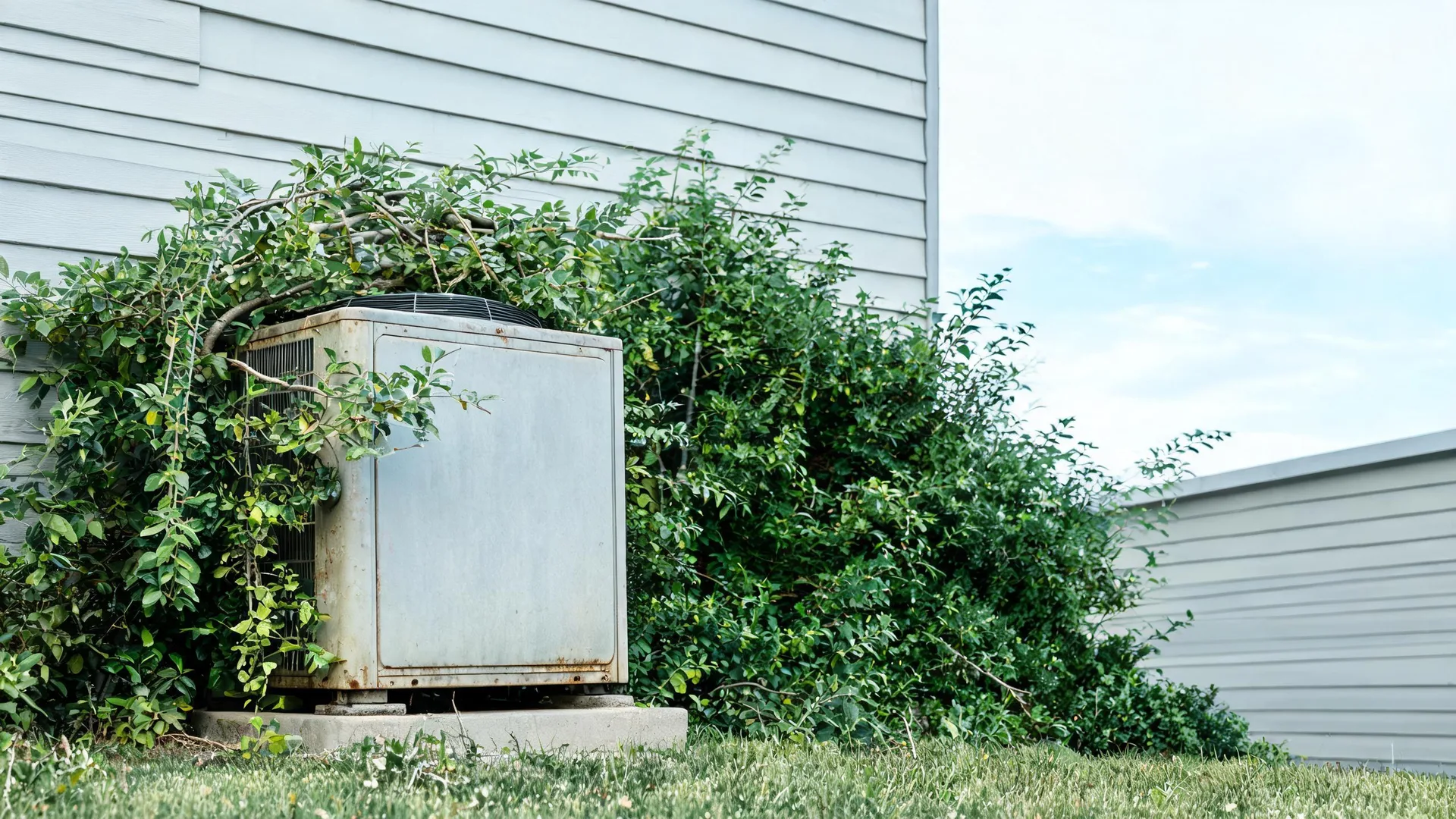
What to leave alone

Don't pull the outdoor panels or touch the refrigerant lines. A heat pump running in defrost mode will sometimes look like it's blowing cold air or steaming, and that's normal operation, not a fault. If the outdoor coil is iced over and defrost isn't clearing it, that's worth a call, not a reason to start chipping at the ice yourself.

A heat pump that's struggling still tries to meet the thermostat setting, so it runs longer to make up for what it's lost. That extra runtime puts more hours on whatever is already weak, whether that's a contactor arcing a little more each cycle or a compressor pulling hard on a low charge. A system low on refrigerant will also run colder than it should on the indoor coil, and over time that can ice up in a way defrost can't keep up with. Short cycling does its own damage too, since every start draws more current than steady running, and a part on its way out usually fails on a start, not in the middle of a run. None of this happens fast. It's the difference between a capacitor swapped on a service call and a compressor that seized because it kept getting asked to do more than it could.

A diagnostic visit starts outside, at the unit itself, checking amp draw on the compressor and fan motor against what the nameplate calls for. A technician will check refrigerant pressures next, since that tells them whether the charge is correct or whether something's leaking. Inside, they're checking the temperature split between the air going into the system and the air coming out, which tells them whether the unit is actually moving heat the way it should. They'll check the defrost board and sensor too, since a bad sensor can leave a unit icing over without ever triggering defrost to clear it. Most of this gets done with gauges and a multimeter, not guesswork, and a failing part usually shows up clearly once it's under load rather than sitting idle. The goal is to find the one part that's actually failing, not to start swapping things and see what helps.