A row of dark-sided houses with brown shingled gable roofs behind tall trimmed hedges, with a mowed lawn in the foreground and overhanging tree branches against an overcast sky.

Heat Pump Repair in Harrison, WI

Tell us about the job

Takes about a minute. No obligation.

RepairHeat PumpCalumet County, WI
Step 1 of 2

What ZIP code is the job in?

September is when a weak heat pump shows itself

Heat here runs September through May, and August is the quiet month before it starts. When the heat pump switches over after sitting idle, the load lands on whatever part was already marginal. A low charge or a weak capacitor that caused no trouble in August can stall the system in September.


A repair now holds for the season ahead

A heat pump fixed at the start of the season has the rest of it, not just a few weeks. Finding the actual cause means the same fault is less likely to knock the system out again before May.

9 months
September through May, your system heats
2 months
July through August, it cools
14°F
the average winter night it heats against
79°F
the average summer afternoon it cools against
Isometric illustration of a cutaway single-family house showing interior ductwork and an air handler, with an outdoor condenser unit connected by lines along the exterior wall.
Your system heats September through May and cools July through August.

NOAA nClimDiv, 1991–2020 normals

Harrison winters average 14°F overnight, cold enough that a heat pump needs to run right, not unusually hard on it.

Calumet County sees its share of snow and ice, but that's weather any working heat pump handles. If yours is struggling, something in it needs attention.

A heat pump running wrong costs more here every month it waits

Power costs 17.18 cents a kWh statewide
14 hail events from 2015 to 2024
19 winter storms from 2015 to 2024

Half the homes in Calumet County were built in 1987 or later. If yours is one of them, the heat pump age by itself isn't a reason to give up on it. A system that age has usually seen regular service and nothing unusual in the way it was installed. That matters when you're deciding whether a repair is worth it. A unit with years of working life left is worth fixing, especially when the fault is something specific like a low charge or a bad capacitor rather than a sign the whole thing is wearing out.

A newer system is worth repairing, not replacing

If your heat pump came with a newer house, repair gets it back for the rest of this season and the ones after. Get the actual fault found and fixed rather than written off.

Find a contractor
A man seen from behind, wearing a dark long-sleeved shirt and brown pants, carries a canvas tool bag as he steps up wooden porch stairs toward a green front door, with a potted plant beside the entry.
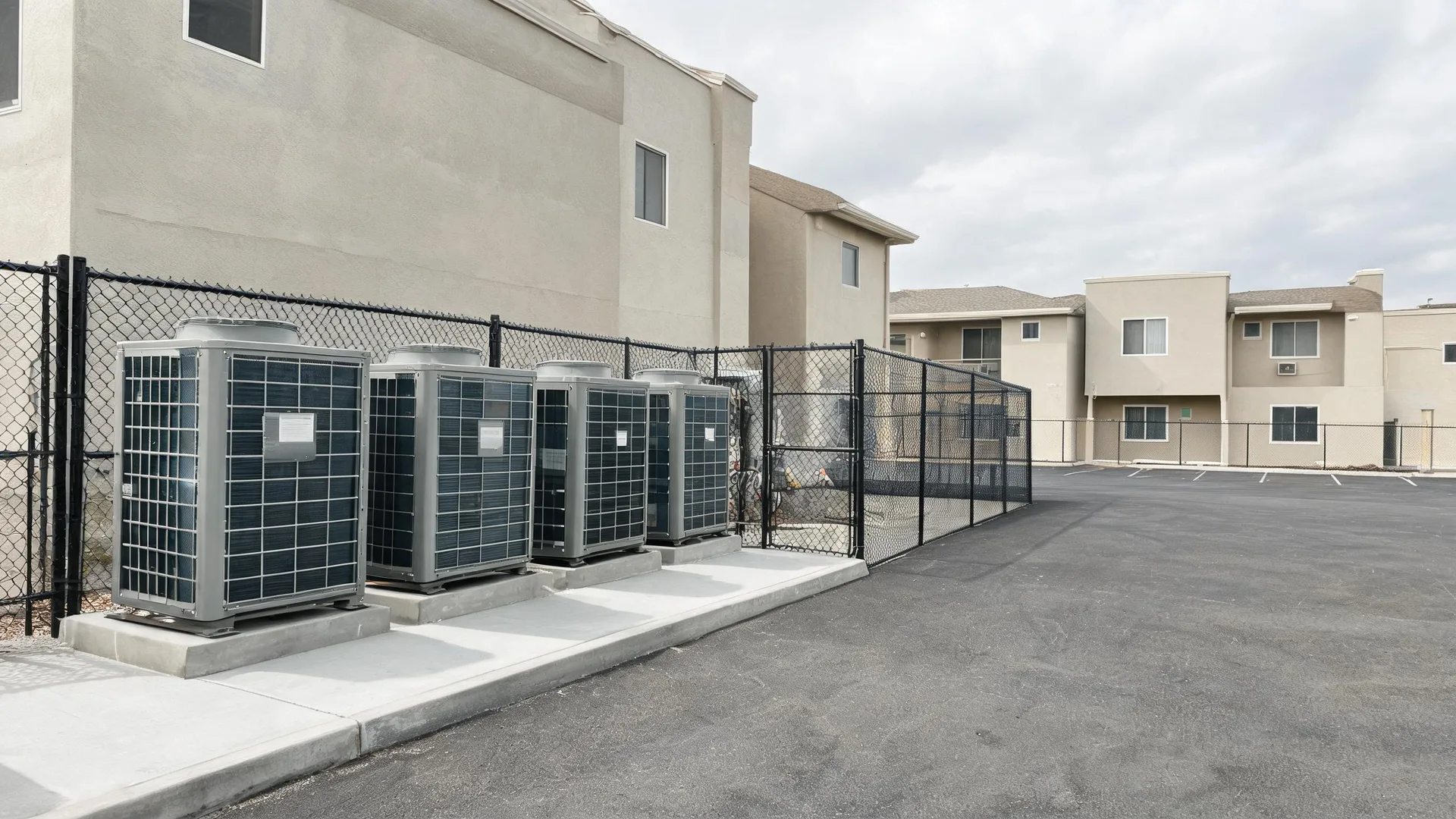
A gray outdoor HVAC unit mounted on a concrete pad beside a house with gray lap siding and a stone foundation.

Your heat pump tells you before it quits

A heat pump that's running fine doesn't announce itself. One that needs attention does, and the signs show up in how it behaves, not just whether it turns on. It runs longer than it used to without the house feeling any warmer. It blows air that's barely lukewarm instead of properly warm. It short cycles, kicking on and off in quick bursts rather than settling into a steady run. Outside, the unit ices over and doesn't clear itself in the defrost cycle the way it should. Indoors you might hear it straining, a hum before startup that goes on too long, or a clunk when the reversing valve switches the system between heating and cooling. Any one of these is the system telling you a part is working harder than it should to make up for something that's failed or is about to.

What's safe to check yourself

Look at the outdoor unit and clear away leaves, mulch or anything stacked against it so air can move through the coil. Check that the filter isn't clogged, since a blocked filter can starve the system and get mistaken for a bigger problem. Check the thermostat is set to heat and the batteries aren't dead. Check the breaker hasn't tripped. These take a few minutes and rule out the simple causes before anything else gets blamed.

What to leave alone

Don't open the outdoor cabinet or touch the refrigerant lines. A low charge has to be diagnosed and refilled by someone with the right gauges, not topped off by guesswork. Don't keep flipping the breaker if it trips again after you reset it. That's the system telling you something is actually wrong, and running it anyway risks turning a repair into a bigger one.

A heat pump that's struggling doesn't fail cleanly. It fails by making something else work harder to cover for it. A weak capacitor forces the compressor to pull more current every time it starts, and that strain adds up the longer it's left in place. A low charge makes the compressor run long and hot trying to move heat it doesn't have enough refrigerant to carry. A coil that can't clear its ice buildup forces the defrost cycle to run more often, which pulls heat right back out of the house it just added. None of that resets itself by running more. The part under strain stays under strain, and the parts around it start taking the load too, until something that was a simple fix becomes a compressor replacement instead.

The decision usually comes down to what actually failed, not how old the unit is. A capacitor, a contactor, a defrost sensor, these are wear parts, and replacing one brings the whole system back to normal. The compressor is different. It's the one part that isn't really repaired, only replaced outright, and a compressor job on an old system often costs enough that putting that money toward a new one makes more sense. So the real question isn't age, it's which part is asking for the money. A system can run for years on its original compressor and still need a handful of smaller repairs along the way, and that's normal wear, not a system falling apart. What changes the math is a system that's needed several different repairs in a short stretch. That pattern means the parts around the original fault are starting to fail too, and it's worth asking whoever's diagnosing it whether you're fixing the cause or just the latest symptom.