



A lit brick residential street at dusk showing a row of two-story homes with covered porches and mature trees.

Heat Pump Repair in Fond du Lac, WI

Tell us about the job

Takes about a minute. No obligation.

RepairHeat PumpFond du Lac County, WI
Step 1 of 2

What ZIP code is the job in?

Winters here are the real test for a heat pump. Overnight lows average 13°F across December, January and February, and that's when the system is working hardest to pull heat out of cold air. A heat pump that's struggling in that stretch isn't failing because of anything odd about Fond du Lac. It's usually a frozen coil that isn't defrosting on schedule, a low refrigerant charge, or a reversing valve stuck in the wrong position. None of that is unusual for the climate here. It's the same handful of problems a contractor sees on any heat pump pushed hard through a cold winter, and they're the kind of thing a proper diagnosis finds fast.

9 months
September through May, your system heats
3 months
June through August, it cools
13°F
the average winter night it heats against
79°F
the average summer afternoon it cools against
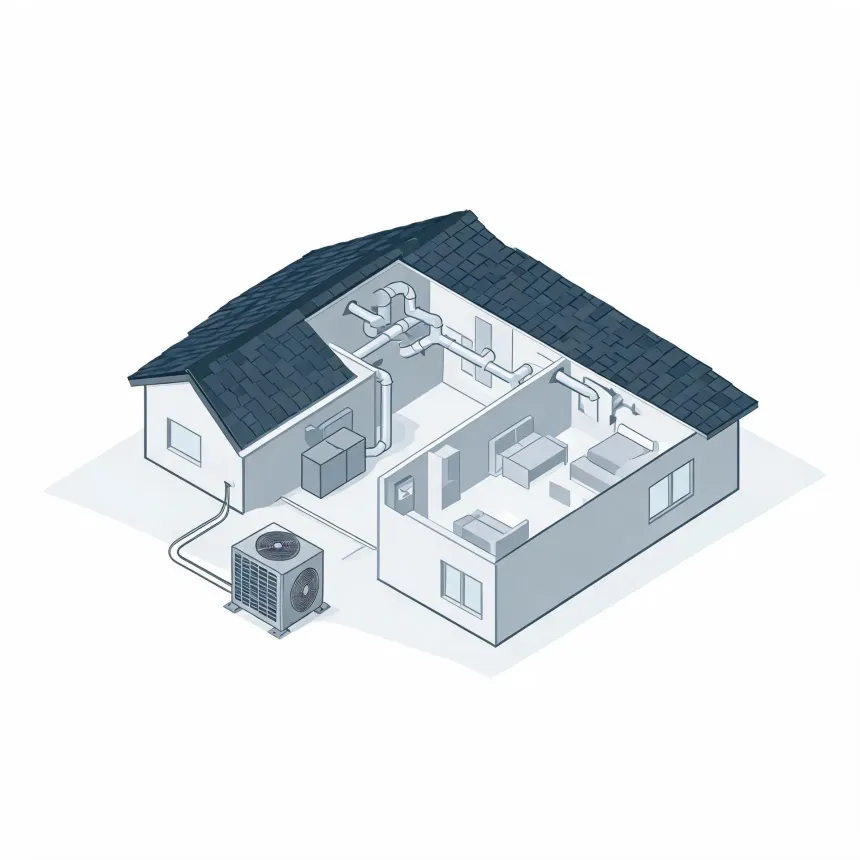
Isometric cutaway illustration of a single-story house showing interior rooms, ceiling ductwork, an indoor air handler, and an outdoor condenser unit connected by lines on the ground.
Your system heats September through May and cools June through August.

NOAA nClimDiv, 1991–2020 normals

Heat pumps here run nearly nine months straight, September through May.

August is when a weak part fails, right before the system has to carry the full heating load.

Fond du Lac runs older homesHalf the homes in the county were built in 1971 or earlier.

Wisconsin electricity runs 17.18 cents per kilowatthour, among the higher rates homeowners pay for power. A heat pump working against a frozen coil or a low charge draws more of that expensive power to make the same amount of heat, and it does that every hour it runs. This is a machine that barely shuts off most of the year here, so the extra draw adds up fast. A unit that's struggling isn't just less comfortable to live with. It's costing you on every bill until the real problem gets fixed.

Get the real cause found before another bill comes

That extra draw shows up on every bill until a contractor finds the actual cause. A frozen coil or a low charge doesn't fix itself, and this is a machine that runs most of the year here.

Find a contractor
A man in a dark long-sleeve shirt and tan work pants carries a worn tool bag up concrete steps toward a green front door of a house with siding and a potted shrub.
A dark gray heat pump unit mounted on a concrete pad next to a house with gray siding and a stone veneer wall.

Ask the age along with the diagnosis

If your heat pump came with the house and the house is on the older side for this county, ask the contractor for the unit's age along with the diagnosis. Half the homes in Fond du Lac County went up in 1971 or earlier, and a heat pump doesn't last as long as the house around it. A frozen coil or a bad reversing valve might be a straightforward fix on a newer unit and a sign to stop repairing on an old one. Get the age and the diagnosis together before deciding what to do next.

What you can check first

Look at the outdoor unit. If it's caked in ice or snow, that alone can stop a heat pump from heating right, and it's safe to clear snow off the top and sides by hand. Check the thermostat is set to heat, not fan only, and that the temperature you want is actually above room temperature. Inside, pull the filter and hold it to the light. If you can't see through it, swap it or wash it if it's a reusable one. A clogged filter starves the system of airflow and can make a working heat pump act like a broken one.
What to leave alone

Don't chip ice off the coil or spray it with water. The defrost cycle is supposed to handle frost on a schedule, and forcing it can bend fins or crack the coil. Don't reset the breaker more than once if it trips again right away, that's the system telling you something is actually wrong, not asking for a second chance. And don't open the refrigerant lines or panels covering the compressor. That part of the job needs gauges and a license, not a wrench.

A heat pump fails the same handful of ways whether it's brand new or on its last season. The reversing valve is usually first. It's what switches the system between heating and cooling, and the coil that does that thousands of times a year eventually sticks or leaks. A capacitor is next. It gives the compressor and fans the jolt they need to start, and a weak one makes the outdoor unit hum and try without actually starting. Low refrigerant charge is another, almost never from the refrigerant wearing out but from a slow leak at a fitting or coil, and a system low on charge works harder for less heat. The defrost control board can fail too, the part that tells the system when to melt frost off the outdoor coil, and when it stops working right the coil ices over and stays that way. None of these announce themselves clearly. They show up as a system that runs constantly, blows air that isn't quite warm enough, or short-cycles on and off.

A diagnostic visit starts outside at the unit itself. A contractor checks the coil for ice, checks that the fan spins freely, and checks the refrigerant pressures with gauges rather than guesswork. Inside, they check the temperature of the air coming out of the vents against the air going in. That difference tells them whether the system is actually moving heat the way it should. They switch the system between heating and cooling to see whether the reversing valve clicks into place like it should. Electrical readings come next. The capacitor, the contactor and the wiring at the compressor all get checked against what the unit is supposed to draw. A heat pump either holds the right pressures and temperatures or it doesn't, and those readings point straight at the part that's failing.