A two-story dark-sided house with a covered front porch behind a trimmed hedge, framed by large green trees, photographed from ground level with blurred grass in the foreground.

Heat Pump Repair in Baraboo, WI

Tell us about the job

Takes about a minute. No obligation.

RepairHeat PumpSauk County, WI
Step 1 of 2

What ZIP code is the job in?

Winters here just mean the heat pump works for its keep

December through February, Baraboo nights average 13°F. A heat pump still has heat to pull from at that temperature, but it runs longer and leans on backup heat more than it does in milder months. That's normal operation, not a sign of damage.

So a breakdown is usually a part, not the climate

When a heat pump stops heating or cooling right, the cause is typically a failed capacitor, a refrigerant leak, or a bad control board, the same things that go wrong with this equipment anywhere. A contractor can trace it to the actual part and fix that, rather than treating the system as if the cold wore it out.

8 months
October through May, your system heats
3 months
June through August, it cools
13°F
the average winter night it heats against
80°F
the average summer afternoon it cools against
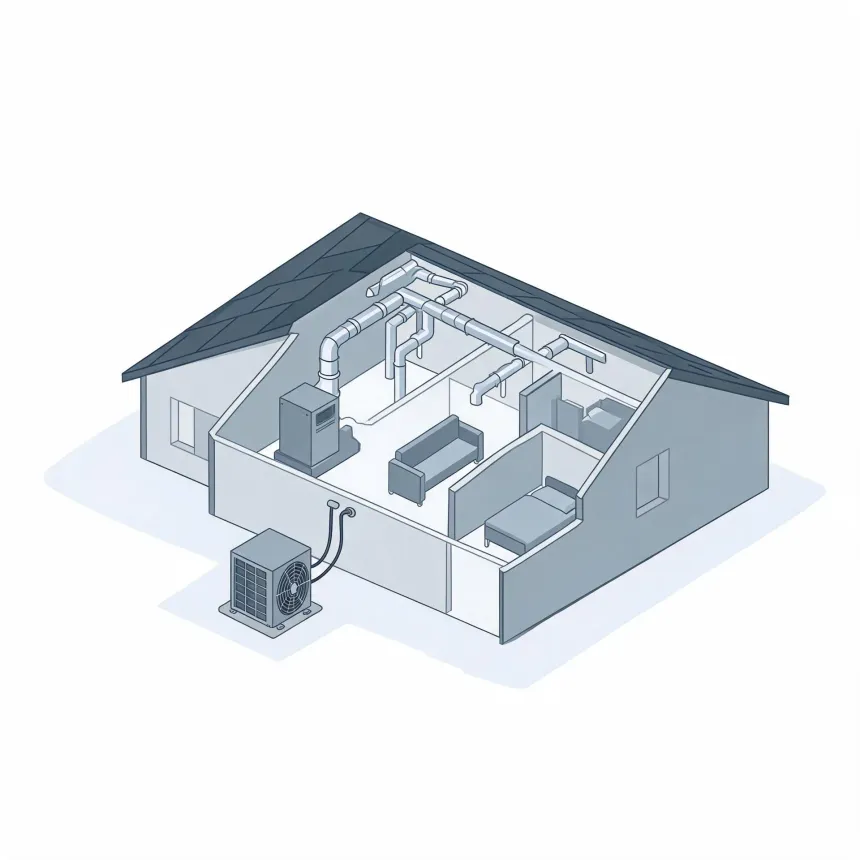
Isometric cutaway illustration of a single-story house showing interior rooms with furniture, an attic duct network connected to a furnace or air handler, and an outdoor condenser unit linked by lines outside the wall.
Your system heats October through May and cools June through August.

NOAA nClimDiv, 1991–2020 normals

Air coming from the vents that isn't warm, or a heat pump that runs nonstop without catching up, means a part has failed somewhere in the system.

A failed part is something a contractor can find and replace, not a reason to plan on replacing the whole system.

Half the homes here were built since 1983, so a lot of heat pumps still have years left

Half the homes here were built by 1983
61 damaging wind events from 2015 to 2024
22 hail events from 2015 to 2024

Wisconsin homes paid 17.18 cents per kilowatthour in 2024, on the higher side for this part of the country. A heat pump that's lost its charge or is running on a weak capacitor doesn't heat or cool the way it should, so it runs longer to do the same job. Every extra hour it runs at that rate shows up on the bill. Backup heat costs more to run than the heat pump itself, and a system with a bad part leans on it more than it needs to. Getting the part fixed stops that waste. Waiting just means paying it another month.

A newer system is worth fixing, not replacing

If the heat pump came with the house, there's a good chance it's not old enough to be the problem. Call for a repair and find out what actually failed.

Find a contractor
A man in a cap, dark work shirt and tan pants carries a worn canvas tool bag up gray steps toward a green paneled front door of a shingled house, with a potted shrub beside the entry.
A gray heat pump condenser unit mounted on a concrete pad against the gray lap-siding exterior wall of a house.

What actually happens when someone comes to look at it

A diagnostic starts outside, at the outdoor unit. A tech checks the refrigerant charge, looks at the compressor, and runs the system through both modes to see where it stops doing its job. Static pressure gets checked too, along with the readings off the control board, since those point to whether the problem is refrigerant, electrical, or airflow before anything gets taken apart. Inside, they'll check the air handler, the indoor coil, and the thermostat's calls against what the unit is actually doing. A heat pump that runs but won't satisfy the thermostat is telling a different story than one that short cycles or won't start at all, and the tech is listening for which story this is. Once the failed part is found, they can tell the homeowner what it is and what fixing it involves, instead of guessing at the whole system.

The reversing valve has no equivalent in a furnace

A heat pump switches between heating and cooling with one part, the reversing valve. When it sticks, the system gets stuck in one mode. You ask for heat and get cool air, or the system won't switch back at all.

The outdoor coil does double duty

The outdoor coil has to release heat in summer and pull heat from the air in winter. Dirt on the fins, a bent coil, or a failing fan motor all slow that exchange down, and the system runs longer to move the same amount of heat.

A heat pump that's low on refrigerant or struggling on a weak compressor will still run when you ask it to. It just won't catch up, so it keeps calling for more runtime to hit the thermostat's setting. That extra runtime is hard on parts that were already failing. A compressor working against a low charge runs hotter than it should, and heat is what wears a compressor down. The reversing valve takes the same kind of punishment if it's sticking rather than failing outright. Letting the system keep cycling under those conditions turns a part replacement into a compressor replacement, which is a different repair and a bigger one.

Most of the time, a heat pump problem is a part problem, and parts get replaced, not the whole system. The compressor is the one part that changes that math. It's the most expensive component in the unit, and if it's failed outright rather than just running hot, a contractor will walk through whether putting in a new one makes sense next to replacing the system outright. Age matters here more than anything else about the unit. A heat pump that's a few years in in with a bad capacitor or a stuck reversing valve is worth fixing without a second thought. One that's near the end of its expected life and now needs a compressor is a different conversation, and a contractor can lay out both sides instead of just quoting the repair. Ask what failed and why before you ask what it costs to fix. That answer tells you whether this is a one-time thing or the first of several.