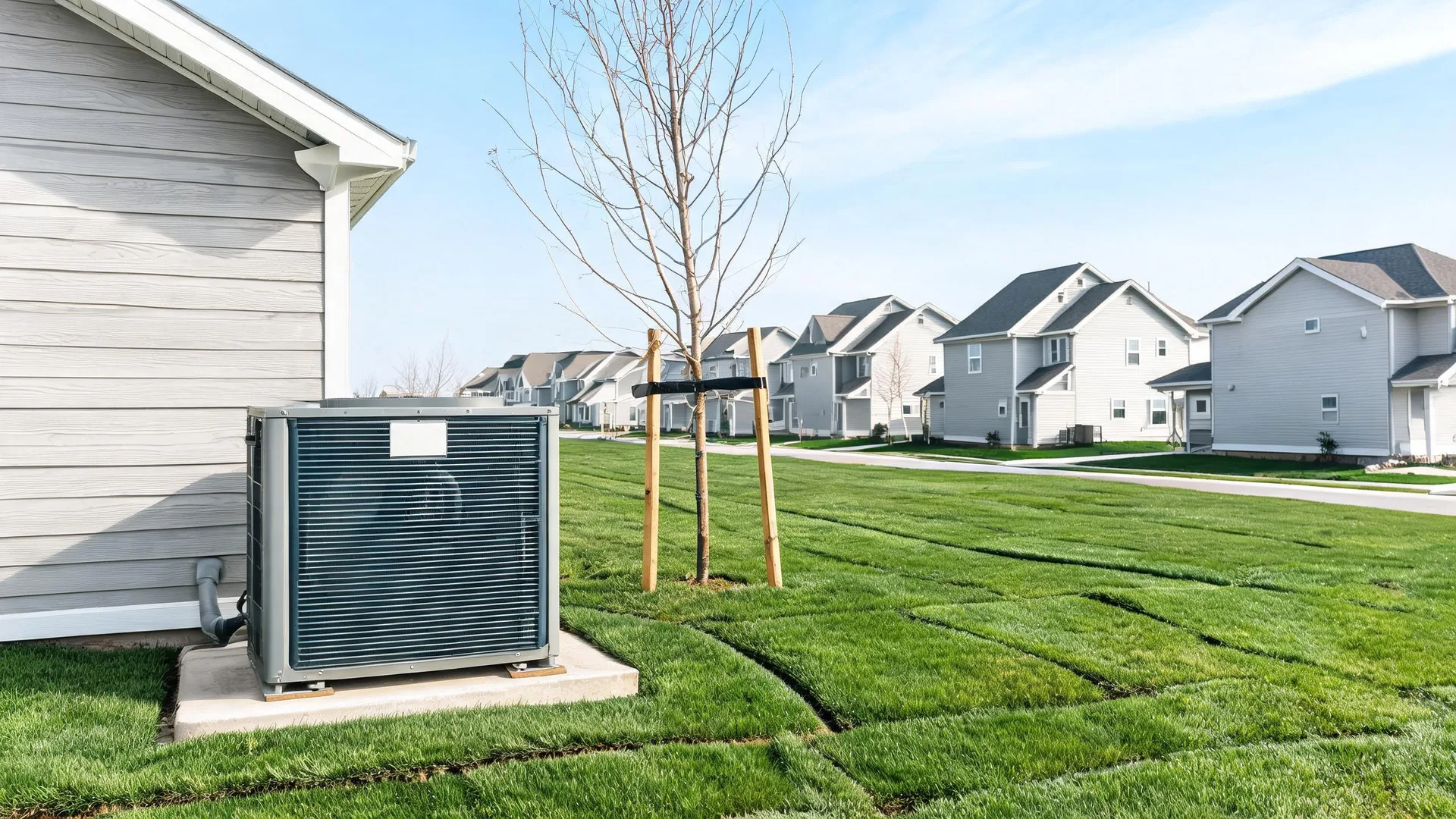
September is when weak units show up
Your heat pump switches over to heat in September after sitting idle most of the summer. If a part was already marginal, this is when it gets asked to work hard and fails.
Takes about a minute. No obligation.
Your heat pump switches over to heat in September after sitting idle most of the summer. If a part was already marginal, this is when it gets asked to work hard and fails.
Heat runs here from September through May, nine months out of the year. Getting a repair done early in that run means it's sorted out before the harder, colder months test it again.

NOAA nClimDiv, 1991–2020 normals
Amery winters average 7°F overnight through December, January and February.
A heat pump that struggles to keep up at that temperature usually has a specific fault, not a design that's failing against the cold.



Electricity in Wisconsin ran 17.18 cents per kilowatthour in 2024. A heat pump that's low on charge or struggling to defrost pulls more power to do the same job, and it's running most months of the year here. A fault like that doesn't show up as one big bill. It shows up as a little extra on every bill, month after month, for as long as it runs that way. Worth having someone find the actual cause rather than letting it keep pulling extra power to limp along.
Half the homes in Polk County were built in 1981 or later. If yours is one of them, the heat pump likely isn't old enough to be the problem. A repair makes sense on a system that still has years ahead of it.
Find a contractor
If your heat pump came with the house, check when that was built. On the newer side of the county, there's no reason to treat this repair as throwing money at something on its way out. Get the actual fault found and fixed, and let it keep running.
The reversing valve is what sends the heat pump into heat or into cooling, and it's always sitting in one position or the other. A stuck or leaking valve shows up as a system blowing air that isn't the temperature you asked for, or one that won't come out of cooling mode at all.
The outdoor unit clears frost on its own through a short defrost cycle during cold weather. When the sensor or control board that runs that cycle fails, frost builds up on the coil and stays there, and the system loses its ability to pull heat from the outside air.
A heat pump that's struggling usually tells you before it quits outright. Warm air blowing that isn't actually warm is the most common one, the system runs, the fan moves air, but it doesn't feel like heat at the register. Short cycling is another, where the unit kicks on, runs a few minutes, and shuts off again before it's done anything useful. Listen for it taking longer than it used to, or running long stretches without ever seeming to catch up to the thermostat. A hissing or bubbling sound from the outdoor unit points to refrigerant, not something to wait out. Any of these is the system telling you a part failed. None of them get better on their own.
A diagnostic visit starts outside, at the unit itself, checking refrigerant pressure and the temperature split between the air going in and the air coming out. That split tells a tech whether the system is actually moving heat the way it should. From there it's the reversing valve, checked by watching it switch between modes, and the defrost control, checked by running the cycle and watching whether frost actually clears. Electrical components get tested under load, not just looked at, because a capacitor or contactor can look fine sitting still and still fail the moment it's asked to do work. The point of all this is to find the one part that's actually failed, not to replace parts until something works. A system that's losing refrigerant gets found and sealed, not just topped off, because topping off without finding the leak means doing it again in a few months.