A row of dark-sided single-story buildings with gabled shingle roofs behind a tall trimmed hedge, with lawn, leafy trees and an overcast sky.

AC Repair in Wisconsin Rapids, WI

Tell us about the job

Takes about a minute. No obligation.

RepairCentral ACWood County, WI
Step 1 of 2

What ZIP code is the job in?

Warm air from the vents means the system isn't cooling, not just running weak

An AC that blows warm or barely cool air usually points to a refrigerant leak, a failing compressor, or a coil that froze up and has since thawed. It will not get better by running the system longer or setting the thermostat lower.

Shutting off a few minutes after starting means something is tripping it early

A dirty coil, a weak capacitor, or a sensor reading wrong can all cause a short cycle. Each time the compressor starts and stops like that, it takes a hard jolt, and compressors are not built to take many of those.

2 months
July through August, your air conditioner is on duty
79°F
the average summer afternoon it cools against
45 hail events
in ten years, and hail bends the fins on outdoor coils
47 wind events
in ten years, and wind drives debris into outdoor units
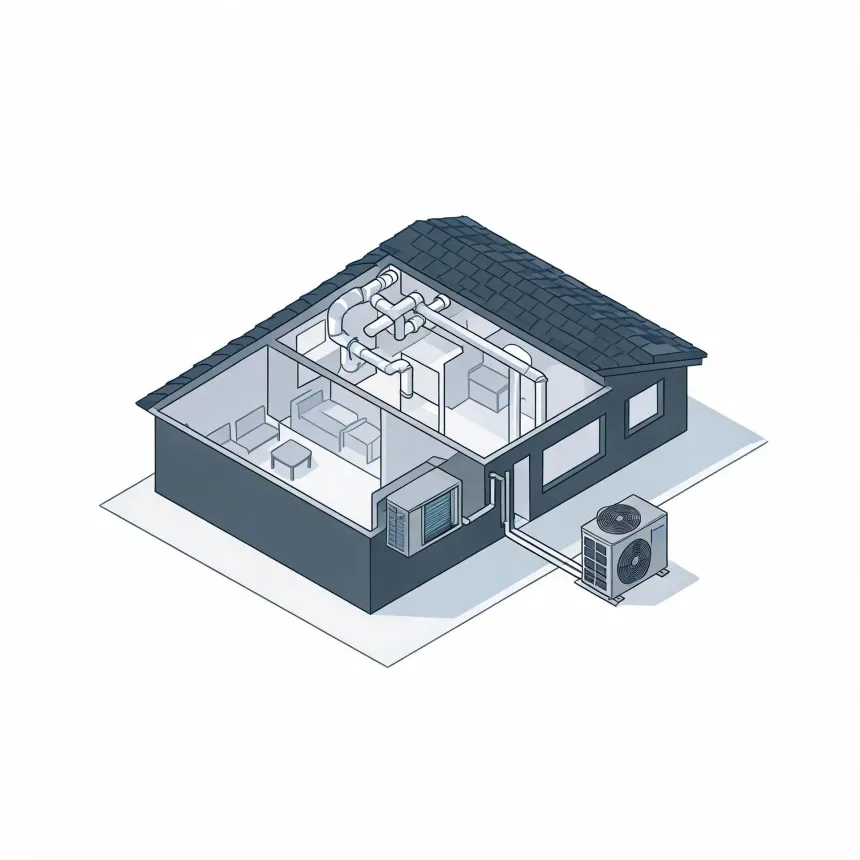
Isometric line illustration of a cutaway single-story house showing interior rooms with furniture, ceiling ductwork, an indoor air handler, and an outdoor condenser unit connected by lines along the exterior wall.
Your air conditioner works hardest from July through August.

NOAA nClimDiv, 1991–2020 normals

Your air conditioner only has to work two months a year here, July and August.

A unit that sits idle most of the year is usually still in good shape underneath, so most repairs are worth making.

Nothing about Wisconsin Rapids wears out an AC faster. When one quits here, it's the same handful of causes you'd find anywhere else.

Power costs 17.18 cents a kWh statewide
Climate zone 6A
Cooling runs July through August
Older homes, older systemsHalf the homes in Wood County were built in 1972 or earlier

Wood County has had its share of rough weather, with damaging wind hitting the area 47 times between 2015 and 2024. None of that is what wears out an air conditioner. Wind and hail can damage an outdoor unit directly, a bent fin, a cracked fan blade, debris in the cabinet, but that's a different problem from the slow wear that takes down most systems. If a storm came through right before the trouble started, that's worth telling a contractor. Short power interruptions don't harm the unit itself. If yours hasn't run right since the last outage, say so when you call, since that points to something specific rather than ordinary age.

Two months of work a year, most of this is worth fixing

Get a contractor to look at it before deciding it's done. A system that only runs July and August usually hasn't been pushed hard, so the part underneath the problem is often still sound. Whatever's causing the warm air or the short cycling is worth tracking down.

Find a contractor
A man seen from behind in a navy T-shirt and tan work pants carries a canvas tool bag up concrete steps toward a green front door, with a potted shrub to the right.
An outdoor residential air conditioning condenser unit mounted on a concrete pad, surrounded by gravel with a blue sky in the background.

One bad part is a repair, a tired compressor is a different conversation

A compressor doesn't fail the moment it's worn. It fails a little more every time it starts, every time it runs low on refrigerant, every time dirt on the coil makes it work harder to move the same heat. None of that shows up as a sudden event. It shows up as a system that used to keep up and now doesn't quite, or one that used to start quiet and now hums first. Repair makes sense when the failure is a single part doing a job the rest of the system can still support, a bad capacitor, a stuck contactor, a leak that gets found and sealed. Replacement starts to make more sense when the compressor itself is the thing failing, since that's the part everything else depends on, and there's no patching a compressor that's worn out inside. Age alone doesn't decide it. How the system has been run and maintained matters more than the number of years on the nameplate.

The capacitor gives out first

The capacitor kicks the compressor and fan motor on and holds them running steady. It's the part most likely to fail, since it takes a small jolt every time the system starts. A weak one causes humming, slow starts, or a system that won't start at all.

A slow refrigerant leak hides for a while

A refrigerant line or coil can develop a small leak that takes a season or more to show up as weak cooling. By the time the air runs warm, enough has escaped that the compressor is working harder than it should. Topping off the charge without finding the leak just buys a little time.

An outdoor central air conditioning unit mounted on a concrete pad beside a blue-sided house at sunset.

A new air conditioner would save little on running costs in Wood County, so the repair decision comes down to the unit's condition.

  • A new one at the federal minimum, 13.4 SEER2$130 a year
  • An older air conditioner$140 a year

Estimates for a typical Wood County home, compared with an older unit built to the previous federal minimum, from EIA household energy data, Wisconsin fuel prices and NOAA climate normals. Your home will differ.

Repair makes sense when a part like a capacitor or contactor has failed.

Replacement makes sense when the compressor has failed or the system uses R-22 refrigerant, which is no longer made.

A diagnostic starts outside at the unit itself, checking the capacitor, the contactor, and the refrigerant pressure with gauges. The tech will run the system and watch how it behaves, not just whether it starts but how it starts, since a slow start or a hum before kickoff points to specific parts. Inside, they'll check the coil for ice or dirt and look at airflow through the vents, since weak airflow can mimic a refrigerant problem. Electrical readings at the compressor tell whether it's drawing the current it should or straining to do its job. Most of this gets answered without opening anything up permanently, through readings and watching the system run a full cycle. What they find determines whether you're looking at a part swap or a harder conversation about the unit's age.