





A low ground-level view across a mown lawn toward a dark two-story house with a covered front porch, flanked by large leafy trees under an overcast sky.

AC Repair in Whitewater, WI

Tell us about the job

Takes about a minute. No obligation.

RepairCentral ACWalworth County, WI
Step 1 of 2

What ZIP code is the job in?

Summers in Whitewater run about three months, June through August, with afternoon highs averaging around 81. That's a normal cooling load, not a hard one. An AC acting up here is almost always a normal problem too. A weak capacitor, a low charge, a dirty coil, something worn out from running the usual summer and nothing more. The fix is finding which one it actually is, not guessing at the most common answer and hoping.

3 months
June through August, your air conditioner is on duty
81°F
the average summer afternoon it cools against
43 hail events
in ten years, and hail bends the fins on outdoor coils
74 wind events
in ten years, and wind drives debris into outdoor units
Isometric cutaway illustration of a house interior showing ducted HVAC piping, an indoor air handler unit, and an outdoor condenser with fan connected by a line, rendered in grey tones on a white background.
Your air conditioner works hardest from June through August.

NOAA nClimDiv, 1991–2020 normals

June is when cooling starts in Whitewater, right after May.

Get the AC looked at in May, before the first hot stretch finds the weak part.

Walworth County sees its share of wind, hail and winter storms. None of it is why your AC is acting up.

151 severe weather events from 2015 to 2024
18% of homes statewide lost power a day or more in 2024
74 damaging wind events from 2015 to 2024

Electricity in Wisconsin ran 17.18 cents per kilowatt-hour in 2024. An AC that's low on charge or running on a weak capacitor draws more than it should to do the same job. That extra draw shows up on the electric bill before the unit ever fails outright. A system that's short-cycling or running longer than it needs to is spending more every month it goes unfixed. Finding the actual cause stops that, where a quick patch usually doesn't.

Your AC problem isn't unusual. Get it diagnosed.

Half the homes in Walworth County were built in 1977 or earlier, half in 1977 or later. Either way, the age of the house doesn't tell you the age of the AC. What's acting up is whatever part has worn out from running the usual summer, old house or new. Get the actual cause found before you spend another month paying for it.

Find a contractor
A man in a dark long-sleeve shirt and olive cargo pants, seen from behind, carries a waxed canvas tool bag up porch steps toward a green front door of a gray clapboard house.
An outdoor residential air conditioning condenser unit mounted on a concrete pad, surrounded by gravel with a blue sky in the background.

What to check before you call

Before anyone comes out, there's a few things worth checking yourself. Look at the thermostat first. Make sure it's set to cool and set below room temperature, and change the batteries if it's been a while. Next, go to the breaker panel and check that the AC breaker hasn't tripped. If it has, reset it once. If it trips again, stop and leave it off. Check the air filter. A filter clogged with dust chokes off airflow and can make the whole system struggle, and it's the one thing on this list you can actually fix yourself. Outside, look at the condenser unit and clear away any leaves, grass clippings or debris piled against it. It needs open air around it to work. Inside, check that no vents are blocked by furniture or closed all the way. None of this fixes a bad capacitor or a low charge, but it rules out the simple stuff first.

A weak part under a bigger load gets weaker

A capacitor that's starting to go still kicks the compressor on, just slower and with more strain each time. A coil that's a little dirty still moves air, just less of it. Keep running the system on either one and the strain doesn't stay level. It climbs, because the part is doing the same job with less to give.

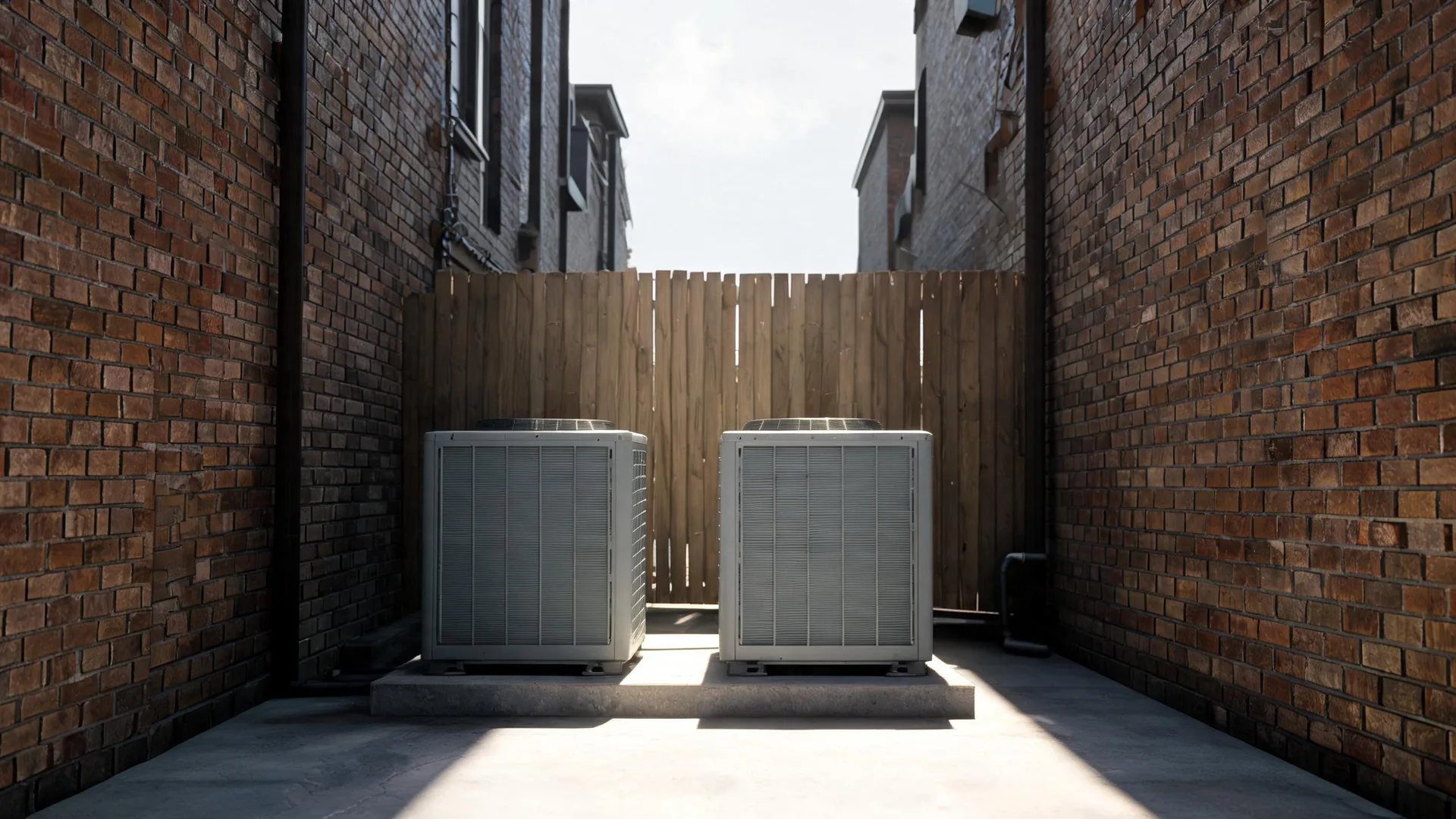
One worn part can take others with it

A compressor is built to run with the right amount of refrigerant moving through it. Run it low on charge and it starts working harder to do the same job, and it heats up more than it should. A compressor that overheats enough times can fail for good, which turns a repair into a replacement.

An outdoor central air conditioning unit mounted on a concrete pad beside a blue-sided house at sunset.

A new air conditioner would save little on running costs in Walworth County, so the repair decision comes down to the unit's condition.

  • A new one at the federal minimum, 13.4 SEER2$180 a year
  • An older air conditioner$190 a year

Estimates for a typical Walworth County home, compared with an older unit built to the previous federal minimum, from EIA household energy data, Wisconsin fuel prices and NOAA climate normals. Your home will differ.

Repair makes sense when a part like a capacitor or contactor has failed.

Replacement makes sense when the compressor has failed or the system uses R-22 refrigerant, which is no longer made.

Most of the time, an AC problem is worth fixing. Capacitors, contactors, fan motors, low charge, these get replaced on their own and the system runs fine for years after. Replacement makes more sense when the compressor itself has failed, or when the refrigerant is an older type that's expensive and hard to source. Age matters too, but not on its own. An old system that's been running fine on a repaired part is still worth repairing. The same system failing a second or third time in a short stretch is telling you something different. A tech who's actually inspected the unit can tell you which situation you're in. Anyone willing to guess without looking at it isn't giving you an answer worth trusting.