





A two-story black house with a covered porch, framed by large deciduous trees and trimmed hedges, photographed from a low angle across a lawn with blurred grass in the foreground.

AC Repair in Sheboygan, WI

Tell us about the job

Takes about a minute. No obligation.

RepairCentral ACSheboygan County, WI
Step 1 of 2

What ZIP code is the job in?

Your AC only has to work about two months a year here, July and August, with afternoon highs averaging around 78°F. That's a light load compared to what the same unit would carry further south. So when something goes wrong, it's rarely because the system has been run into the ground. More often it's a capacitor that's given out, a dirty coil, or a refrigerant leak that's been sitting unnoticed. That kind of problem is usually worth fixing rather than replacing the whole unit. Sheboygan County does see its share of wind and hail, so outdoor units can take a hit a system in a calmer climate wouldn't.

2 months
July through August, your air conditioner is on duty
78°F
the average summer afternoon it cools against
22 hail events
in ten years, and hail bends the fins on outdoor coils
46 wind events
in ten years, and wind drives debris into outdoor units
Isometric cutaway illustration of a single-story house showing interior rooms, ceiling ductwork, an indoor air handler, and an outdoor condenser unit connected by lines, in gray and white tones on a white background.
Your air conditioner works hardest from July through August.

NOAA nClimDiv, 1991–2020 normals

June is the month to get your AC looked at, before it has to run in July.

A weak capacitor or low charge usually gives out in that first hot stretch, so checking it in June catches it before August does.

Half the homes here were built by 1970, old enough that the AC may be near the end of its life

Half the homes here were built by 1970
Cooling runs July through August
Summer afternoons average 78°F

Electricity here ran 17.18 cents per kilowatt-hour in 2024, a bit above the national average. That matters most when the fix under discussion is a full system replacement rather than a repair, since a more efficient unit shows up on the bill over the following summers. It matters less for a one-time repair like a capacitor or a refrigerant leak, where the part costs the same no matter what you pay per kilowatt-hour. Worth asking the contractor, when a repair is pricey, whether the unit is old enough that the math shifts toward replacing it instead.

Most AC problems here are worth repairing

A light load usually means a fixable problem, not a dying unit. Get the actual cause checked out instead of assuming the worst.

Find a contractor
A man in a gray long-sleeve shirt and brown pants, seen from behind, carries a canvas tool bag up wooden steps toward a green front door.
A gray metal air conditioning condenser unit mounted on a concrete pad in a flat grassy field under a partly cloudy sky.

Ask how old the system actually is

If your AC came with the house, ask the contractor how many years it has left before you agree to a repair. Half the homes in the county were built in 1970 or earlier, so plenty of systems have already been swapped out once without the homeowner tracking when. A repair is still worth doing on a unit with years ahead of it. It's a different conversation on one that's near the end.

A weak capacitor can take the compressor with it

A capacitor that's starting to fail still kicks the compressor on, just with a harder pull of current each time it starts. Run it like that long enough and the compressor windings take the damage instead of the capacitor. Replacing a capacitor is a quick job. Replacing a compressor usually means a new outdoor unit.

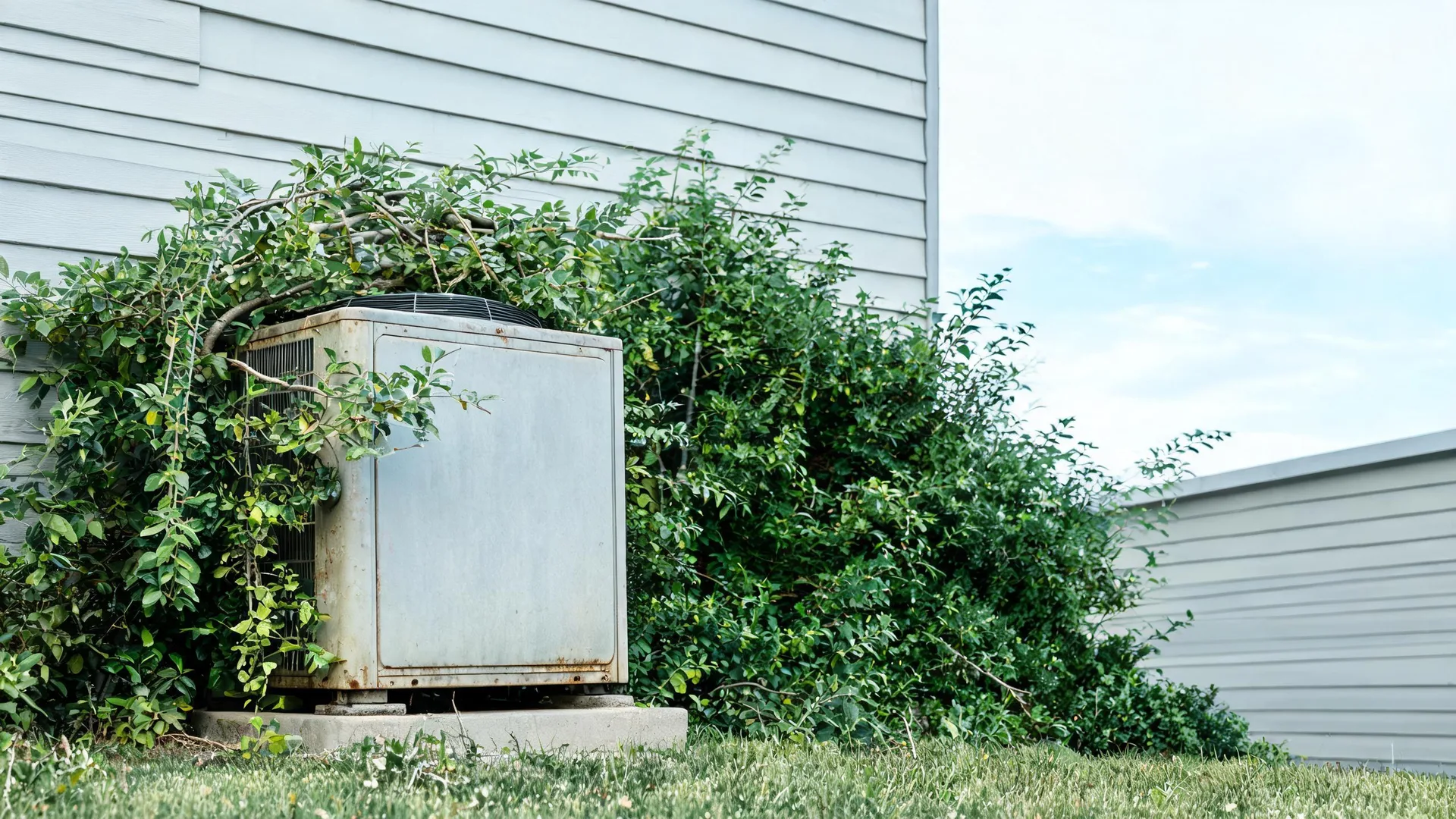
A slow refrigerant leak gets worse at the coil

Low charge forces the system to run longer to reach the same temperature, and that extra runtime lets the evaporator coil frost over. Ice on the coil blocks airflow, which drops the cooling effect further and feeds the same cycle. What started as a leak worth patching can end with a coil that needs replacing.

Aerial view of a gray central air conditioning condenser unit on a concrete pad next to a house with vinyl siding.

A new air conditioner would save little on running costs in Sheboygan County, so the repair decision comes down to the unit's condition.

  • A new one at the federal minimum, 13.4 SEER2$130 a year
  • An older air conditioner$140 a year

Estimates for a typical Sheboygan County home, compared with an older unit built to the previous federal minimum, from EIA household energy data, Wisconsin fuel prices and NOAA climate normals. Your home will differ.

Repair makes sense when a part like a capacitor or contactor has failed.

Replacement makes sense when the compressor has failed or the system uses R-22 refrigerant, which is no longer made.

A diagnostic starts outside, with the condenser unit off, checking the capacitor's charge and the contactor for pitting. Next comes the refrigerant charge, checked with gauges at the service valves, since both low and overcharged systems show up as weak cooling. Indoors, the tech checks airflow at the vents, pulls the filter if it's accessible, and looks at the evaporator coil for frost or buildup. A clamp meter on the compressor's run current tells them if it's pulling harder than it should, which points back to that capacitor before it fails completely. If the coil's frosted over, they'll shut the system down to let it thaw before doing anything else, since you can't get an accurate reading through ice. By the end they can usually point to one part and tell you straight whether it's a quick fix or something bigger.