An outdoor air conditioning condenser unit on a concrete pad next to the gray vinyl siding of a residential home.

AC Repair in River Falls, WI

Tell us about the job

Takes about a minute. No obligation.

RepairCentral ACPierce County, WI
Step 1 of 2

What ZIP code is the job in?

Three months of work a year

Air conditioners in Pierce County run from June through August and sit idle the rest of the year. The afternoon high those months averages 79°F, and the dew point averages 60°F, lower than most of the country. A compressor that only has to fight that kind of heat a few months a year doesn't wear the way one running longer, heavier summers does.


What that means for a repair call

A system here has usually logged a lot less strain than the same unit would see further south. If yours is breaking down, age, a stuck part, or something missed on a service call is a more likely cause than the machine being worked to death. That's a better starting point for a repair than a replacement.

3 months
June through August, your air conditioner is on duty
79°F
the average summer afternoon it cools against
24 hail events
in ten years, and hail bends the fins on outdoor coils
31 wind events
in ten years, and wind drives debris into outdoor units
Isometric line illustration of a cutaway house showing an indoor air handler with branching ducts in the attic space, connected by a line set to an outdoor condenser unit beside the building, with simple furniture in two rooms.
Your air conditioner works hardest from June through August.

NOAA nClimDiv, 1991–2020 normals

A warm air conditioner usually means low refrigerant, not a dying compressor.

That's a leak a tech can find and seal, not a reason to replace the unit.

A newer house behind it usually means more life left in the system

Half the homes here were built by 1980
Climate zone 6A
Power here costs 14.70 cents per kilowatt-hour

Before anyone comes out, check the thermostat is set to cool and the setpoint is actually below room temperature. Go look at the outdoor unit. If the fan isn't spinning and you don't hear any hum, check the breaker first, that trips more often than people expect. A dirty filter is worth a look too, since restricted airflow across the indoor coil can cause it to ice over, and a frozen coil will make the system blow warm air no matter what else is wrong. If you do see ice on the coil or the lines, switch the system off and let it thaw fully before anyone diagnoses it further, otherwise the real problem gets harder to find. Clear away any leaves, grass clippings or mulch piled against the outdoor unit, since blocked airflow there can mimic a refrigerant problem. None of this fixes a leak or a failing part, but it rules out the easy stuff before a tech has to charge for a visit to flip a breaker.

Fix the system you have

Half the houses in Pierce County were built in 1980 or later. If yours is one of them, the system behind that wall still has working life in it. A repair call makes sense for a machine with years left to run.

Find a contractor
A gray cylindrical air conditioning condenser unit mounted on a concrete pad next to a light-colored vinyl-sided house exterior.

Years on the clock, not hours in the heat

A unit here logs maybe three months of real work a year, June through August, then sits idle the rest of the year. That schedule stretches out how long the parts last before anything major goes wrong. If nobody remembers when this one went in, a tech can read the nameplate and tell you the year. Most of what fails on a system that light is a part wearing out on its own schedule, a capacitor, a contactor, a slow refrigerant leak, not a compressor giving out from overwork. Age alone still isn't a reason to replace it.

Most failures are small parts, not the compressor

A capacitor weakens and can no longer give the compressor or fan motor the kick it needs to start. A contactor pits from years of arcing and stops making good contact. A fan motor bearing dries out and starts dragging. None of these mean the system is done. They're individual parts a tech can test and swap, and the rest of the unit keeps running the same as before.

The other common cause is a slow leak

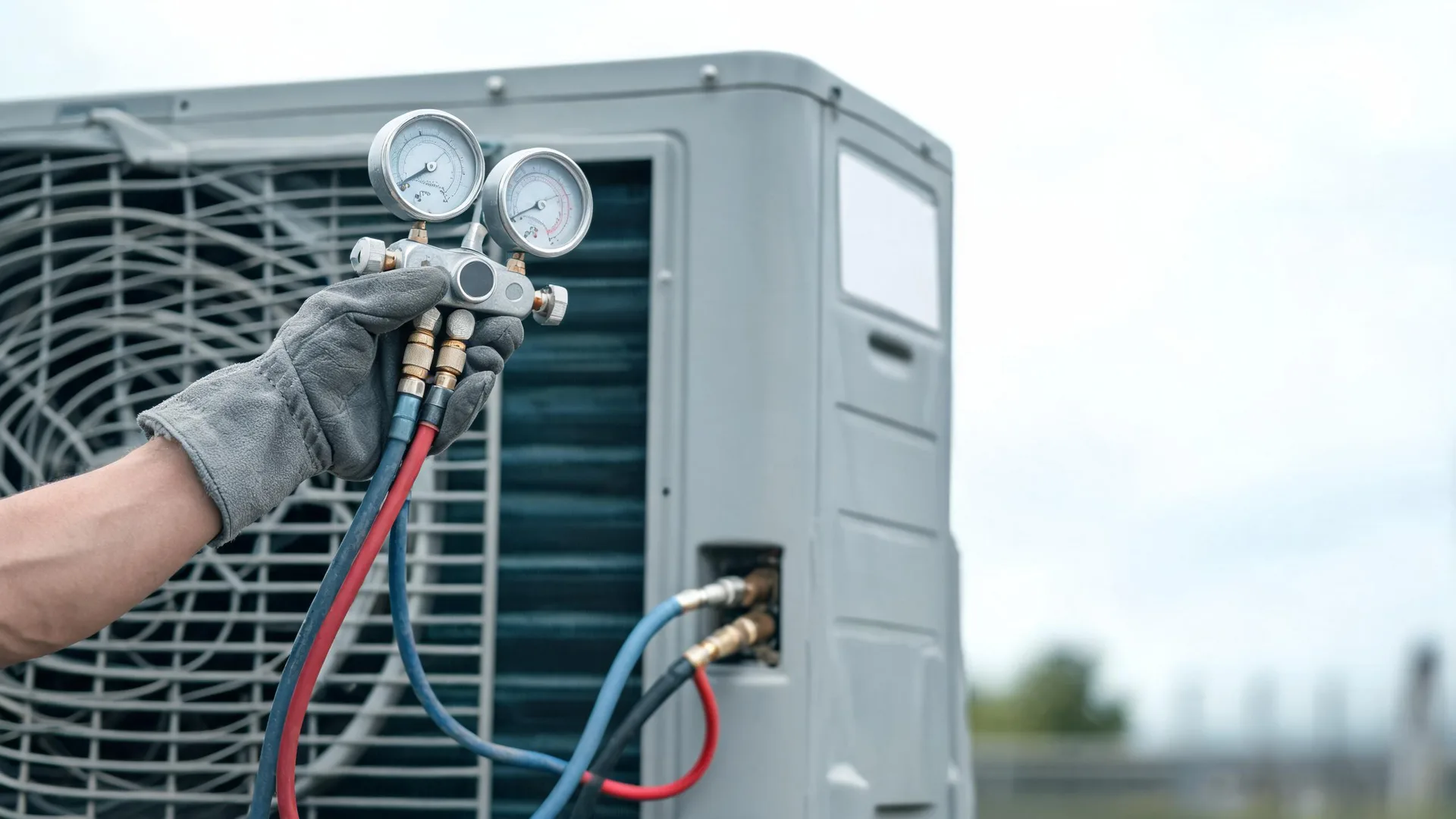
Refrigerant doesn't get used up. If the charge is low, it left through a leak somewhere in the coil or the line set, usually at a joint or a worn spot in the copper. A leak that small can take seasons to show up as warm air. A tech finds it with a gauge set and a leak detector, seals it, and recharges the system to the right level. That's a repair, not a sign the equipment is failing on its own.

An outdoor air conditioning condenser unit positioned beside a blue-sided house at sunset.

A new air conditioner would save little on running costs in Pierce County, so the repair decision comes down to the unit's condition.

  • A new one at the federal minimum, 13.4 SEER2$160 a year
  • An older air conditioner$170 a year

Estimates for a typical Pierce County home, compared with an older unit built to the previous federal minimum, from EIA household energy data, Wisconsin fuel prices and NOAA climate normals. Your home will differ.

Repair makes sense when a part like a capacitor or contactor has failed.

Replacement makes sense when the compressor has failed or the system uses R-22 refrigerant, which is no longer made.

A compressor that still runs well doesn't need to be replaced just because it's old. What matters more is whether it's holding pressure and starting the way it should. A tech checks the suction and head pressure, listens to how the compressor starts, and looks for oil residue around the fittings, which usually means a leak. If the compressor itself has failed, that's a harder call, since it's the most expensive part in the system and sits inside a sealed circuit that takes real labor to open up. But a failed capacitor, a bad contactor, or a leak at a fitting doesn't take the compressor down with it. Those get fixed on their own, and a sound compressor on a system that's otherwise been maintained is usually worth building back around.