





A row of dark-sided houses with brown shingled gable roofs behind tall trimmed hedges, with a mowed lawn in the foreground and overhanging tree branches against an overcast sky.

AC Repair in Racine, WI

Tell us about the job

Takes about a minute. No obligation.

RepairCentral ACRacine County, WI
Step 1 of 2

What ZIP code is the job in?

AC runs June through August here, about three months a year. May is when a part that barely made it through last summer gets tested again, after sitting unused since it was last run. A weak capacitor or contactor often fails in that first hot week rather than in the worst heat of August. If your AC is acting up now, in May or early June, the cause is probably something ordinary that was already on its way out. Getting it checked before August means it gets fixed before the hottest stretch, not during it.

3 months
June through August, your air conditioner is on duty
80°F
the average summer afternoon it cools against
25 hail events
in ten years, and hail bends the fins on outdoor coils
48 wind events
in ten years, and wind drives debris into outdoor units
Isometric line illustration of a cutaway house showing interior rooms with furniture, ductwork leading to an indoor air handler, and an outdoor condenser unit connected by a line set.
Your air conditioner works hardest from June through August.

NOAA nClimDiv, 1991–2020 normals

Summer here runs about three months, June through August, with afternoon highs averaging 80.

An AC that only has to carry three months of heat usually has less wear on it, so a repair is often the right call.

Half the homes here are from 1968 or earlier, old enough that the AC is not the original equipment

Half the homes here were built by 1968
Cooling runs June through August
Summer afternoons average 80°F

A system that has to work harder than it should shows up on the electric bill before it quits outright. Wisconsin runs 17.18 cents per kilowatt-hour, so a dirty coil, a low charge, or a capacitor on its way out costs something every time the AC kicks on, not just on the day it finally fails. Short cycling or warm air blowing from the vents is usually one of those ordinary problems, not a sign the unit is overmatched by the climate here. Worth having someone check it rather than waiting for the bill or the breakdown to make the case.

A light summer here means repair is usually the right call

Three months of summer duty keeps wear down on the parts that usually fail first, the capacitor, the contactor, the fan motor. That points toward a repair, not a replacement, when something goes wrong. Get it looked at and fixed.

Find a contractor
A man in a cap, dark jacket and tan work pants carries a canvas tool bag up porch steps toward a green front door, with a potted shrub beside the entrance.
An outdoor air conditioning condenser unit mounted on a concrete pad surrounded by gravel, photographed against a partly cloudy blue sky.

Ask how much life is left before paying for a big repair

If the AC at your place came with the house, and the house dates to 1968 or earlier, that part is worth checking before you pay for a big repair. The light duty here means parts often outlast the house they're in, but no AC runs forever. Ask whoever comes out how old the unit actually is and how much life is left in it. That answer tells you whether this repair is the last one or one of a few more to come.

Check the obvious before you call

Look at the thermostat first. Make sure it's set to cool and set below room temperature, and check the batteries if it has a screen that's dim or blank. Then check the breaker box. A tripped breaker will shut the whole unit down and looks like a bigger failure than it is. Outside, look at the unit itself and clear away any leaves, grass clippings or debris blocking the sides. Airflow in and out of that cabinet matters, and a blocked unit can trip right back off after you reset it.

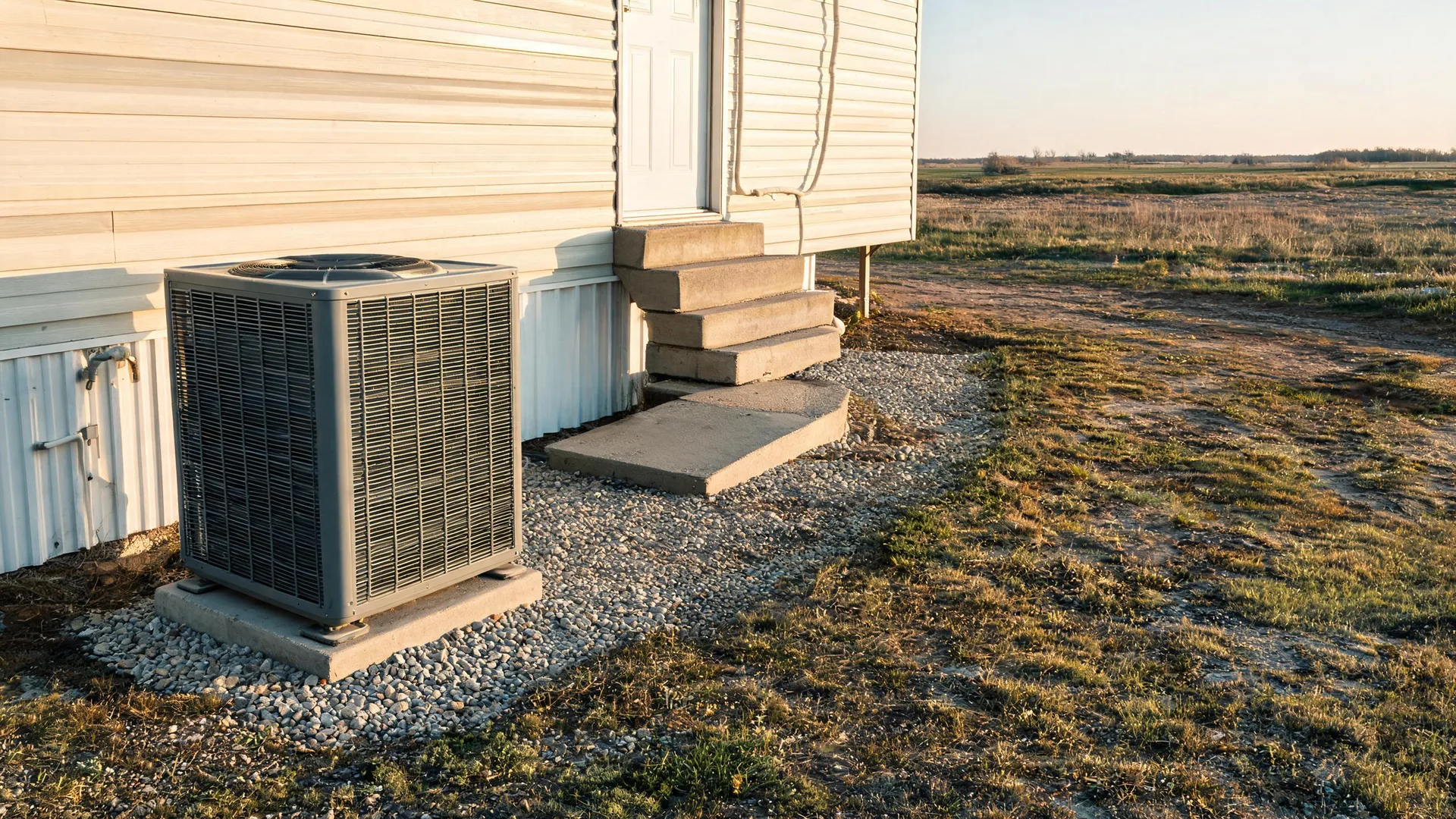
Know what to tell the tech

Pull the filter and look at it before anyone shows up. A filter clogged with dust and pet hair chokes airflow and can cause a lot of what feels like a bigger problem, including ice forming on the indoor coil or warm air at the vents. Note whether the outdoor unit is running at all, whether it's making a new noise, and whether air is moving from the vents even if it's not cold. That tells the tech more in the first minute than they'd get from describing the problem as the whole house being hot.

Aerial view of a residential air conditioning condenser unit mounted on a concrete pad next to a house with vinyl siding and a sliding glass door.

A new air conditioner would save little on running costs in Racine County, so the repair decision comes down to the unit's condition.

  • A new one at the federal minimum, 13.4 SEER2$180 a year
  • An older air conditioner$190 a year

Estimates for a typical Racine County home, compared with an older unit built to the previous federal minimum, from EIA household energy data, Wisconsin fuel prices and NOAA climate normals. Your home will differ.

Repair makes sense when a part like a capacitor or contactor has failed.

Replacement makes sense when the compressor has failed or the system uses R-22 refrigerant, which is no longer made.

A repair makes sense when the rest of the system is sound and only one part failed. A capacitor, a contactor, a fan motor, these wear out on their own schedule and replacing one doesn't mean the others are close behind. Replacement starts to make more sense when the compressor itself is failing, or when the refrigerant is an older type that's getting hard to source. The compressor is the one part that's rarely worth repairing on its own, since the labor to get to it costs about as much as replacing the whole outdoor unit. Age matters less than what's actually broken. An old unit with a bad capacitor is still just that, a bad capacitor, and that's a straightforward fix.