





A illuminated two-story red brick house on a quiet residential street at dusk, flanked by mature trees under a deep blue evening sky.

AC Repair in Platteville, WI

Tell us about the job

Takes about a minute. No obligation.

RepairCentral ACGrant County, WI
Step 1 of 2

What ZIP code is the job in?

Grant County saw 186 severe weather events between 2015 and 2024. Damaging wind caused 113 of those, hail caused 36, and seven tornadoes touched down in that same stretch. An outdoor AC unit sits outside through all of it, exposed to whatever the wind throws at it or whatever falls on it during a storm. Hail can dent the fins on the coil or bend the cabinet, and both can cut into how the unit runs even if it still turns on. If a storm has come through and your system took a hit, it's worth having someone look at it rather than waiting for it to fail.

3 months
June through August, your air conditioner is on duty
80°F
the average summer afternoon it cools against
36 hail events
in ten years, and hail bends the fins on outdoor coils
113 wind events
in ten years, and wind drives debris into outdoor units
Isometric cutaway illustration of a house interior showing ducted air handling equipment, ceiling ducts, furniture in two rooms, and an outdoor condenser unit connected by lines outside the wall.
Your air conditioner works hardest from June through August.

NOAA nClimDiv, 1991–2020 normals

Half the homes in Grant County were built in 1973 or earlier.

An AC repair call on a house that old may be a sign the whole system is nearing the end, not just the part that failed.

Cooling starts in June, right when a weak part is most likely to give out

Cooling runs June through August
Summer afternoons average 80°F
113 damaging wind events from 2015 to 2024

If your house dates back to 1973 or earlier, ask the contractor one more question while they're out: not just what broke, but how much is left in the unit overall. A repair on a system that old can still be the right call. It can also be good money going into a cabinet and coil that won't last another few summers. A straight answer on the unit's condition now saves a second service call later, and it tells you whether to budget for a patch or for a replacement.

Had a storm come through? Get the unit checked, even if it's still running

If a storm has come through recently, have the outdoor unit checked before you assume it's fine. A system that still turns on can be running on bent fins or a dented cabinet, and that damage doesn't fix itself.

Find a contractor
An outdoor air conditioning condenser unit mounted on a concrete pad surrounded by gravel, photographed against a partly cloudy blue sky.

What a failing AC tells you before it quits

An air conditioner doesn't fail the first hot day it runs. It wears toward it, and most of the signs show up before the unit quits for good. Warm air from the vents when the thermostat is set low. Short cycling, where the unit kicks on, runs a few minutes, and shuts off again before the house cools. A hissing or bubbling sound near the lines, which points to refrigerant escaping somewhere it shouldn't. Ice on the coil or the copper line, which usually means airflow is restricted or the charge is low. A warm, musty smell when the system starts, or water pooling near the indoor unit where the condensate line has backed up. None of these mean the unit is done. They mean something specific is wrong, and the longer it runs that way, the more it drags the rest of the system down with it. A compressor working against a bad capacitor or a dirty coil runs harder to do the same job, and that strain is what turns a small repair into a bigger one.

Most failures start outside, not in the house

The outdoor unit carries the compressor and condenser coil, and both sit exposed to weather and debris year round. Dirt and grass clippings packed against the coil block airflow, and the unit has to run longer to move the same heat. A capacitor that's worn down makes the compressor strain to start, and that strain is what eventually kills it. Refrigerant lines can rub against the cabinet or a mounting bracket over time and wear through, which lets the charge leak out slowly rather than all at once.

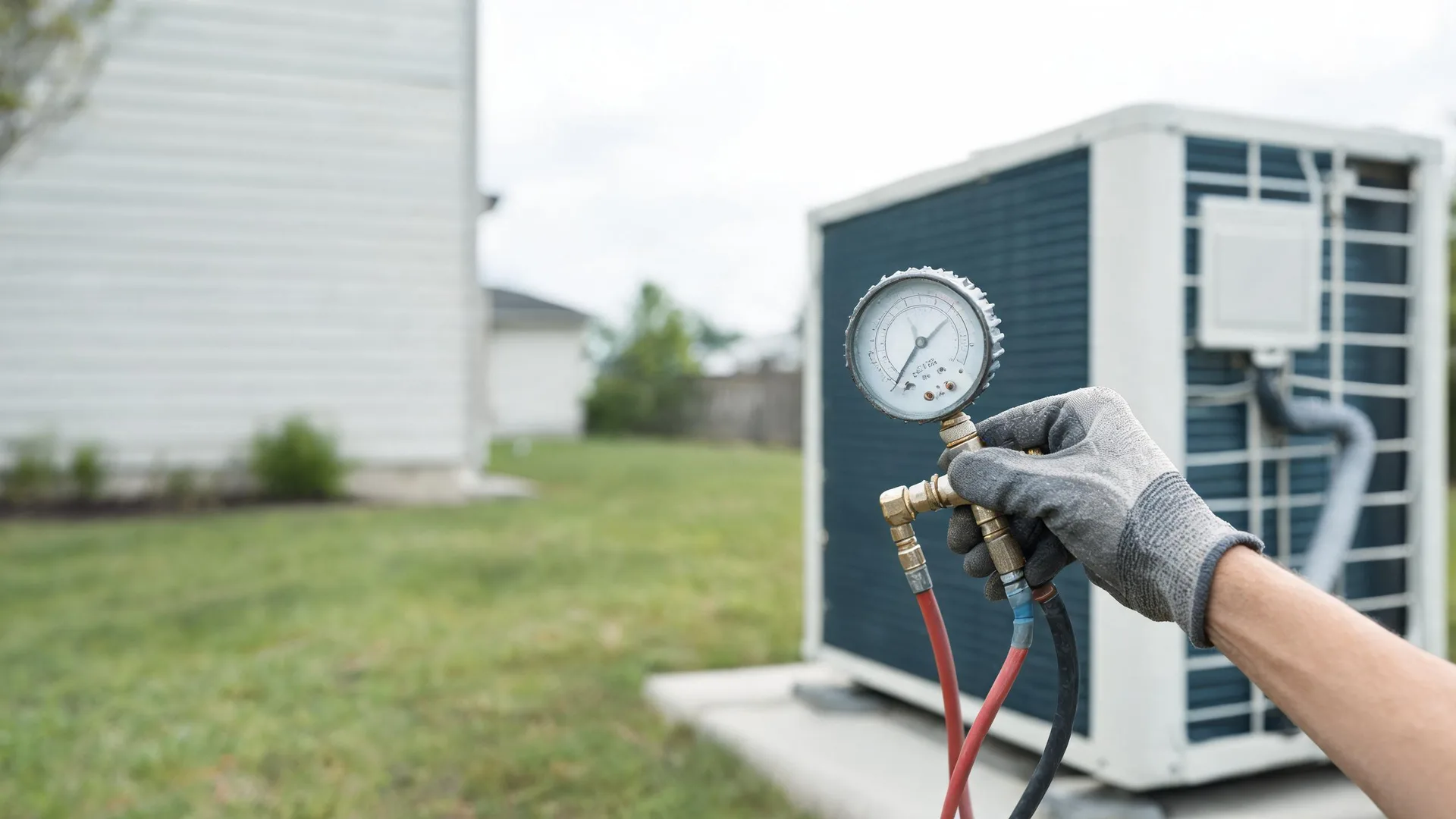
A refrigerant leak rarely announces itself

Low refrigerant doesn't mean the system used it up. Refrigerant doesn't get consumed, so if the level is low, it's leaking out somewhere in the lines or the coil. A unit running low charge will still blow air, just not cold, and it'll ice up the coil trying to compensate. Running it in that state for long stretches puts extra load on the compressor, which is the part most expensive to replace and the one least worth pushing past its limit.

Aerial view of a gray outdoor air conditioning condenser unit mounted on a concrete pad next to a house with vinyl siding.

A new air conditioner would save little on running costs in Grant County, so the repair decision comes down to the unit's condition.

  • A new one at the federal minimum, 13.4 SEER2$190 a year
  • An older air conditioner$210 a year

Estimates for a typical Grant County home, compared with an older unit built to the previous federal minimum, from EIA household energy data, Wisconsin fuel prices and NOAA climate normals. Your home will differ.

Repair makes sense when a part like a capacitor or contactor has failed.

Replacement makes sense when the compressor has failed or the system uses R-22 refrigerant, which is no longer made.

A diagnostic visit starts outside at the condenser, not at the thermostat. The contractor checks refrigerant pressure, looks at the capacitor and contactor, and watches how the compressor starts up. Inside, they'll check the coil for ice or buildup and look at airflow through the filter and ducts, since weak airflow can mimic a refrigerant problem and send someone chasing the wrong fix. They'll also run the system through a full cycle rather than just glancing at it, because some failures only show up once the compressor has been running a few minutes. What they find determines whether the fix is a single part or a sign of something larger going on in the system. A good diagnosis ends with a plain answer: what failed, why it failed, and what it affects if left alone.