



Aerial view of a residential air conditioning condenser unit mounted on a concrete pad next to a house with vinyl siding and a sliding glass door.

AC Repair in Oshkosh, WI

Tell us about the job

Takes about a minute. No obligation.

RepairCentral ACWinnebago County, WI
Step 1 of 2

What ZIP code is the job in?

Your AC in Oshkosh only has to work three months a year, June through August, with afternoon highs averaging around 80. That's not a heavy summer for a condenser and compressor to get through. So when something goes wrong, it's rarely because the unit was pushed too hard. More often it's age, a part that wore out on its own, or something that got missed at the last tune-up. That's good news for a repair call. A system that hasn't been worked hard all season is usually a system worth fixing rather than replacing.

3 months
June through August, your air conditioner is on duty
80°F
the average summer afternoon it cools against
16 hail events
in ten years, and hail bends the fins on outdoor coils
54 wind events
in ten years, and wind drives debris into outdoor units
Isometric cutaway illustration of a house interior showing ducted air handling equipment and duct runs through rooms, connected by piping to an outdoor condenser unit on a pad outside the wall.
Your air conditioner works hardest from June through August.

NOAA nClimDiv, 1991–2020 normals

Cooling in Oshkosh starts up in June after months with the AC off.

A weak capacitor or low charge usually shows up in the first weeks of June, not in the middle of August.

Half the homes here are older, half newerHomes in Winnebago County split evenly, half built in 1975 or earlier, half after. Age of the house doesn't point to age of the AC.

None of this points to one fix costing more than another here. Electricity in Wisconsin ran 17.18 cents per kilowatt-hour in 2024, which matters more for what the system costs to run than for what's wrong with it. A capacitor swap or a contactor replacement is cheap parts and quick work either way. A leak means finding where the coil or line set is losing charge, and that takes longer no matter what power costs. The repair itself doesn't get harder or easier because of the electric rate. It only changes what the unit costs to run once it's fixed.

It's usually worth repairing

It has an easier job here than in most places, so your air conditioner is often in decent shape. Repair is usually worth it.

Find a contractor
A gray residential air conditioning condenser unit mounted on a concrete pad outdoors, surrounded by green grass under a partly cloudy blue sky.

What actually breaks, and why

A weak capacitor is one of the most common reasons a condenser won't start. It gives the compressor and fan motor the jolt they need to get moving, and it weakens with age and with every on-off cycle until one day it can't deliver that jolt anymore. When it goes, the unit hums but doesn't start, or the fan turns slowly instead of spinning up. The contactor fails the same slow way. It's the switch that sends power to the outdoor unit, and its contacts pit and burn from years of opening and closing until they stop making contact. A low refrigerant charge is different. It almost always means a leak in the coil or line set, not refrigerant simply running low on its own, since a sealed system doesn't use it up. Fan motors wear out on their bearings over time, and condenser coils cake up with dirt until the unit can't shed heat the way it should. None of this comes down to how hard the system worked. It comes down to age and cycles, so a unit that's barely run can fail the same way as one that's run hard all season.

A low charge keeps a compressor running hot

A compressor low on refrigerant runs hotter than it should and draws more current to do the same job. Left alone, that heat breaks down the motor windings, and what started as a slow leak ends with a compressor that won't start at all.

A weak capacitor asks the compressor to do its job

When a capacitor can't deliver a full jolt, the compressor tries to start without it and draws hard trying to get moving on its own. A compressor forced to start that way over and over is what fails next, not the capacitor. Caught early, while the fan is only turning slowly, it's a capacitor swap and nothing more.

Overhead view of a gray outdoor AC condenser unit on a concrete pad beside a mulched garden bed and a house with vinyl siding.

A new air conditioner would save little on running costs in Winnebago County, so the repair decision comes down to the unit's condition.

  • A new one at the federal minimum, 13.4 SEER2$160 a year
  • An older air conditioner$170 a year

Estimates for a typical Winnebago County home, compared with an older unit built to the previous federal minimum, from EIA household energy data, Wisconsin fuel prices and NOAA climate normals. Your home will differ.

Repair makes sense when a part like a capacitor or contactor has failed.

Replacement makes sense when the compressor has failed or the system uses R-22 refrigerant, which is no longer made.

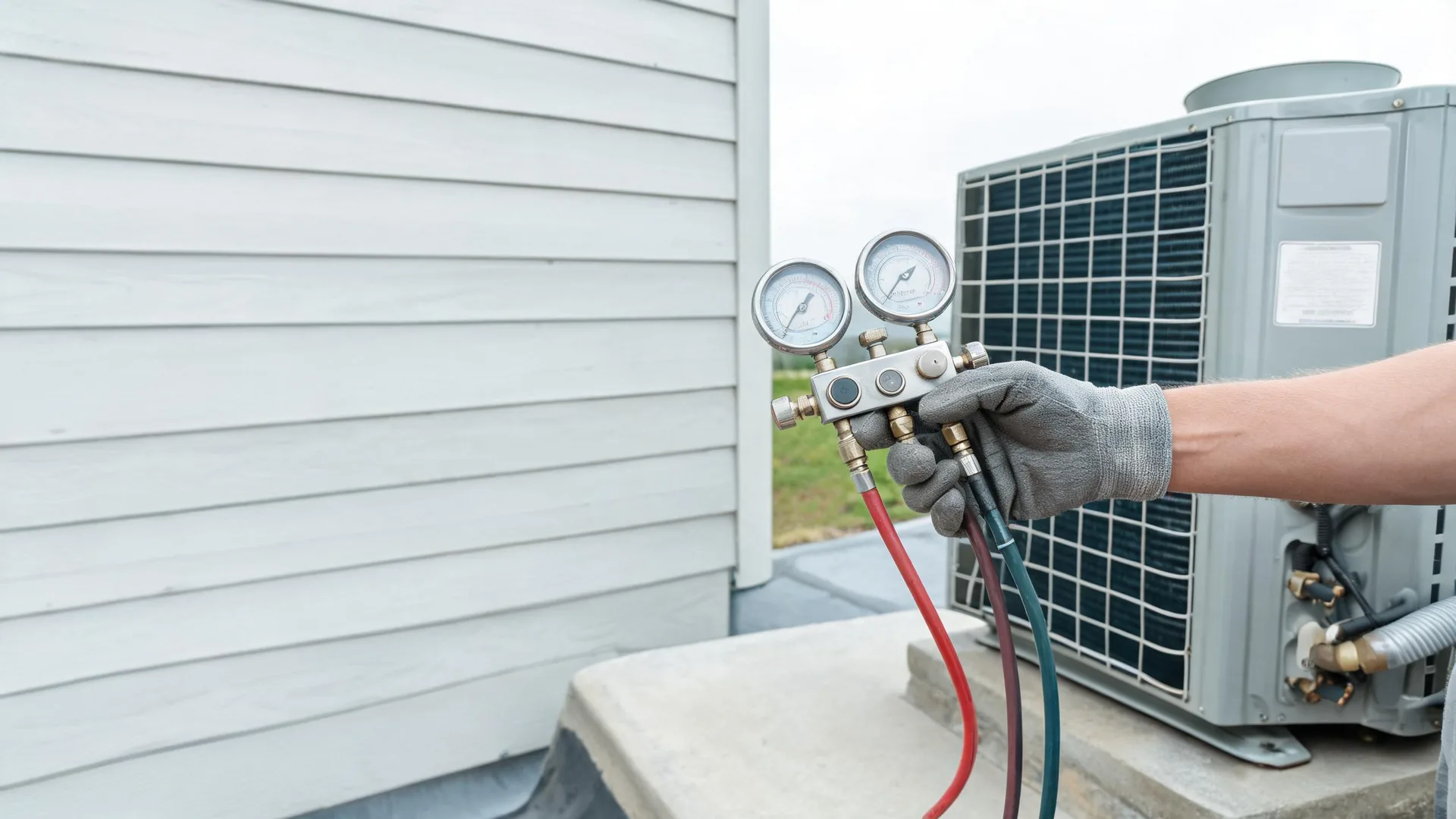
A diagnostic visit starts outside at the condenser, not inside at the thermostat. A tech checks capacitor readings against the rating printed on the part, tests the contactor for pitting, and checks the refrigerant charge against what the system calls for. Electrical readings come next, since a motor pulling too much current is usually a motor on its way out. If the coil looks caked with dirt or the fins are bent, that gets noted too, because airflow across the coil matters as much as the refrigerant inside it. Most of this is testing against a known number, not guesswork. A capacitor either holds the charge it should or it doesn't, and a system either has the charge it needs or it's leaking somewhere along the coil or line set.