






A nighttime view of a tree-lined residential street with illuminated two-story brick houses and street lamps.

AC Repair in Marinette, WI

Tell us about the job

Takes about a minute. No obligation.

RepairCentral ACMarinette County, WI
Step 1 of 2

What ZIP code is the job in?

Cooling only runs two months here, July through August, so a lot of systems sit idle most of the year before being asked to work hard again. June is when it's worth having a repair looked at rather than waiting. A capacitor or contactor that was already marginal last August often doesn't make it through the first hot week this time around. Catching that in June, before the real heat, means it gets fixed on your schedule instead of during a breakdown.

2 months
July through August, your air conditioner is on duty
78°F
the average summer afternoon it cools against
23 hail events
in ten years, and hail bends the fins on outdoor coils
30 wind events
in ten years, and wind drives debris into outdoor units
Isometric cutaway illustration of a house showing attic ductwork, an indoor air handler, and an outdoor condenser unit connected by lines.
Your air conditioner works hardest from July through August.

NOAA nClimDiv, 1991–2020 normals

A diagnostic visit starts with the thermostat and the breaker, not the condenser, because a tech has to rule out the simple stuff before opening anything up.

Gauges on the lines and a meter on the capacitor tell the tech what's actually wrong, so the fix is decided before any part gets replaced.

A light load on the condenser, so the fix is usually straightforward

Power costs 17.18 cents a kWh statewide
Cooling runs July through August
Summer afternoons average 78°F

A capacitor is usually the first thing to go. It stores a charge and gives the compressor and fan motor the kick they need to start, and the heat of the season wears it down until it can't deliver that kick anymore. A weak capacitor shows up as a unit that hums but doesn't start, or a fan that spins slow. The contactor is the other common one. It's a switch that opens and closes every time the thermostat calls for cooling, and the contacts pit and burn with each cycle until they stop making good contact. Refrigerant leaks are different. They don't wear in from use, they come from a rubbed line or a bad joint, and they show up as ice on the line or cooling that trails off over days instead of quitting all at once.

The usual problem has a straightforward fix

Half the homes in Marinette County were built in 1975 or earlier, half in 1975 or later. Either way, it doesn't change what's likely wrong with your AC. A capacitor or contactor wears out on the same schedule no matter the age of the house. Get the actual cause found and the right part fixed.

Find a contractor
A man in a cap, dark jacket and tan work pants walks up porch steps toward a green front door, carrying a worn canvas tool bag in his right hand, with a potted shrub beside the entry.
A gray residential air conditioning condenser unit mounted on a concrete pad outdoors, surrounded by green grass under a partly cloudy blue sky.

A light load most of the year, so a repair usually makes sense

Two months of real strain a year is nothing for a condenser to carry, so when one of these fails it's rarely because the unit is worn out underneath. That's the case for calling in a repair instead of pricing a new system. A tech can confirm the capacitor or contactor is the only thing gone and send the rest of the unit back to work.

A weak capacitor can take the compressor with it

A capacitor that's starting to fail still lets the compressor limp along, drawing more current than it should to make up for the weak kick. Run it that way for days and the compressor motor windings take the heat instead of the capacitor. A loose connection or a swapped part fixes a bad capacitor. A burned-out compressor means replacing the whole unit.

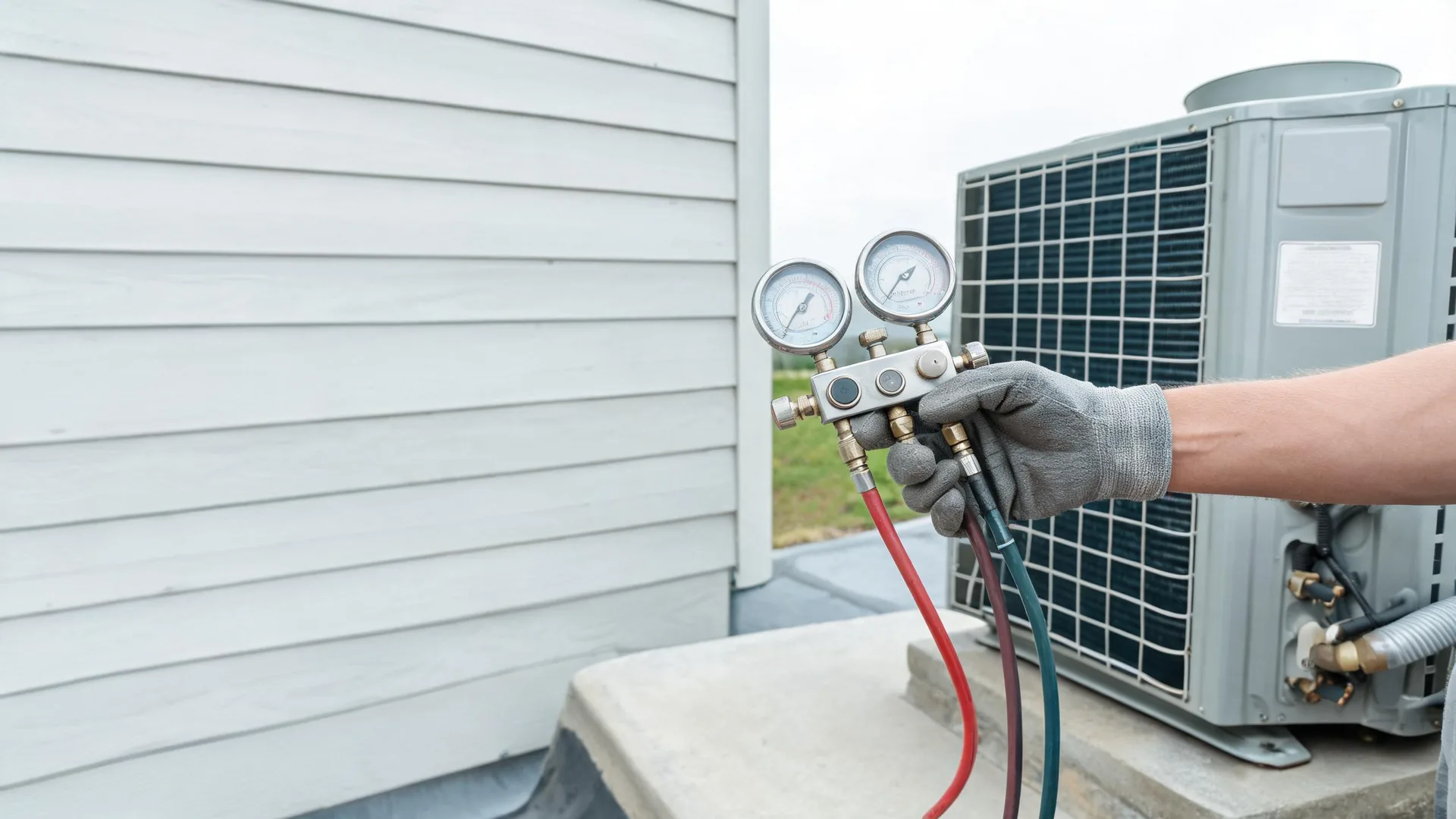
Ice on the line only gets worse with the unit running

A refrigerant leak that shows up as frost on the line means the system is low on charge, and running it low makes the coil colder than it should get. Ice builds on the coil itself, blocks airflow, and the compressor ends up pulling in liquid refrigerant instead of gas. Shutting the unit off and letting the ice melt is better than leaving it running while you wait for someone to look at it.

An outdoor air conditioning condenser unit on a concrete pad next to the gray vinyl siding of a residential home.

A new air conditioner would save little on running costs in Marinette County, so the repair decision comes down to the unit's condition.

  • A new one at the federal minimum, 13.4 SEER2$90 a year
  • An older air conditioner$100 a year

Estimates for a typical Marinette County home, compared with an older unit built to the previous federal minimum, from EIA household energy data, Wisconsin fuel prices and NOAA climate normals. Your home will differ.

Repair makes sense when a part like a capacitor or contactor has failed.

Replacement makes sense when the compressor has failed or the system uses R-22 refrigerant, which is no longer made.

Most of the time, repair is the right call, but age catches up with every unit eventually. A compressor doesn't get replaced on its own, it gets replaced with the whole system, so a failed compressor is usually the point where a tech starts talking about new equipment instead of a fix. The coil is the other one to watch. It's not a part that gets swapped out cheaply, and a leak in the coil itself is a different conversation than a leak at a fitting or a rubbed line. Age matters here too, not because of a number but because refrigerant and parts for an older system get harder to source the longer it's been in service. If the compressor and coil are both sound, almost anything else is worth fixing.