A quiet suburban street at twilight featuring two-story brick homes with illuminated windows and large trees lining the sidewalk.

AC Repair in La Crosse, WI

Tell us about the job

Takes about a minute. No obligation.

RepairCentral ACLa Crosse County, WI
Step 1 of 2

What ZIP code is the job in?

Check the thermostat and the breaker first

Make sure the thermostat is set to cool and the set point is actually below room temperature. Then check the breaker box for the outdoor unit and the furnace, since the indoor blower and the outdoor condenser are usually on separate circuits. A tripped breaker or a thermostat bumped to the wrong setting looks exactly like a dead system but takes two minutes to rule out.

Look at the filter and the outdoor unit

Pull the air filter and hold it up to a light. If you can't see through it, swap it, because a clogged filter chokes airflow and can ice up the coil. Walk outside and check that the condenser isn't buried in leaves, grass clippings or a fallen branch. These checks tell you whether the problem is something simple or something that needs a tech's gauges and tools.

3 months
June through August, your air conditioner is on duty
80°F
the average summer afternoon it cools against
66 hail events
in ten years, and hail bends the fins on outdoor coils
100 wind events
in ten years, and wind drives debris into outdoor units
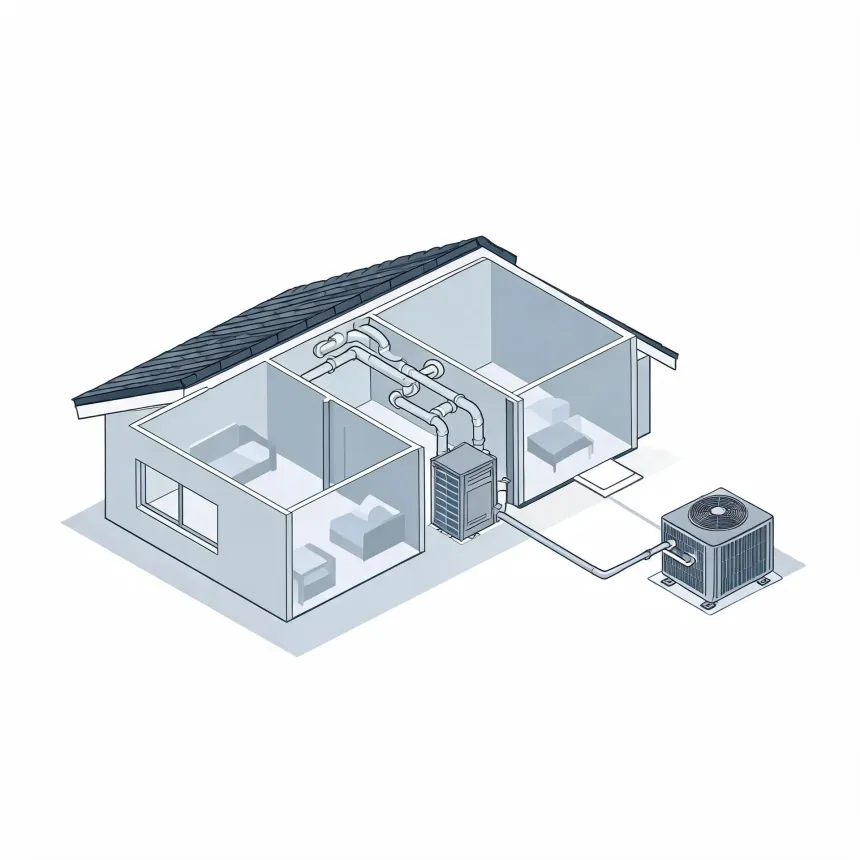
Isometric line illustration of a cutaway single-story house showing interior rooms, ductwork, an indoor air handler or furnace, and a refrigerant line running to an outdoor condenser unit on a pad.
Your air conditioner works hardest from June through August.

NOAA nClimDiv, 1991–2020 normals

A tech starts by hooking up gauges to check refrigerant pressure, not by guessing at parts.

That's the difference between a repair that holds and one that calls them back out in a month.

Storms here are hard on an outdoor unit

195 severe weather events from 2015 to 2024
18% of homes statewide lost power a day or more in 2024
100 damaging wind events from 2015 to 2024
June Is When a Weak AC Gets Found OutCooling runs June through August here, and the first hot stretch is when a part that barely made it through last summer gives out.

Most AC failures start with the capacitor or the contactor. The capacitor gives the compressor and fan motor the jolt they need to start spinning, and it wears out from heat cycling until one day it can't do the job. You'll hear the outdoor unit hum but the fan won't turn, or the whole thing won't start at all. The contactor is the switch that sends power to the outdoor unit, and its contacts pit and burn with every cycle until they stop making good contact. A dirty condenser coil causes a different kind of trouble. Dirt and debris packed into the coil fins make the system work harder to dump heat, and that extra strain shortens the life of the compressor itself. Refrigerant leaks are another common cause, usually at a fitting or a worn spot in the coil, and a system low on charge will run but won't cool the way it should.

If the outdoor unit took a hit, get it checked even if it still runs

Hail and wind this common leave marks you can't always see from the patio. A bent fin or a cracked line can keep a unit running for weeks before it quits. If a storm came through and the AC hasn't been looked at since, that's worth a visit before it fails on the next hot day.

Find a contractor
A gray metal air conditioning condenser unit mounted on a concrete pad in a flat grassy field under a partly cloudy sky.

A Small Problem Left Running Becomes a Big One

A system low on refrigerant doesn't just cool poorly, it starts damaging itself. The compressor depends on refrigerant passing through it to stay cool while it runs, and when charge is low that cooling drops off too. Keep running it short on refrigerant and the compressor overheats a little more each cycle until it fails for good, a repair that costs far more than fixing the leak would have. A dirty condenser coil sets off a similar chain. The compressor has to work harder to push heat out through a coil packed with dirt, and that extra load wears it down faster than normal running would. Even a failing capacitor can take a motor with it if the system keeps getting switched on and off while it struggles to start. None of these show up as a sudden breakdown. They show up as a system that still runs, a little worse every week, until the part that was never fixed takes a more expensive part down with it.

Warm air instead of cold

Air still moves out of the vents but it's not cold, or it's only a little cooler than the room. This usually traces back to low refrigerant, a compressor that isn't running, or a coil so dirty it can't pull heat out of the air anymore. Any of these can turn into a bigger repair the longer the system keeps running this way.

Short cycling or no start at all

The outdoor unit clicks, hums, or shuts off seconds after it starts instead of running a full cycle. That pattern points to the capacitor or the contactor, the parts that get the compressor and fan spinning and keep power flowing to them. A system that struggles to start and gets switched on and off again and again can damage the compressor motor on top of whatever caused the stall.

Aerial view of a square outdoor air conditioning condenser unit on a concrete pad beside a house wall with a sliding glass door.

A new air conditioner would save little on running costs in La Crosse County, so the repair decision comes down to the unit's condition.

  • A new one at the federal minimum, 13.4 SEER2$180 a year
  • An older air conditioner$190 a year

Estimates for a typical La Crosse County home, compared with an older unit built to the previous federal minimum, from EIA household energy data, Wisconsin fuel prices and NOAA climate normals. Your home will differ.

Repair makes sense when a part like a capacitor or contactor has failed.

Replacement makes sense when the compressor has failed or the system uses R-22 refrigerant, which is no longer made.

Once a tech has the system diagnosed, the next question is whether to fix what's broken or put the money toward a new system instead. Age matters more than the symptom does. A capacitor or contactor failure on a unit that's otherwise sound is a straightforward repair, and the system should run fine for years after. The compressor is a different story. If the compressor itself has failed, that's the most expensive part in the unit, and on an older system the cost of replacing it can get close to what a new unit runs. A refrigerant leak is worth asking about too, since some older systems use a refrigerant that's being phased out, and tracking down a slow leak can cost more than the leak itself would suggest. The honest way to think about it is one repair against the next one. A system that's needed a few different repairs over a few different years is telling you something a single fix won't change.