






An outdoor air conditioning condenser unit mounted on a concrete pad next to a blue-sided residential house at sunset.

AC Repair in Eau Claire, WI

Tell us about the job

Takes about a minute. No obligation.

RepairCentral ACEau Claire County, WI
Step 1 of 2

What ZIP code is the job in?

Your AC only has to work three months a year here, June through August, with afternoon highs averaging 79°F. That's a mild load compared to what the same unit would face further south. So when a system here breaks down, it's rarely because the compressor got run into the ground. More often it's age, a part that wore out on its own schedule, or something that got neglected over the winter months when the unit sat unused. That's worth knowing, because it usually means a repair will hold. A machine that hasn't been worked hard is a machine worth fixing.

3 months
June through August, your air conditioner is on duty
79°F
the average summer afternoon it cools against
23 hail events
in ten years, and hail bends the fins on outdoor coils
35 wind events
in ten years, and wind drives debris into outdoor units
Isometric cutaway illustration of a house showing attic ductwork, an indoor air handler, refrigerant lines running outside, and an outdoor condenser unit on a pad.
Your air conditioner works hardest from June through August.

NOAA nClimDiv, 1991–2020 normals

June is when cooling starts here, and when a weak part finally gets tested.

Have your AC checked in May, before the first hot week of June finds the problem for you.

Mild summers here, so when it breaks, it's not from overwork

Power costs 17.18 cents a kWh statewide
Cooling runs June through August
Summer afternoons average 79°F

Half the homes in Eau Claire County were built in 1978 or earlier, half in 1978 or later. Either way, the house doesn't tell you the age of the AC. Systems get replaced, added onto, swapped out when a homeowner remodels. So if your unit is giving out, check what's actually outside. The model number and install date, if they're stamped on the unit or on paperwork from a past job, tell a contractor more than the age of the house ever could. An old system and a newer one fail for different reasons, and knowing which you have narrows down where the problem is.

A system that's had it easy is a system worth repairing

Get a diagnosis before you decide it's time to replace. A unit that's only run three months a year, with no heavy wind or hail damage behind it, usually just needs the one worn part found and fixed.

Find a contractor
A man in a dark T-shirt and tan work pants, carrying a canvas tool bag, walks up wooden steps toward a green front door flanked by white siding and a potted shrub.
An outdoor residential air conditioning condenser unit mounted on a concrete pad, surrounded by gravel with a blue sky in the background.

What failed matters more than how long it's been running

Age on its own doesn't tell you much. What matters is which part failed and whether the rest of the unit is still sound. A compressor going bad is a different conversation than a capacitor or a fan motor, because the compressor is most of what the unit costs and the other parts are routine swaps. Ask the contractor what failed and whether it's original to the unit or something that's already been replaced once. A unit on its second blower motor in a handful of years is telling you something different than one where everything's original and one part finally gave out. Rust and corrosion on the coil or the cabinet matter more than years do, since that points to a leak or drainage problem that's been going on a while. If the refrigerant lines or coil are original and clean, there's usually a sound unit under whatever broke.

Warm air instead of cold

The blower runs, air comes out the vents, but it's not cold. This usually means the system is low on refrigerant from a leak, or the compressor itself is failing. Either way the system can't move heat out of the house anymore, even though the fan still works fine.

Short cycling

The unit kicks on, runs a few minutes, then shuts off before the house cools, over and over. This points to a dirty coil, a bad thermostat sensor, or electrical trouble that's shutting the compressor down to protect itself. Running the system this way for long stretches wears out the compressor faster.

An outdoor air conditioning condenser unit positioned on a concrete pad next to a blue-sided house, surrounded by green shrubs and flowering hydrangeas at sunset.

A new air conditioner would save little on running costs in Eau Claire County, so the repair decision comes down to the unit's condition.

  • A new one at the federal minimum, 13.4 SEER2$140 a year
  • An older air conditioner$150 a year

Estimates for a typical Eau Claire County home, compared with an older unit built to the previous federal minimum, from EIA household energy data, Wisconsin fuel prices and NOAA climate normals. Your home will differ.

Repair makes sense when a part like a capacitor or contactor has failed.

Replacement makes sense when the compressor has failed or the system uses R-22 refrigerant, which is no longer made.

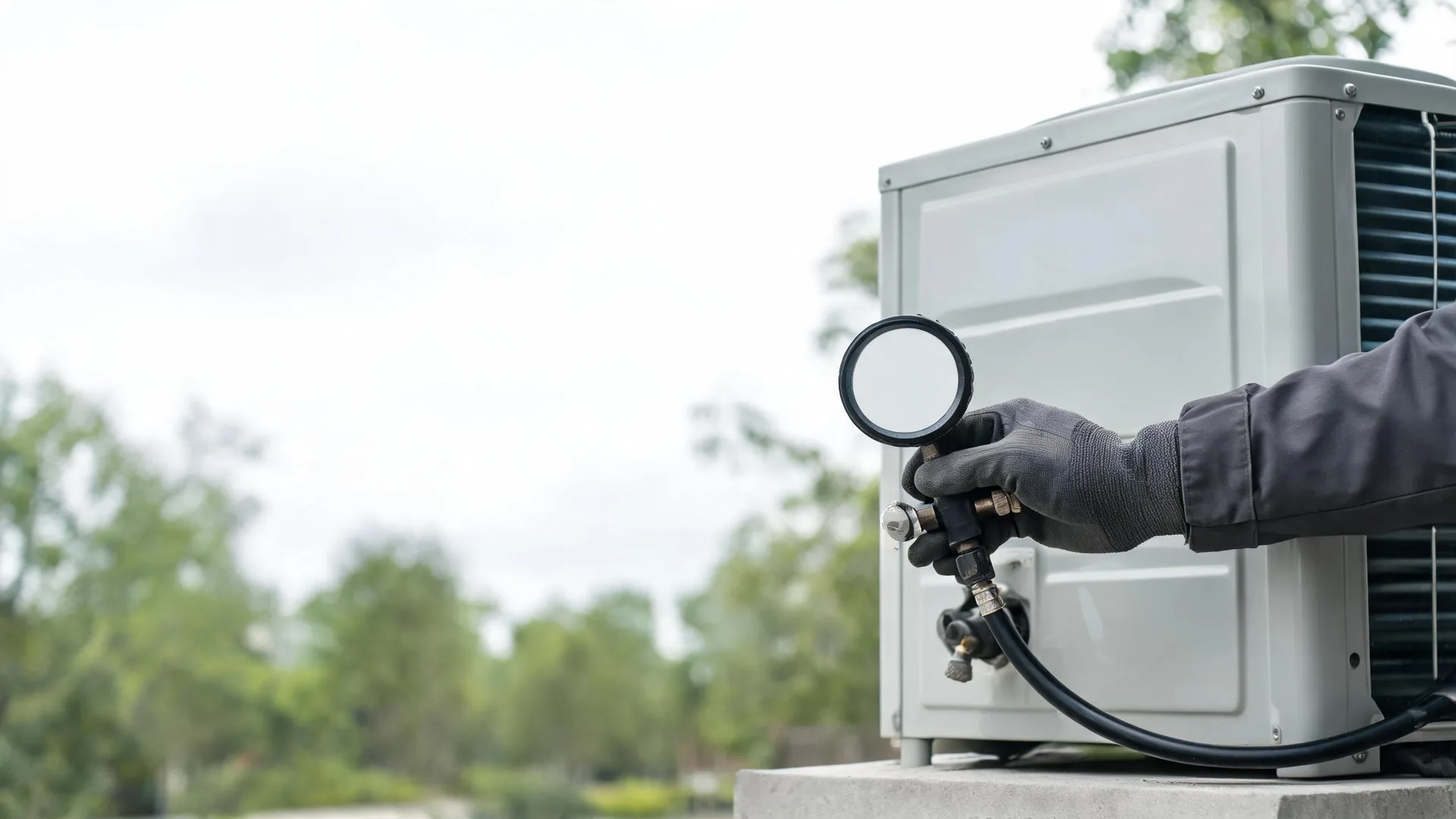
A diagnostic visit starts outside at the unit itself, not with questions about the thermostat. The tech checks refrigerant pressure, looks at the capacitor and contactor, and listens to how the compressor sounds when it kicks on. Electrical readings come next, since a failing part often draws current differently than a healthy one even before it quits outright. Inside, they'll check the coil for ice or dirt and confirm air is actually moving through the ducts the way it should. Most of this gets diagnosed without guesswork, because a failing part usually shows itself clearly on a gauge or a meter. What takes the visit longer is confirming there's only one problem, not patching the obvious one and missing a second thing that'll fail next month.