







Overhead view of a gray outdoor AC condenser unit on a concrete pad beside a mulched garden bed and a house with vinyl siding.

AC Repair in Chippewa Falls, WI

Tell us about the job

Takes about a minute. No obligation.

RepairCentral ACChippewa County, WI
Step 1 of 2

What ZIP code is the job in?

Your air conditioner only has to earn its keep here from July through August. Afternoon highs sit around 78 through the summer, which is mild work for a compressor built to handle much hotter runs. That short season means less wear year over year, so if yours is acting up, the cause is more likely a part that failed or was never maintained than a system worn out from overwork. Most of the time that makes repair the right call rather than replacement.

2 months
July through August, your air conditioner is on duty
78°F
the average summer afternoon it cools against
23 hail events
in ten years, and hail bends the fins on outdoor coils
53 wind events
in ten years, and wind drives debris into outdoor units
Isometric cutaway illustration of a house showing attic ductwork, an indoor air handler, refrigerant lines running outside, and an outdoor condenser unit on a pad.
Your air conditioner works hardest from July through August.

NOAA nClimDiv, 1991–2020 normals

Cooling starts in July here, so June is when a weak part is still sitting quiet.

The first hot stretch in July is when that same part gets tested and fails.

Chippewa County sees its share of rough weather, but that's not why your AC is down

116 severe weather events from 2015 to 2024
18% of homes statewide lost power a day or more in 2024
53 damaging wind events from 2015 to 2024
Nothing about Chippewa County wears out an AC fasterHalf the homes here were built in 1978 or earlier, half later. Either way, the house age isn't your answer.

A capacitor is the most common failure, and it doesn't give much warning. It stores the charge that kicks the compressor and fan motor into motion, and when it weakens, the unit hums or clicks but won't start, or the fan turns slowly instead of spinning up. A dirty condenser coil causes a different kind of trouble. Outside, dirt and grass clippings build up on the coil and block the heat from leaving the system, so it works harder and can trip off on high pressure. Low refrigerant almost always means a leak somewhere in the line, not normal use, since a sealed system doesn't lose charge on its own. A clogged drain line backs up condensate until a float switch shuts the whole system down to stop water damage. None of these have much to do with how hard the summer pushes the unit. They're wear and dirt and age catching up with a part.

Fix the part, not the whole system

Get the actual cause found and fixed. With a mild two-month season behind it, a unit that's acting up is almost always dealing with one bad part, not a system worn past saving.

Find a contractor
A man in a dark work shirt and brown pants carries a canvas tool bag as he steps up to a green front door on a porch with a potted shrub.
A gray cylindrical air conditioning condenser unit mounted on a concrete pad next to a light-colored vinyl-sided house exterior.

Running it through the problem rarely ends well

A struggling AC doesn't idle, it strains, and that strain spreads. When the capacitor is weak, the compressor still tries to start. It pulls more current each attempt and the motor windings heat up a little more each time. Keep running it on a bad capacitor and a part failure turns into a compressor failure. A dirty coil causes trouble a different way. The system can't shed heat outside, so it runs longer to reach the same temperature inside, and that extra runtime pushes head pressure higher until something trips or cracks. A refrigerant leak gets worse with runtime too. Low charge makes the compressor work harder to move less refrigerant, and that starves it of the oil it needs, which is what scores the inside of a compressor. Shutting the system off once something sounds wrong or the air stops getting cold is what keeps a bad part from turning into a bad compressor.

What you'll actually notice first

The air coming out of the vents turns warm or barely cool before anything else gives it away. Some units short cycle, running briefly and shutting off before the room temperature moves at all. Others run constantly and never seem to catch up. A grinding or squealing sound from the outdoor unit, or a hard clunk when it tries to start, usually means a motor or capacitor is on its way out rather than something that will smooth itself out.

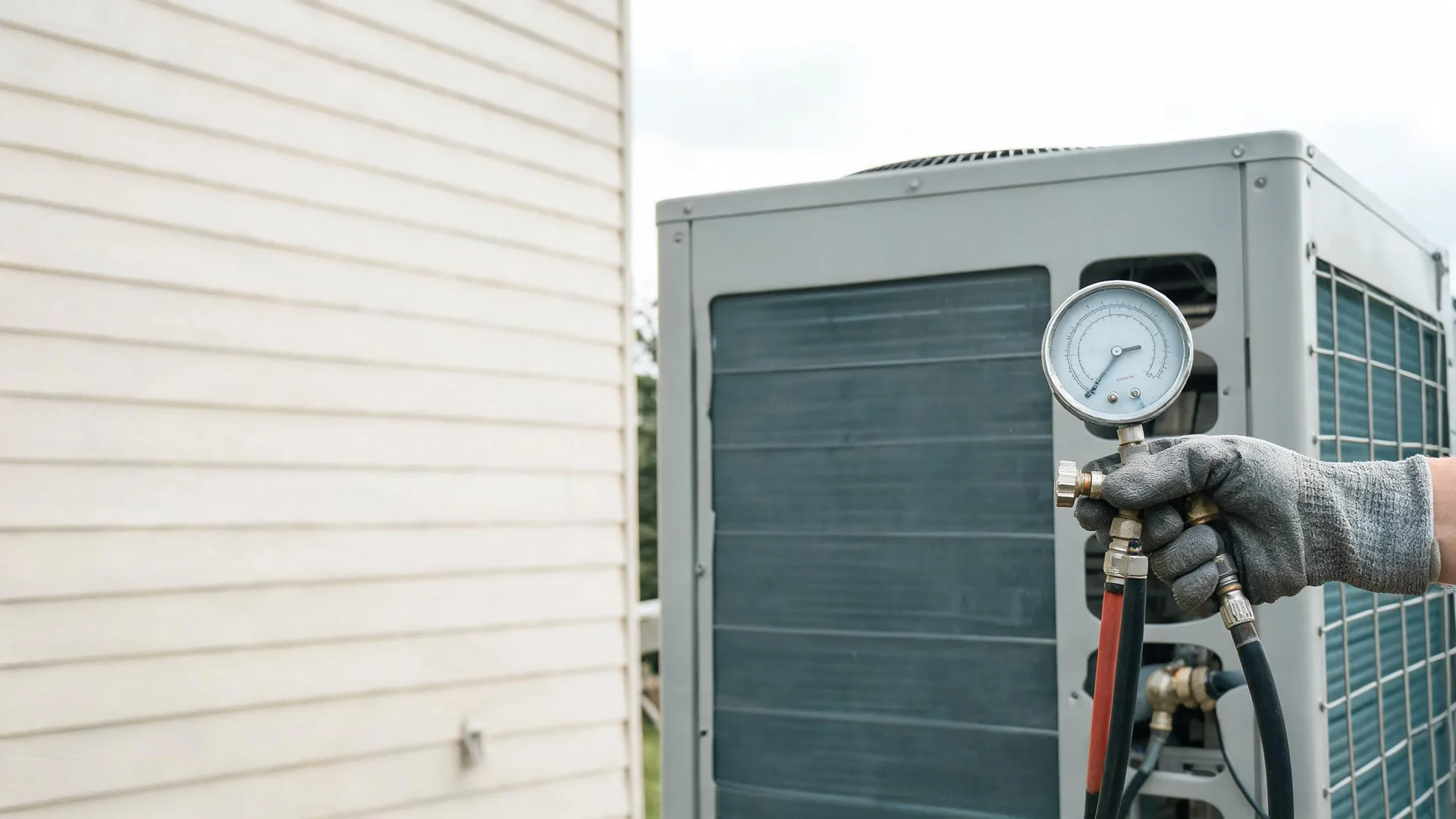
How soon it needs a look

Warm air or a system that won't start at all means calling now, since running a unit that's trying and failing to start can burn out a compressor fast. A system that cools fine but cycles oddly or smells musty near the vents can wait a little, but it's still worth getting looked at before it turns into a bigger repair. Water pooling near the indoor unit is its own kind of urgent, since that's a sign the drain line is already backed up and shutting the system down on purpose.

An outdoor air conditioning condenser unit mounted on a concrete pad next to a blue-sided residential house at sunset.

A new air conditioner would save little on running costs in Chippewa County, so the repair decision comes down to the unit's condition.

  • An older air conditioner$130 a year
  • A new one at the federal minimum, 13.4 SEER2$130 a year

Estimates for a typical Chippewa County home, compared with an older unit built to the previous federal minimum, from EIA household energy data, Wisconsin fuel prices and NOAA climate normals. Your home will differ.

Repair makes sense when a part like a capacitor or contactor has failed.

Replacement makes sense when the compressor has failed or the system uses R-22 refrigerant, which is no longer made.

Age of the part matters more than age of the system. A capacitor or a fan motor is a small, isolated fix. Replacing one doesn't mean the rest of the unit is in any worse shape than it was the day before. The compressor changes the math. It's the most expensive thing in the cabinet. If it's failed outright rather than just strained, a tech will usually say straight out that putting a new compressor in an old system isn't worth it. The other thing worth asking is whether this is the first repair or the third. A unit that needed a new capacitor, then a new fan motor, then shows up with a refrigerant leak a year later is telling you something different than a unit that's run clean for years and suddenly trips once. One bad part is a repair. A pattern of them is a reason to start talking about replacing the system before the next part picks a bad week to fail.