





A nighttime view of a tree-lined residential street with illuminated two-story brick houses and street lamps.

AC Repair in Beaver Dam, WI

Tell us about the job

Takes about a minute. No obligation.

RepairCentral ACDodge County, WI
Step 1 of 2

What ZIP code is the job in?

Cooling runs about three months here, June through August, with afternoon highs averaging around 80. That's a short, mild stretch for a compressor compared to what it would handle further south. Less time spent working each year means less wear building up on it. So when a unit here starts acting up, it's usually a specific part giving out, or just age, rather than years of strain catching up with it. That's worth knowing if yours is having trouble. There's a decent chance it still has good life left in it, and that's what makes repair worth a look before anything else.

3 months
June through August, your air conditioner is on duty
80°F
the average summer afternoon it cools against
37 hail events
in ten years, and hail bends the fins on outdoor coils
79 wind events
in ten years, and wind drives debris into outdoor units
Isometric cutaway illustration of a house showing attic ductwork, an indoor air handler, refrigerant lines running outside, and an outdoor condenser unit on a pad.
Your air conditioner works hardest from June through August.

NOAA nClimDiv, 1991–2020 normals

Cooling starts in June here, and the first hot stretch is when a weak part usually gives out.

If your AC is struggling now, get it looked at before August asks even more of it.

Beaver Dam doesn't push an AC hard. If yours is struggling, something specific is wrong.

Power costs 17.18 cents a kWh statewide
Cooling runs June through August
Summer afternoons average 80°F

A refrigerant leak is the clearest example. Once the charge drops, the compressor has to work harder to move heat, and it runs hotter doing it. Keep it running low on refrigerant and the compressor itself can fail, not just the line that's leaking. A failing capacitor does something similar. It makes the compressor and fan motor strain to start and run, and that strain wears them down faster. A dirty coil traps heat the system needs to shed, so the compressor runs longer and hotter to do the same job. None of these fix themselves by running more. They just move the damage from a part that's simple to replace to the compressor, which isn't.

Know how old your AC really is before you fix it

Half the homes in Dodge County were built in 1970 or earlier, so the AC in yours may not be the original one. If it came with the house, ask the contractor how old it actually is before paying for a repair. That tells you more than the house's age does.

Find a contractor
An outdoor residential air conditioning condenser unit mounted on a concrete pad, surrounded by gravel with a blue sky in the background.

Light duty each summer adds up to more years left in it

Three summers' worth of work a year leaves most of a unit's life still ahead of it. A compressor that's only had to handle 80-degree afternoons, three months at a stretch, hasn't logged the hours a unit further south would have by the same age. That's the case for having yours looked at rather than replaced. Age by itself doesn't rule out repair here. What does is a part that's actually failed, and that's a different question than how long the unit's been running.

What you'll actually notice first

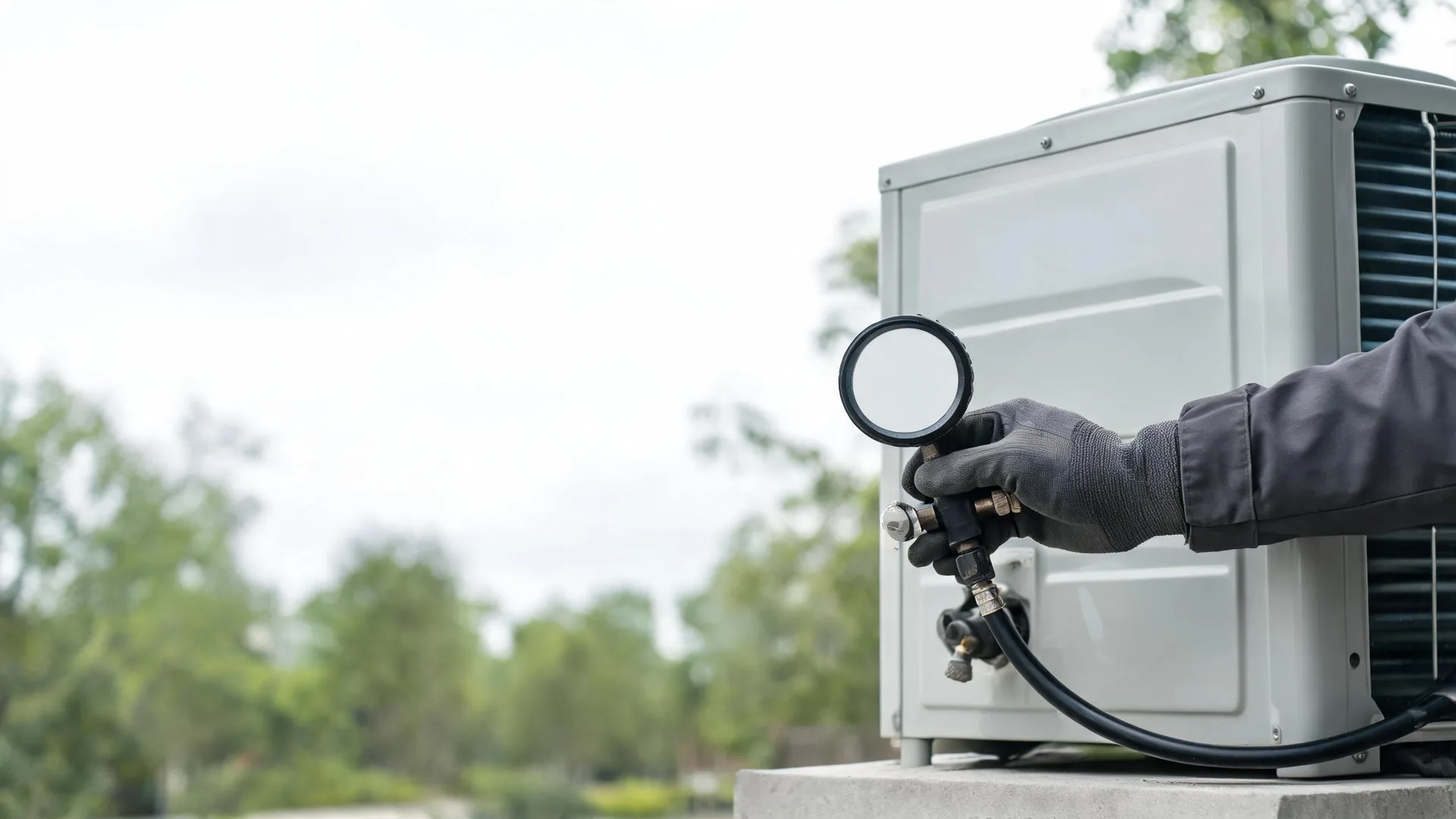
Warm air out of the vents when the thermostat is set low. Short cycles, where the unit kicks on and off every few minutes instead of running a full cycle. A hissing sound near the lines, which usually means refrigerant is escaping. Ice on the coil or on the copper line outside. Any of these means a part has already started to fail, not that the system is just working hard.

Why waiting makes it worse

A struggling AC doesn't stay a small problem if it keeps running. A weak capacitor that makes the compressor strain to start will eventually take the compressor down with it. A low refrigerant charge left alone lets the compressor run hot until it burns out. Catching the part that's failing now keeps the problem contained to that part.

An outdoor air conditioning condenser unit mounted on a concrete pad next to a blue-sided residential house at sunset.

A new air conditioner would save little on running costs in Dodge County, so the repair decision comes down to the unit's condition.

  • A new one at the federal minimum, 13.4 SEER2$160 a year
  • An older air conditioner$170 a year

Estimates for a typical Dodge County home, compared with an older unit built to the previous federal minimum, from EIA household energy data, Wisconsin fuel prices and NOAA climate normals. Your home will differ.

Repair makes sense when a part like a capacitor or contactor has failed.

Replacement makes sense when the compressor has failed or the system uses R-22 refrigerant, which is no longer made.

A repair makes sense when the part that failed is one piece doing one job. A capacitor, a contactor, a fan motor, a low charge from a leak that's been found and sealed. Replace that part and the rest of the system goes back to normal work, including the compressor. Replacement starts to make more sense when the compressor itself is the thing failing. A compressor isn't a part you swap out on its own economically, and once it's damaged the unit is close to the end of its line. Age matters too, but not by itself. A unit that's old and still cooling fine on a healthy compressor can often be patched along through another failure. The question worth asking isn't how old the unit is. It's which part actually broke and what that part means for the rest of the system.