




A row of dark-sided single-story houses with shingled roofs behind trimmed hedges and mown lawn, framed by large leafy trees under an overcast sky.

AC Repair in Amery, WI

Tell us about the job

Takes about a minute. No obligation.

RepairCentral ACPolk County, WI
Step 1 of 2

What ZIP code is the job in?

Half the homes in Polk County were built in 1981 or later. If yours is one of them, your air conditioner probably isn't that old either, even if it's not the original unit. A system installed in a newer home has usually had an easier run, with ductwork and electrical sized for it from the start rather than adapted after the fact. That matters when you're deciding whether a repair makes sense. A compressor or capacitor problem in a system with years left on it is worth fixing. Check when your house was built, and if it lines up, that's a point in favor of the repair.

3 months
June through August, your air conditioner is on duty
79°F
the average summer afternoon it cools against
25 hail events
in ten years, and hail bends the fins on outdoor coils
42 wind events
in ten years, and wind drives debris into outdoor units
Isometric cutaway illustration of a small home interior with furniture and ducting, showing an indoor air handler connected by lines to an outdoor condenser unit on a pad.
Your air conditioner works hardest from June through August.

NOAA nClimDiv, 1991–2020 normals

Warm air blowing from the vents usually means the problem is with cooling, not airflow.

A failing capacitor or a low refrigerant charge both show up this way, and a tech needs to check which one it is.

Summer here doesn't ask much of it

Cooling runs June through August
Summer afternoons average 79°F
42 damaging wind events from 2015 to 2024

Cooling here only has to run from June through August, three months out of the year. May is usually when people turn it on for the first time and find out what didn't make it through winter sitting idle. A capacitor that was already weak doesn't fail sitting still. It fails the first time the compressor asks something of it, which is why early summer is when a lot of these calls come in. If yours is struggling in the first warm week, that's not a bad sign for the system overall. It's just the one weak part finally getting tested.

A newer home is a reason to repair it

If your house was built in 1981 or later, the AC is probably not old enough to write off. Get it looked at and fixed rather than planning around a replacement.

Find a contractor
An outdoor air conditioning condenser unit mounted on a concrete pad beside a house, with electrical conduit running to a wall-mounted disconnect box.

It hasn't logged the hours

Three months of real heat a year doesn't put many hours on a compressor. Over a normal lifespan, that adds up to a lot less run time than the same machine would log further south. So when something does go wrong here, it's less likely to be the system worn out and more likely to be one part that quit, a capacitor, a contactor, a fan motor. Those are fixable. Get the broken part replaced and the rest of the system usually has plenty of life left to keep running on the same light schedule it's always had.

Ice on the lines means shut it off

A refrigerant leak or a dirty blower wheel can both starve the coil of what it needs, and the coil answers by icing over. Once ice forms, running the system longer just adds more ice, and that ice blocks the airflow the compressor depends on to run cool. Shutting it off and letting it thaw protects the compressor. Leaving it running to see if it fixes itself usually ends with the compressor taking the damage instead of the coil.

A struggling compressor doesn't get a break

A compressor low on charge or pulling against a bad start capacitor works harder for the same result, and that strain shows up as heat inside the compressor itself. It can take that strain for a while. It can't take it indefinitely. Catching a weak capacitor early means replacing a cheap part. Ignoring it means the compressor eventually takes the hit, and a compressor is the one part in the system that's expensive to replace on its own.

Aerial view of a square outdoor air conditioning condenser unit on a concrete pad beside a house wall with a sliding glass door.

A new air conditioner would save little on running costs in Polk County, so the repair decision comes down to the unit's condition.

  • A new one at the federal minimum, 13.4 SEER2$140 a year
  • An older air conditioner$150 a year

Estimates for a typical Polk County home, compared with an older unit built to the previous federal minimum, from EIA household energy data, Wisconsin fuel prices and NOAA climate normals. Your home will differ.

Repair makes sense when a part like a capacitor or contactor has failed.

Replacement makes sense when the compressor has failed or the system uses R-22 refrigerant, which is no longer made.

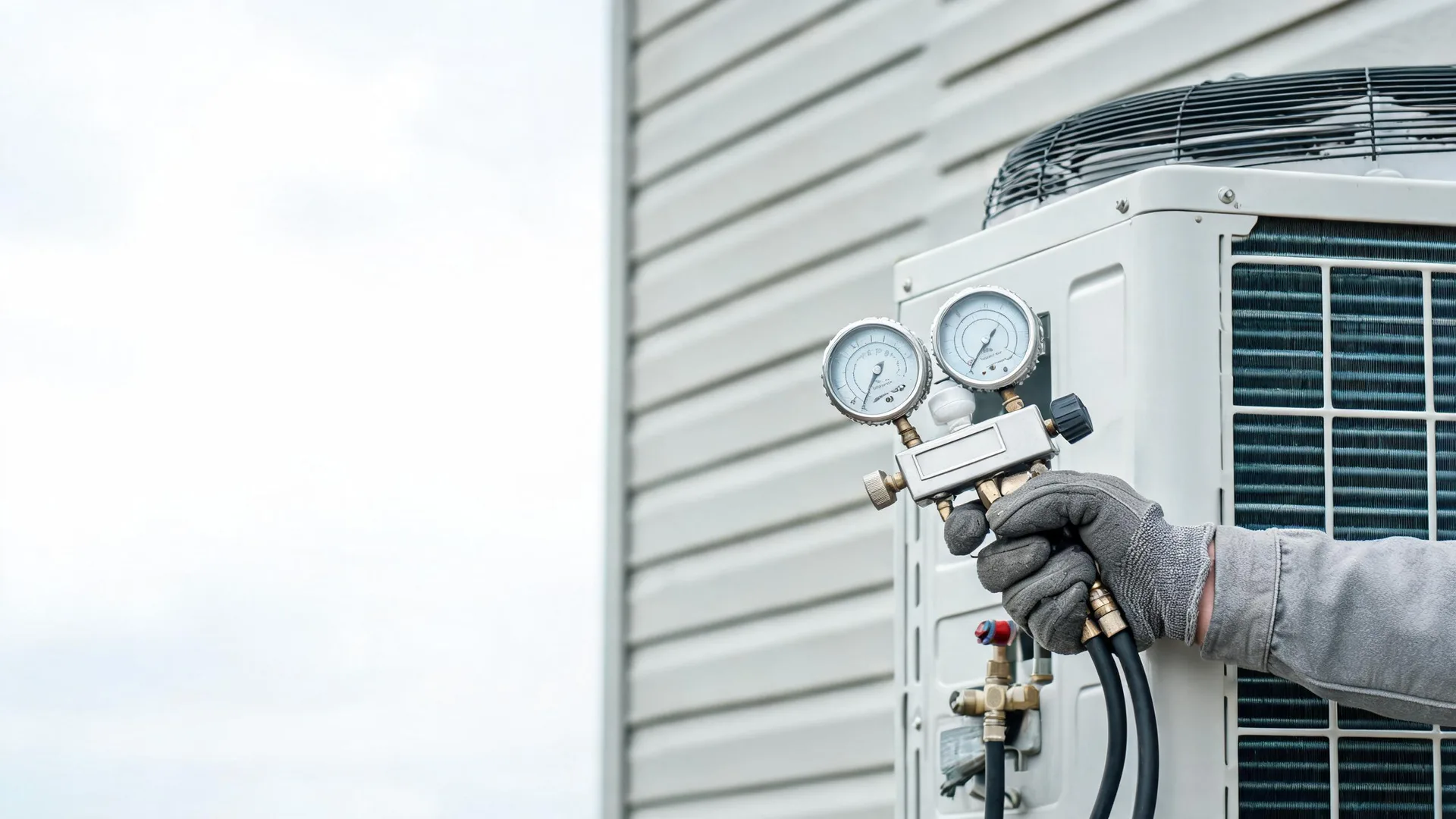
A diagnostic visit starts before the panels come off. A tech will ask when the problem started, whether it's warm air, no air, or the system running nonstop, and what the thermostat is set to versus what it's actually doing. Then it's gauges on the refrigerant lines and a meter on the electrical components, checking the capacitor's output against what it's rated for and watching how the compressor draws power when it starts. Airflow gets checked too, since a coil that's icing or a blower that's weak can look like a refrigerant problem when it isn't one. Most of this takes less time than people expect, because the readings usually point somewhere specific rather than leaving things open. By the end, the tech should be able to name the part that's failing and explain why that part, and not another, is the one causing what you're seeing.