




A gray cat sleeps curled up on a dark-made bed in a moody, minimalist bedroom with a wall-mounted air conditioning unit and warm accent lighting.

Mini Split Installation in Milwaukee, WI

Tell us about the job

Takes about a minute. No obligation.

New system or replacementMini-splitMilwaukee County, WI
Step 1 of 2

What ZIP code is the job in?

Most homes in Milwaukee County heat with utility gas, at 77.2 percent. A mini split works differently. It's electric, and it moves heat instead of burning fuel for it, so it runs on the same power that's already in your home. That makes it a common choice as a second system, cooling and heating a room or addition without extending gas line or ductwork to it. Some homeowners are using one to replace window units, others are putting in a full set of indoor units to cover a house that never had central air. Either way, the electric panel it ties into matters more than what's heating the rest of the house.

8 months
October through May, your system heats
3 months
June through August, it cools
18°F
the average winter night it heats against
79°F
the average summer afternoon it cools against
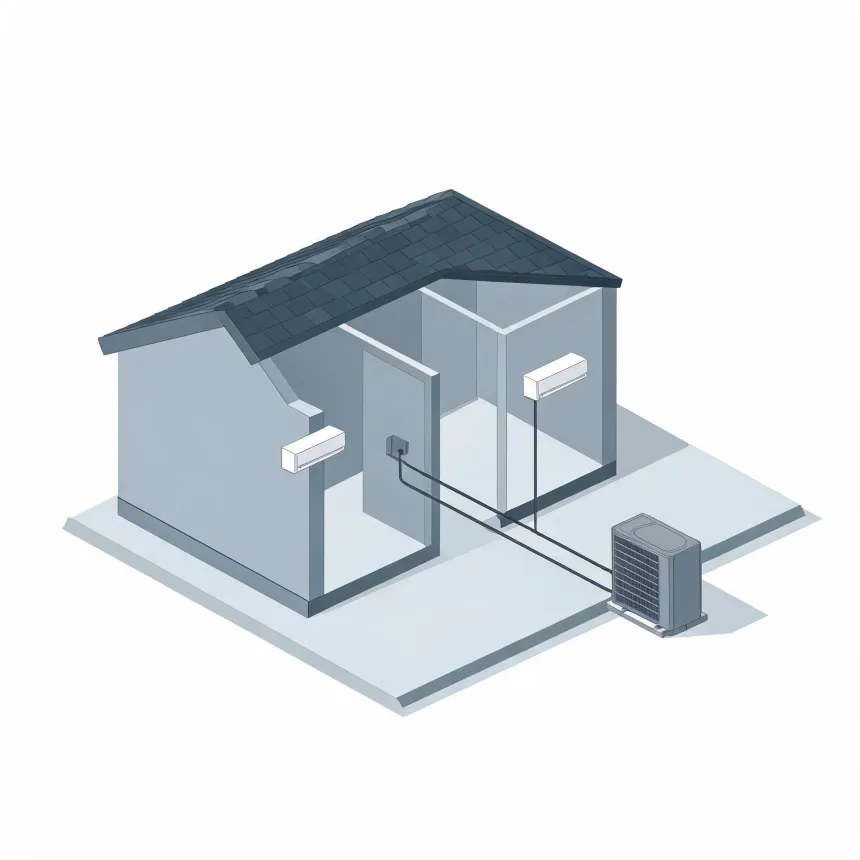
Isometric illustration of a cutaway gray house with a dark shingled roof, showing two wall-mounted indoor air handlers connected by line sets to an outdoor condenser unit on a pad outside.
Your system heats October through May and cools June through August.

NOAA nClimDiv, 1991–2020 normals

The cost comes down to how many indoor units the job needs and where each one goes.

Every head and every run of line set adds to the job, so the layout drives the price more than the equipment itself.

Cooling starts in June. Get the mini split in before it does.

Cooling runs June through August
Summer afternoons average 79°F
71 damaging wind events from 2015 to 2024

A standard mini split, sized for the room or addition it's covering, is the right call here. Milwaukee County doesn't put unusual strain on the equipment itself, so there's no case for going bigger or paying up for a higher tier than the space needs. Milwaukee County has logged 70 hail events and 71 damaging wind events over the past decade, and a mini split's outdoor unit sits outside year-round, so where the installer places it is worth asking about. That's a question about placement, not about size. A unit built for the room it's heating and cooling will do the job whether the weather that day is calm or not.

A mini split here has to meet zone 5A's standard. See what qualifies.

Milwaukee County falls in climate zone 5A, and any mini split installed here has to meet 14.3 SEER2 for cooling and 7.5 HSPF2 for heating. That's the federal minimum for split-system heat pumps, ductless included. A system meeting that standard may also qualify for a federal tax credit. Get a quote and find out what fits.

Find a contractor
A man in a cap, dark jacket and tan work pants carries a canvas tool bag up porch steps toward a green front door, with a potted shrub beside the entrance.
A white outdoor air conditioner condenser unit mounted on metal wall brackets against gray horizontal siding, with a blue sky and white clouds behind it.

Half these homes date to 1957 or earlier

Half the homes in Milwaukee County were built in 1957 or earlier. A mini split doesn't ask much of a house since there's no ductwork to tie into, just a line set run through an exterior wall and a spot for the outdoor unit. That's worth knowing if you're covering a room an old furnace never reached well, or an addition that came along after the house did.

Ask what each quote covers per zone

One indoor head cooling and heating one room is a different job from a multi-zone system running several heads off one outdoor unit. Each quote should say how many zones, what size each indoor unit is, and whether one outdoor unit is expected to carry all of them. A system split across too many zones for its capacity will run constantly and still fall short in the rooms farthest from it.
Ask who sizes the system and how

Sizing should come from a room by room load calculation, not a flat rule based on square footage. A unit sized too large cools fast and shuts off before it pulls moisture out of the air, leaving a room cold and damp. One sized too small runs nonstop and never quite catches up. The contractor doing the math, not the equipment brand, is what determines whether the system fits the space.

If this mini split is going in alongside a window unit coming out, there's nothing to it. Pull the unit, patch the hole it sat in, done. A full replacement of an older central system is a longer job. The old outdoor unit gets disconnected and hauled off, and if the refrigerant inside it is one of the older types, it has to be recovered properly rather than just vented. Old ductwork, if it's not feeding anything else, usually just gets capped or left alone rather than torn out. The one thing worth asking about ahead of time is the electrical. A mini split needs its own circuit, and whatever that old system was running on doesn't necessarily carry over to the new equipment.

SEER2 and HSPF2 are both ratios. SEER2 measures cooling output against the power it takes to get there over a season, and HSPF2 does the same for heating. A higher number means the unit is pulling more heat out of a room, or into it, for the same draw of electricity. That rating is tested per indoor and outdoor pairing, so it tells you about the equipment itself, not about how big a space it can cover. A high rating on a unit that's undersized for the room still leaves that room short. What the label guarantees is efficiency at the size you need, not a shortcut around sizing.