





A golden retriever sleeps on a neatly made bed in a minimalist bedroom equipped with a wall-mounted air conditioning unit.

Mini Split Installation in Janesville, WI

Tell us about the job

Takes about a minute. No obligation.

New system or replacementMini-splitRock County, WI
Step 1 of 2

What ZIP code is the job in?

Gas heats 70.2% of homes in Rock County, most of them with a furnace already in place. A mini split isn't there to replace that furnace. It's a way to add cooling, or heat, to a room the ductwork never reached well, like a bonus room, a garage conversion, or an addition. Electricity heats 17.9% of homes here, and those homeowners are more often looking at a mini split as the whole system for a room or a small house. Either way, the unit runs on its own circuit. It doesn't touch the gas line or the furnace at all.

8 months
October through May, your system heats
3 months
June through August, it cools
16°F
the average winter night it heats against
81°F
the average summer afternoon it cools against
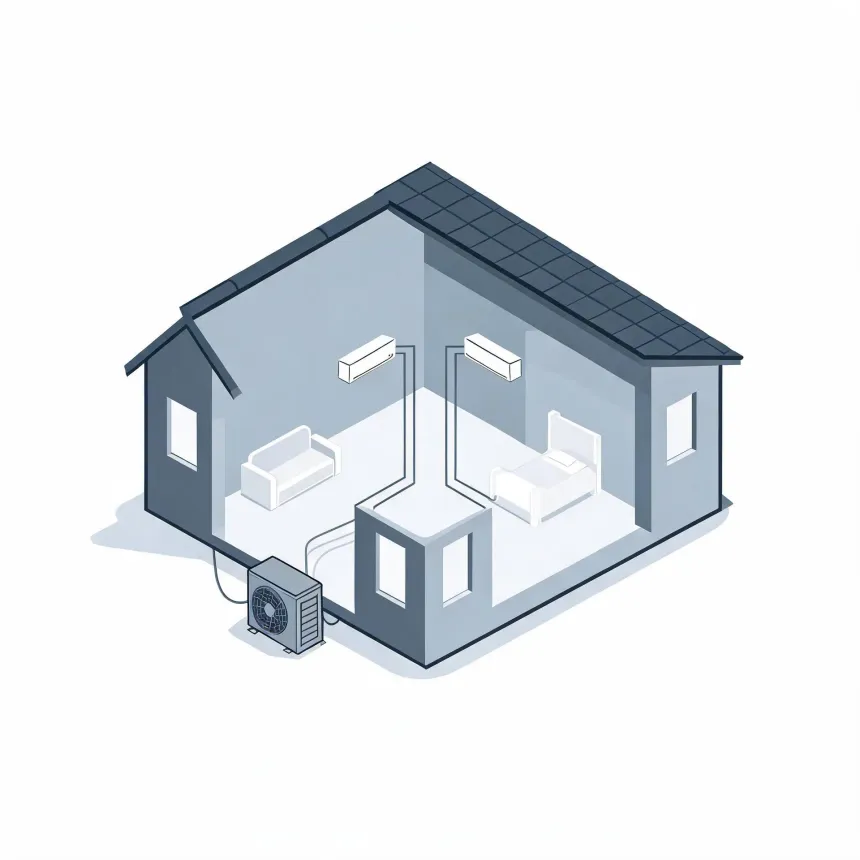
Isometric cutaway illustration of a small house showing two wall-mounted indoor air conditioning units connected by lines to a single outdoor condenser unit beside the building, with a sofa in one room and a bed in another.
Your system heats October through May and cools June through August.

NOAA nClimDiv, 1991–2020 normals

Rock County sees its share of wind, hail and winter storms, but none of that calls for a bigger or higher-capacity unit than any other mini split job.

Size this to the room you're adding capacity to, not to the weather outside.

Half the homes here were built by 1970, and the new unit has to fit that house

Half the homes here were built by 1970
Cooling runs June through August
Summer afternoons average 81°F

A mini split's efficiency rating tells you how much heat it moves per unit of electricity, and in a state where power runs 17.18 cents a kilowatt-hour, that number is worth asking about when you compare quotes. A standard-efficiency unit sized right for the room will cost less to run than an oversized one, no matter what rating is on the label. There's nothing about Janesville that calls for a bigger unit or a higher-end one than you'd install anywhere else. Size it to the room, pick a contractor who sizes it that way, and the electric bill takes care of itself.

A standard mini split, sized to the room, is what this job calls for

Cooling here only has to carry June through August, with afternoons around 81 degrees. That's a normal load for a standard mini split, and nothing about Rock County winters changes the size of the unit either. Get a few quotes and check that each one sizes the unit to the room, not past it.

Find a contractor
A man in a cap, gray T-shirt and tan work pants carries a worn leather tool bag up wooden porch steps toward a green front door.
A beige split-system air conditioner outdoor condenser unit mounted on metal wall brackets atop a stucco wall.

Three months of cooling, one month to get ready for it

Cooling here runs June through August, three months total. May is the month to get a mini split installed, before the first warm week sends everyone else to the phone too. Installed in May, the lines get checked and the unit gets tested before it has to run for you. Wait until the season's already underway and you're scheduling around a line of calls instead of your own plans.

The line set and where the unit goes

The indoor head and outdoor condenser connect through a line set that runs through a hole drilled in the wall. How far that unit sits from where the condenser can go outside, and whether the wall it passes through is brick, siding or something harder to drill, changes how much work that run takes. A straight shot through a stud wall is a different job than routing around a corner or up through a floor.
One zone or several

A single room needs one indoor head and one outdoor unit. Cover more than one room and you're either running separate systems or going with a multi-zone setup, one outdoor condenser feeding several indoor heads. More zones means more line sets, more labor, and a controller that can run each head on its own. Decide how many rooms actually need it before you price the job, since adding a zone later costs more than including it up front.

That efficiency number on the label is measured against a standard-efficiency unit, so it tells you how much less power this one draws to move the same heat or cooling. A higher-rated unit costs more up front, and it earns that back through lower bills over the years you run it, not the first season. How fast depends on how many hours a year it actually runs, which comes back to how the room gets used, not just its size. A bonus room that sees heat every afternoon in summer will pay off a higher rating faster than a spare room that runs occasionally. If a contractor pushes the top-rated unit before asking how the room gets used, that's a question worth asking back.

Installation starts with the walk-through, before anyone touches a drill. The tech checks where the indoor head will mount, where the outdoor condenser will sit, and the straightest path between them for the line set. That path decides most of the day. A hole gets drilled through the wall, just big enough for the line set, the drain line and the power cable to pass through together. The line set gets connected at both ends, then the system is pressurized and checked for leaks before any refrigerant goes in. Once that holds, the unit runs through a test cycle, heating and cooling both, so any problem shows up that day instead of the first week you depend on it.