

A row of dark-sided single-story houses with gabled shingle roofs behind a long trimmed hedge, with mown lawn in the foreground and large leafy trees overhead under an overcast sky.

AC Installation in Beaver Dam, WI

Tell us about the job

Takes about a minute. No obligation.

New system or replacementCentral ACDodge County, WI
Step 1 of 2

What ZIP code is the job in?

Gas heats close to six in ten homes in Dodge County, and most of those furnaces share a blower and ductwork with central air. That's the simplest kind of AC installation, because the line set and the duct work are often already sized for it. If your home uses bottled or LP gas instead, which is common enough here too, the same logic applies as long as a furnace or air handler is already moving air through ducts. Electric heat, at 17.2% of homes, usually means a different setup, sometimes no ducts at all, and that changes what an AC installation involves. Worth checking which one you have before you compare quotes.

3 months
June through August, your air conditioner is on duty
80°F
the average summer afternoon it cools against
37 hail events
in ten years, and hail bends the fins on outdoor coils
13.4 SEER2
the federal minimum any new unit must meet
Isometric cutaway illustration of a house showing interior ductwork, an air handler and furnace unit, and an outdoor condenser connected by lines outside the wall.
Your air conditioner works hardest from June through August.

NOAA nClimDiv, 1991–2020 normals

Cooling runs three months a year here, June through August, with afternoon highs around 80.

A system that doesn't have to fight much heat doesn't need to be the top efficiency model to hold up.

Summer here doesn't push a system hard

Power costs 17.18 cents a kWh statewide
Cooling runs June through August
Summer afternoons average 80°F

Dodge County sits in zone 5A, a cool climate where winter is the bigger job for any system. Cooling is the smaller piece here, but any AC installed still has to meet the federal floor. That's 13.4 SEER2 for split systems under 45,000 Btu/h built from 2023 on. It's not a local rule, it's the baseline everywhere now, so it shapes which units a contractor can offer you. A federal tax credit is available for qualifying high-efficiency equipment, worth asking about when you're comparing options.

A standard system is the right call here

A standard-efficiency system sized right for your home is a reasonable choice here. Dodge County sees its share of wind, hail, and winter storms, but none of that changes what the summer heat load asks of an AC. Get it installed before the cooling months are already underway.

Find a contractor
A man in a dark shirt and tan work pants, seen from behind, climbs porch steps toward a green front door while carrying a waxed canvas tool bag, with a potted evergreen shrub to the left.
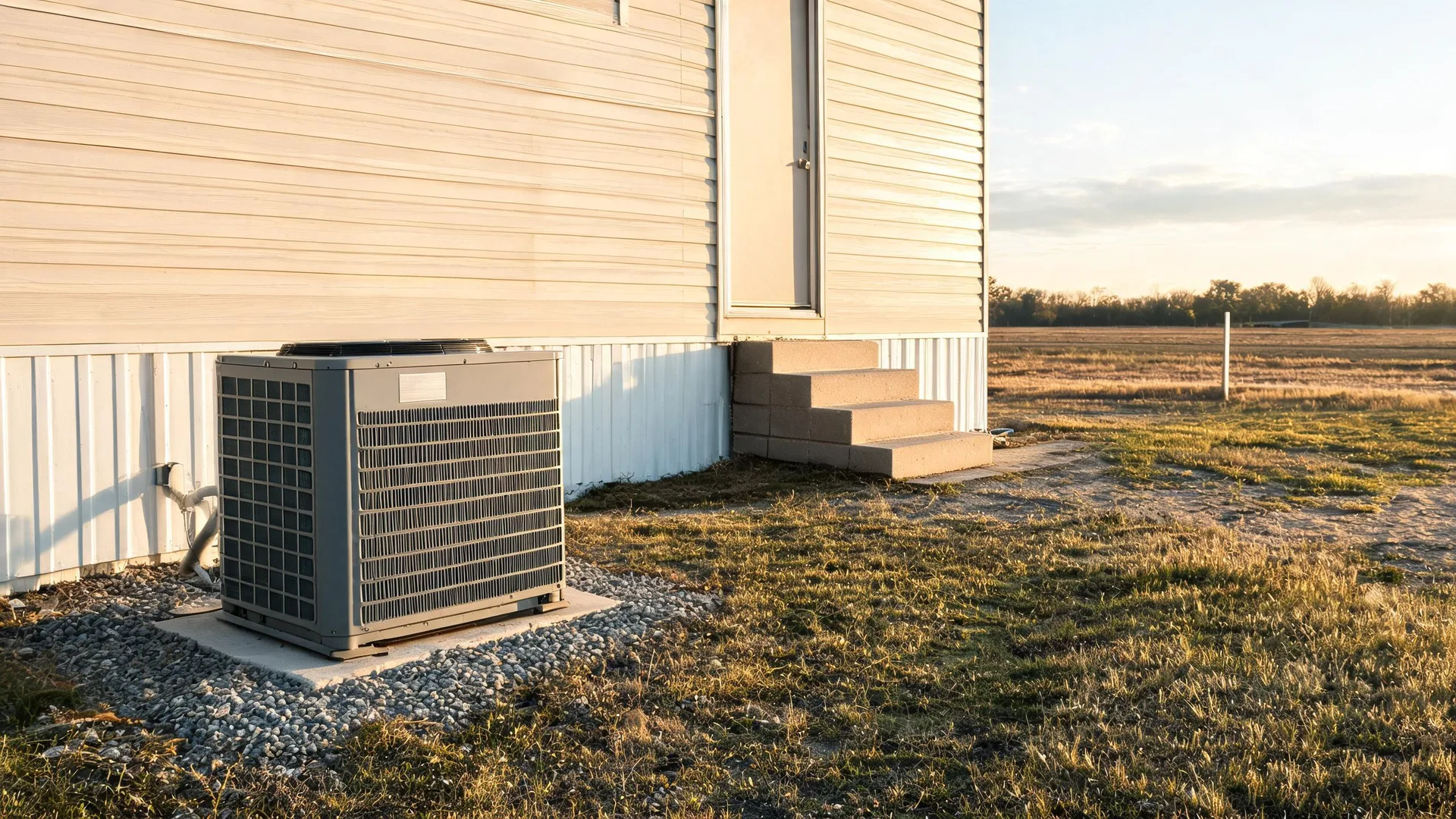
An outdoor residential air conditioning condenser unit mounted on a concrete pad, surrounded by gravel with a blue sky in the background.

Your house was likely built before central air was

Half the homes in Dodge County were built in 1970 or earlier. A house that age wasn't necessarily built with central air in mind, and the ducts, if it has them, were sized for whatever furnace came first. An AC installed now has to match that, not the other way around. Worth having the contractor check your ductwork and line set before they size the new system, not after.

The number is a ratio, not a guarantee

SEER2 compares the cooling a system puts out against the power it draws, tested under set conditions. A higher number means less power for the same cooling, but only when the system is sized right and the ducts can actually move the air it needs. An oversized unit, or a duct system that chokes airflow, will never hit that number in the house no matter what the label says.

It only pays back if the system runs long hours

A higher SEER2 unit costs more going in, and that gap only closes through lower power bills over time. The more months the system runs, the faster that happens. If it's only working hard a few months a year, it spends the rest sitting idle, and the extra cost has fewer hours to earn back.

Aerial view of a square outdoor air conditioning condenser unit on a concrete pad beside a house wall with a sliding glass door.

Going above the federal minimum saves little here, about $20 a year.

  • A higher-efficiency unit$140 a year
  • A new unit at the federal minimum, 13.4 SEER2$160 a year

Estimates for a typical Dodge County home, from EIA household energy data, Wisconsin fuel prices and NOAA climate normals. Your home will differ.

Installation day starts with the old equipment coming out, not the new one going in. The condenser outside gets disconnected and hauled off. If the evaporator coil inside the air handler is being swapped too, that comes apart next. A good crew checks the line set before reusing it. Old copper can be the right size for the old system and the wrong size for the new one, and running the wrong line set is one of the easier ways to shortchange a unit from day one. Once the new coil and condenser are in place, the lines get connected and pressure tested for leaks, then evacuated to pull out air and moisture before refrigerant goes in. Last comes startup. The charge gets checked, airflow across the coil gets checked, and the thermostat has to actually be talking to the new equipment before anyone calls it done.