




Three illuminated two-story brick houses on a tree-lined residential street photographed at twilight, with warm window light and landscape uplighting visible against a deep blue evening sky.

AC Installation in Amery, WI

Tell us about the job

Takes about a minute. No obligation.

New system or replacementCentral ACPolk County, WI
Step 1 of 2

What ZIP code is the job in?

Most homes in Polk County heat with bottled or tank LP gas, at 42 percent, and another 32.6 percent run on utility gas. Gas heat is the norm here, not electric. That matters for AC installation because your cooling system usually ties into the same ductwork your furnace already uses, so a contractor sizing the new AC will want to see what's moving that air now. Homes on electric heat are a smaller share here, and if yours is one of them, say so up front since the setup differs. Either way, what's already in place shapes what fits.

3 months
June through August, your air conditioner is on duty
79°F
the average summer afternoon it cools against
25 hail events
in ten years, and hail bends the fins on outdoor coils
13.4 SEER2
the federal minimum any new unit must meet
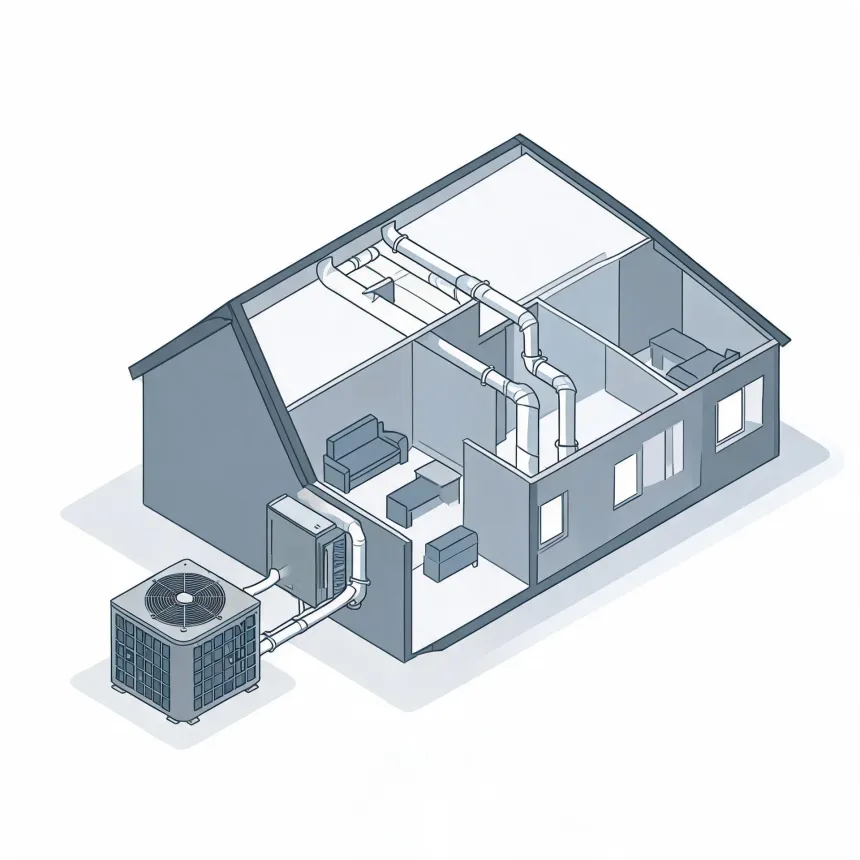
Isometric line illustration of a cutaway house showing interior rooms with ductwork, an indoor air handler, and an outdoor condenser unit connected by lines, on a white background.
Your air conditioner works hardest from June through August.

NOAA nClimDiv, 1991–2020 normals

Cooling in Polk County starts in June and runs through August.

May is the month to put in a new AC, before the first hot week puts you on a waiting list.

Three months of 79 degree afternoons is not a hard season to cool for

Cooling runs June through August
Summer afternoons average 79°F
42 damaging wind events from 2015 to 2024

A standard AC, sized right, is what this job needs

A system sized to meet the federal minimum and matched to your square footage is what this county calls for. Nothing about Polk County's summers or its wind pushes you toward a bigger unit or a higher tier than that. At 17.18 cents per kilowatt-hour, what you pay to run it comes down to the size and efficiency you choose, not where you live.

Find a contractor
A gray metal air conditioning condenser unit mounted on a concrete pad in a flat grassy field under a partly cloudy sky.

Three months a year, nothing strained

June through August, running at a 79 degree average, is three months of light work. That's the season this unit has to get through here. A system sized right for your square footage will cycle on through those afternoons without strain, so there's no case for buying past the federal minimum.

Bigger isn't better here

An oversized air conditioner cools the room fast, then shuts off before it pulls the moisture out of the air. That leaves the house feeling clammy even at the temperature you want. It also cycles on and off more, and that start-stop wear on the compressor is harder on the system than running a proper cycle through.


How a contractor gets the number right

Sizing starts with a load calculation, not a chart based on square footage alone. A contractor walks the house, counts windows and their direction, checks insulation and ceiling height, and looks at how much heat the house picks up through the walls and roof on a hot afternoon. That calculation points to a tonnage, and the unit gets matched to it.

Aerial view of a gray central air conditioning condenser unit on a concrete pad next to a house with vinyl siding.

Going above the federal minimum saves little here, about $20 a year.

  • A higher-efficiency unit$120 a year
  • A new unit at the federal minimum, 13.4 SEER2$140 a year

Estimates for a typical Polk County home, from EIA household energy data, Wisconsin fuel prices and NOAA climate normals. Your home will differ.

Installation day starts with the old unit coming out, the pad or slab checked or replaced, and new line set run if the location is changing at all. The refrigerant lines get connected, the system gets charged, and the electrical hookup gets tied in and tested. Any ductwork connections get sealed, since a loose seam at the plenum lets cooled air escape before it reaches a room. Once it's charged and wired, the contractor runs the system through a full cycle and checks the temperature split between the air going in and the air coming out. That split tells them whether it's working the way it's supposed to, not just whether it turns on. A thermostat that's being replaced or relocated gets set up and tested before anyone leaves.